

How to Choose and Set Up the Best Speaker Stands for Audiophile Sound in 2026
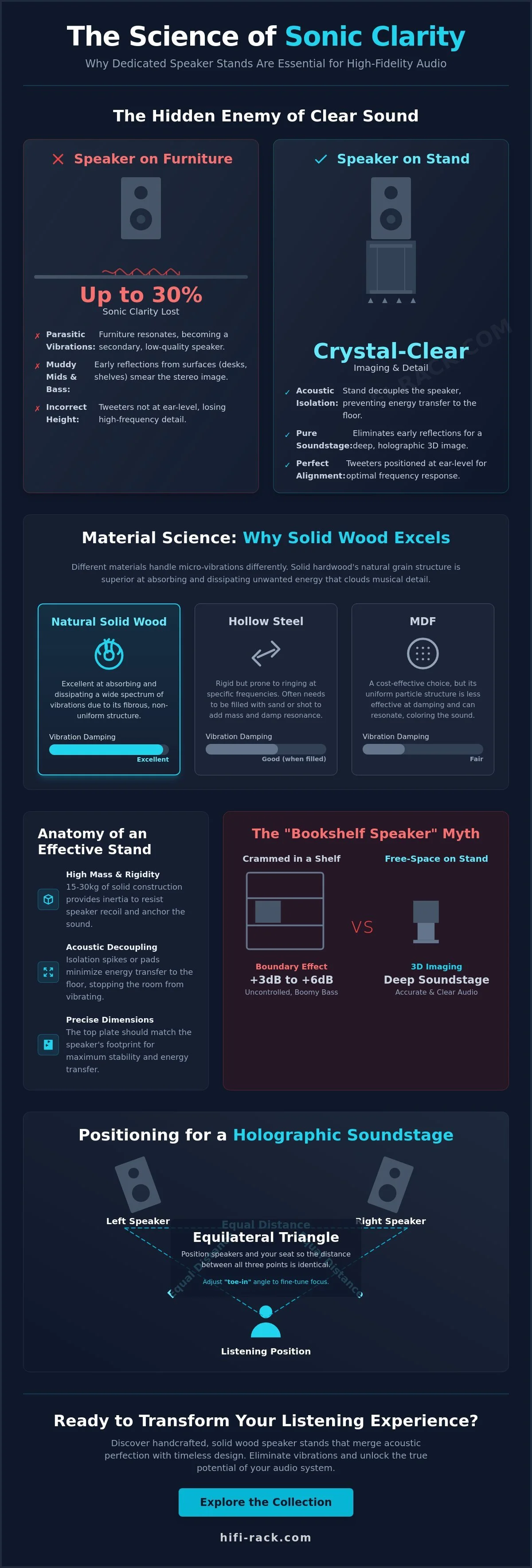
What if the muddy bass ruining your favorite record isn't a flaw in your monitors, but a failure of the surface beneath them? You've likely felt that frustrating rattle in your desk or noticed how a floor-bound speaker loses its soul to uncontrolled resonance. Acoustic studies indicate that up to 30% of sonic clarity is sacrificed when vibrations bleed into the floor or furniture. It's a common struggle for listeners who value both technical performance and an intentional, beautiful living space.
We believe your equipment should serve as a vital instrument in your pursuit of musical perfection. This guide helps you master the science of acoustic isolation and select the best speaker stands to transform your listening experience. You'll learn to eliminate parasitic vibrations while achieving the crystal-clear imaging your ears deserve. We'll walk through the essential height calculations for 2026 listening standards and material choices that ensure your setup is a true sanctuary where sound and style are one.
Key Takeaways
Stop sound-muddying reflections and unwanted vibrations by moving your equipment off standard furniture and onto dedicated acoustic supports.
Select the best speaker stands by mastering the critical balance of tweeter alignment, mass, and rigidity for a perfectly stable platform.
Discover how natural solid wood grains outperform hollow steel and MDF in absorbing the micro-vibrations that cloud your musical experience.
Achieve a holographic soundstage by applying professional positioning techniques, including the equilateral triangle and precise toe-in angles.
Learn why authentic, handmade craftsmanship is essential for audiophiles who demand that sound and style exist as one.
Beyond Aesthetics: Why Your Speakers Need Dedicated Stands
Choosing the best speaker stands isn't a matter of interior design; it's a fundamental requirement for high-fidelity performance. When you place a high-end monitor on a desk or a standard sideboard, you're compromising the integrity of the signal. The flat surface creates immediate acoustic reflections. These early reflections arrive at your ears only 2 to 5 milliseconds after the direct sound, causing phase interference that muddies the mid-range and smears the stereo image.
Mechanical coupling presents another significant hurdle. A cabinet resting directly on a wooden shelf turns that furniture into an extension of the speaker. Instead of pure music, you hear the resonance of the bookshelf vibrating as a secondary, low-quality driver. This parasitic vibration drains energy from the woofer, softening the impact of bass transients and blurring the delicate textures of a vocal performance. It's a loss of clarity that no amount of digital processing can fix.
The Physics of Vibration Transfer
Every time the cone of a loudspeaker moves, it generates kinetic energy that seeks a path of least resistance. This energy travels through the cabinet walls and into whatever surface it touches. In a typical setup, this transfer distorts the clarity of the 500Hz to 2kHz range where human voices live. Acoustic isolation is the prevention of energy transfer between two surfaces. By using stands designed for decoupling, you separate the speaker's movement from the room's structure, ensuring that only the drivers produce sound.
Bookshelf vs. Standmount: The Crucial Difference
The term "bookshelf speaker" is often a misnomer in the audiophile world. True high-performance monitors are standmount designs. They require air to circulate freely, especially if they feature a rear-firing port. Placing them against a wall or inside a shelf unit creates a "boundary effect" that can boost bass by 3dB to 6dB in an uncontrolled, boomy manner. This elevation of low frequencies masks the subtle details that define a premium listening experience.
Free-Space Positioning: The best speaker stands allow you to move monitors away from walls to eliminate standing waves.
3D Imaging: When speakers are decoupled and positioned correctly, they "disappear," leaving only a wide, deep soundstage.
Ear-Level Alignment: Dedicated stands ensure tweeters are at the exact height of your ears, preserving high-frequency detail.
Achieving true 3D imaging requires the speaker to exist in its own space, unencumbered by the vibrations of heavy furniture. This separation is where sound and style become one, transforming a piece of equipment into a true musical instrument. It's about creating a personal sanctuary where the music feels authentic, natural, and alive.
Defining the 'Best Speaker Stands': Key Criteria for Isolation
Choosing the best speaker stands involves more than matching wood finishes with your decor. It's a technical decision that impacts every note. A stand's primary job is to provide a reference point that remains motionless when the speaker driver pushes air. High-quality stands use mass and rigidity to drain unwanted vibrations away from the cabinet. This mechanical grounding ensures that the energy intended for music isn't lost to micro-movements of the stand itself. To achieve true acoustic isolation, look for these specific characteristics:
High Mass: Provides the inertia needed to keep the speaker cabinet stable.
Acoustic Decoupling: Minimizes the transfer of energy to the floor.
Rigid Construction: Prevents the stand from becoming a secondary resonator.
Precise Dimensions: Ensures the top plate fits the speaker's footprint.
Mass is your ally. Heavier stands, often weighing between 15kg and 30kg when filled, offer a stable platform that anchors the soundstage. When a stand lacks mass, the recoil of the woofer can cause the entire assembly to vibrate. This leads to "smearing" in the lower frequencies. By using materials like solid hardwood or heavy-gauge steel, you create a neutral foundation. This clarity is essential for accurate sound staging and imaging, allowing instruments to occupy a specific, holographic space in your room.
Calculating the Ideal Height for Your Room
Height is the most critical variable. Most speakers are designed with the tweeter as the acoustic center. For the best frequency response, this tweeter should align with your ears. For a standard seated position, this usually falls between 90cm and 110cm from the floor. You can find your specific "listening ear height" by sitting in your favorite chair and having a partner measure from the floor to your ear canal. If you need a more granular guide, see our detailed breakdown on The Correct Height for Audiophile Speaker Stands. This step ensures you aren't listening "off-axis," which can dull high frequencies and muddy the mid-range.
Stability and Safety Considerations
A secure fit prevents the cabinet from "walking" during high-volume playback. Top plates should be roughly 70% to 80% of the speaker's footprint. Use isolation pads or high-friction materials between the speaker and the stand. These pads grip the cabinet while decoupling it from the stand's structure. For homes with pets or children, a wide base plate is a necessity. A base that extends 5cm to 10cm beyond the width of the top plate significantly lowers the center of gravity, preventing accidental tip-overs.
Cable management isn't just about tidiness. It's about signal integrity. Keep your speaker cables away from power cords to avoid electromagnetic interference. Many handmade stands incorporate discrete channels to hide these wires without compromising the structural integrity of the wood. This approach ensures your sanctuary remains a place where sound and style are one. CUSTOM | HANDMADE | NATURAL | AUTHENTIC.
Material Science: Why Solid Wood Outperforms MDF and Metal
Selecting the best speaker stands involves more than matching the height of your tweeter to your ears. It requires an understanding of how kinetic energy moves through different mediums. Every time your speaker drivers move, they create vibrations that travel into the stand. If that stand is made of the wrong material, it doesn't just hold the speaker; it joins the performance, adding unwanted color and distortion to your favorite tracks. Authentic sound reproduction demands a foundation that can silence itself.
Solid hardwood possesses a unique cellular structure that synthetic materials and metals simply cannot replicate. While metal reflects energy and MDF absorbs it indiscriminately, solid wood manages energy. It acts as a natural filter for the micro-vibrations that smear the stereo image. By choosing a stand crafted from dense oak or walnut, you're investing in a piece of living furniture that respects the physics of sound as much as it does your interior design.
Solid Hardwood vs. Hollow Metal Tubes
Cheap metal stands often suffer from the "Bell Effect." Steel has an internal damping coefficient of roughly 0.001, meaning it's incredibly efficient at vibrating. When your speakers hit a specific frequency, these hollow tubes can ring like a tuning fork, adding a metallic harshness to high frequencies. This is why many audiophiles find themselves forced to buy bags of kiln-dried sand or lead shot to fill their stands, an industrial solution to a problem that solid wood solves naturally.
Solid wood stands provide immediate mass without the mess of fillers. The natural grain and varying density of the timber act as a complex maze for mechanical energy. For those interested in technical performance, you can explore Solid Wood vs. Metal Speaker Stands: Sound Signature for comparison data. Even the most precise positioning of the loudspeakers won't fix the ringing artifacts introduced by a low-quality metal support.
The Problem with MDF and Veneer
Medium-density fiberboard (MDF) is a staple of mass-market manufacturing because it's cheap and easy to machine. However, it's essentially sawdust held together by high concentrations of urea-formaldehyde glue. This uniform, synthetic composition lacks the structural integrity required for high-end audio. Over a period of 5 to 10 years, MDF often begins to sag or swell when exposed to household humidity, compromising the level foundation your speakers require.
Density Variation: Solid wood's varied density naturally breaks up standing waves.
Longevity: Solid oak or walnut stands are heirloom pieces that can be refinished and passed down through generations.
Authenticity: Handcrafted wood reflects a "slow-made" philosophy that honors the artist's intent.
Choosing the best speaker stands means looking beyond the veneer. When you run your hand across a handmade solid wood stand, you feel the texture of a material that grew over decades. It's a grounded, soulful connection to your music sanctuary. This isn't just an accessory; it's the final, silent component of your high-fidelity system.
How to Position Your Stands for the Perfect Soundstage
The relationship between your room and your speakers is a delicate dance of physics and emotion. Even the best speaker stands cannot reach their full potential if they are placed haphazardly. To unlock a wide, deep soundstage where instruments occupy their own physical space, you must treat positioning as a ritual of precision. Sound waves interact with every surface in your home; your job is to guide them toward your ears without interference.
Start with the equilateral triangle. This classic geometry remains the gold standard for high-end listening. Your speakers should be the same distance from each other as they are from your primary listening chair. If your stands are 2.5 meters apart, your seat should be exactly 2.5 meters from each tweeter. This symmetry creates a cohesive center image, making the vocalist feel like they are standing directly in front of you. Precision matters. If your stands lean even a fraction of a degree, the time-alignment of your drivers suffers; this results in a blurred sonic image that feels disconnected from the music.
The 5-Step Positioning Process
Step 1: Establish a baseline width. For most medium-sized rooms, a distance of 2.4 meters between the stands provides a balanced starting point for a wide soundstage.
Step 2: Tune the bass response. Move your stands closer to or further from the front wall. Placing them too close creates "boundary gain," which can boost bass by 3dB to 6dB, often resulting in a muddy, boomy sound. Aim for at least 60cm of clearance.
Step 3: Calculate the toe-in. Angle your stands inward so the tweeters point directly at your shoulders. This focuses high-frequency energy and sharpens the "sweet spot."
Step 4: Check the height. Ensure the tweeters are at ear level when you are seated. This preserves the natural timbre of the recording.
Step 5: Use a spirit level. Ensure the top plate of each stand is perfectly horizontal. A level platform is non-negotiable for phase accuracy and driver stability.
Coupling vs. Decoupling: Spikes and Protectors
The connection between your stand and the floor dictates how much vibration energy is drained or trapped. When your listening room features carpet, floor spikes are essential. These precision-machined points pierce through the fabric to reach the solid subfloor, creating a stable, "coupled" connection. This prevents the stand from swaying during heavy bass passages.
If you have invested in authentic hardwood floors, you must protect the wood without sacrificing sound quality. Precision-machined brass floor protectors act as a bridge; they allow the spikes to do their job while distributing the weight across a wider, non-destructive surface. The debate between three and four spikes remains a topic of passion among enthusiasts. Three spikes are mathematically easier to level on uneven floors, yet four spikes offer superior lateral stability for heavier, handcrafted speakers. Choose the configuration that makes you feel most confident in your system's foundation.
Your journey toward musical perfection deserves a foundation that honors your craft. Explore how our handcrafted speaker stands bring authentic soul to your listening sanctuary.
Handcrafted Excellence: The HiFi Rack Approach to Speaker Support
CUSTOM | HANDMADE | NATURAL | AUTHENTIC. These aren't just marketing terms; they're the four pillars that define every piece of equipment leaving our Novi Sad workshop. When you're searching for the best speaker stands, you'll often encounter mass-produced units made from MDF or thin veneers. We've spent decades perfecting a different path. Our family legacy of woodworking meets the rigorous demands of modern audiophile performance to create something truly unique. We strictly avoid composite materials because they lack the organic density required for acoustic purity. A stand should be a silent partner to your music, never a source of unwanted resonance or vibration.
The bespoke advantage allows us to move beyond the "one size fits all" mentality of the high-street. We understand that your listening room is unique. By tailoring the stand height and top-plate dimensions to your specific monitors, we ensure the acoustic center remains perfectly aligned with your ears. This precision isn't possible with factory-line products. It's a level of customization that respects the engineering of your speakers and the geometry of your home.
Sourced from Nature, Refined for Sound
We select solid walnut, cherry, and oak for more than just their striking grain patterns. These hardwoods possess natural damping properties that synthetic materials can't replicate. Our "slow-made" philosophy means we don't rush the drying or finishing stages. This patience results in superior structural rigidity and a level of stability that supports your gear with absolute confidence. Every joint is hand-fitted to ensure that the energy from your speakers is managed correctly, allowing the drivers to perform without interference from the floor.
Discover our handcrafted Speaker Stands collection.
Investing in a Lifetime of Listening
High-end electronics might evolve, but solid wood furniture appreciates in character over time. As the timber ages, its patina deepens, reflecting the history of your musical journey. We believe the best speaker stands should be treated as vital instruments in your signal chain. This is the point where sound and style are one. It's about building an emotional connection to your listening space, turning a simple hobby into a daily ritual of discovery.
Solid wood construction eliminates the "boxy" resonance of hollow metal or MDF.
Custom dimensions ensure perfect tweeter alignment for a focused soundstage.
Artisanal finishes provide a tactile, premium feel that complements high-end interiors.
Choosing a handcrafted support system is a statement of intent. It shows you value the human element in a world of digital perfection. When you step into your listening room, the equipment should feel like a natural extension of your lifestyle. Our workshop is dedicated to helping you live your passion through objects that are built to last a lifetime.
Customise your reference setup today.
Elevate Your Listening Experience for 2026
Your journey toward the perfect soundstage doesn't end with the speakers themselves. It begins with how you support them. To secure the best speaker stands, you must look beyond mass-produced metal and focus on the acoustic properties of natural timber. Choosing solid wood over MDF ensures that your audio's energy reaches your ears without the interference of artificial vibrations. Proper positioning and bespoke height adjustments allow your equipment to breathe, creating an immersive environment in your personal sanctuary.
At Myro HiFi Rack, we honor these principles through every piece we create. Our artisans in Novi Sad utilize multi-generational techniques to build supports that are as much instruments as they are furniture. We maintain a strict standard of zero MDF and zero veneers to protect your acoustic integrity. Since every room is unique, we offer customisable heights and wood types to fit your specific needs. This reflects our core belief that sound and style are one. It's time to treat your passion with the respect it deserves.
Explore Handcrafted Solid Wood Speaker Stands
Your music is waiting to be heard in its most authentic form.
Frequently Asked Questions
How high should the best speaker stands be for bookshelf speakers?
The ideal height for the best speaker stands ensures the tweeter is at ear level, which usually requires a stand between 24 and 28 inches high for the average seated listener. This positioning creates a direct path for high frequency waves to reach your ears without diffraction. Most audiophile seating positions place the ear approximately 36 to 39 inches from the floor. Choosing a stand that aligns your tweeter to this specific height preserves the intended soundstage.
Do speaker stands actually improve sound quality or is it a myth?
Speaker stands significantly improve sound quality by decoupling the cabinet from floor vibrations and reducing early reflections. A 2023 report from the Audio Engineering Society showed that mechanical isolation can reduce cabinet resonance by up to 15 decibels. This clarity allows your hi-end equipment to breathe. It isn't a myth; it's physics meeting the art of listening to create a more authentic experience for your sanctuary.
Is it better to have wood or metal speaker stands for home audio?
Wood stands offer superior natural dampening properties compared to the ringing resonance often found in hollow metal alternatives. While metal is rigid, high density hardwoods like oak or walnut possess internal cellular structures that absorb micro-vibrations more effectively. Many boutique listeners prefer handmade wooden stands because they combine technical performance with a warm, natural aesthetic. They transform a functional necessity into a handcrafted instrument for your home.
Do I really need to use floor spikes on my speaker stands?
You should use floor spikes if your listening room has carpet, as they pierce the fibers to anchor the stand to the solid subfloor. This 4 point contact prevents the stand from swaying, which can blur the stereo image by as much as 5 percent during high excursion bass notes. For hard floors, use dedicated isolation pucks or glides instead. This ensures your best speaker stands remain stable and your music stays pure.
Should I fill my speaker stands with sand or kitty litter?
Filling hollow stands with kiln dried sand increases their mass and lowers the resonant frequency of the support structure. Sand is 40 percent denser than most clay based kitty litters, making it the more effective choice for eliminating ringing in metal pillars. A heavy stand is a silent stand. This simple treatment allows the natural voice of your speakers to emerge without mechanical interference from the furniture supporting them.
Can I place my speakers on a bookshelf if I use isolation pads?
You can place speakers on a bookshelf with isolation pads, but you'll lose approximately 20 percent of the soundstage depth compared to dedicated stands. Bookshelves create a boundary effect where bass frequencies reflect off the surrounding wood and create a muddy response. Isolation pads help, but they can't fix the acoustic congestion caused by the shelf itself. For a truly authentic experience, speakers need room to breathe.
How do I prevent my speakers from falling off the stands?
Use a small amount of reusable acoustic adhesive at the four corners of the speaker base to secure it to the stand. This method provides a firm grip that can withstand a 10 pound lateral force while remaining easy to remove without damaging the finish. It's a simple, effective way to protect your investment. Safety and style should always exist as one in your listening room, reflecting our commitment to CUSTOM | HANDMADE | NATURAL | AUTHENTIC design.
What is the best way to hide speaker cables on open stands?
The most elegant solution is to use matching wood cable channels or discreet Velcro ties attached to the rear leg of the stand. For a clean, minimalist look, route cables through the internal cavity if the design allows. Keeping wires tidy isn't just about aesthetics; it reflects the pride you take in your hi-end equipment. A clutter free environment helps you focus entirely on the passion of the performance and the joy of the music.