

What if the most vital component in your high-fidelity system isn't the amplifier or the speakers, but the very ground they stand upon? You've likely felt that subtle frustration when a favorite recording feels veiled or blurred by mechanical resonance. It's a common struggle for those of us who seek a deeper, more tactile relationship with our music. We understand that a true sanctuary requires more than just electronics; it demands a foundation of organic materiality and structural integrity.
In this audio rack setup guide, I'll show you how to transform any space into a high-fidelity refuge by balancing acoustic science with artisanal craftsmanship. We'll discuss how to eliminate visual clutter and vibrations to create a quiet, resonant-free environment. You'll learn how the Reference Myro HiFi Rack, handcrafted from solid hardwood, serves as both a technical instrument and a piece of living art. By the end, you'll have a clear path to building a listening space that offers not just sound, but a profound emotional connection to every note.
Key Takeaways
Reclaim the ritual of intentional listening by creating a dedicated sanctuary that counters digital fatigue and invites deep focus.
Achieve absolute acoustic isolation by choosing structurally rigid materials that prevent mechanical resonance from blurring your sound clarity.
Master the geometry of your space with the Golden Triangle layout to ensure a perfect soundstage and balanced room reflections.
Follow our audio rack setup guide to integrate solid hardwood foundations that provide both technical precision and organic sensory appeal.
Elevate your environment with artisanal craftsmanship that transforms functional equipment into a timeless, resonant-free refuge.
The Modern Need for an Analog Sanctuary
The pace of life in 2026 has pushed many of us toward a breaking point. We spend our days surrounded by the constant hum of digital notifications and low-quality background streams. This relentless noise has sparked a significant psychological shift. We no longer just want to hear music; we want to experience it. This is why the concept of an intentional listening sanctuary has become so vital. It's about more than just buying equipment. It's about carving out a space that allows for a deep, tactile connection to sound.
Creating this refuge requires a delicate balance of comfort, aesthetics, and technical precision. A true sanctuary is a personal refuge where every element serves a purpose. When you begin your journey with an audio rack setup guide, you're not just organizing gear. You're building a foundation for sensory peace. This space becomes a sensory sanctuary where the stresses of the digital world finally fall silent. Just as we curate our environment for peace, many also prioritize their physical well-being and personal rejuvenation; to explore advanced aesthetic care, you can check out Cosmetic Wellness.
Beyond the Gear: The Emotional Payoff
A well-designed room does more than just sound better. It changes how you feel. When I step into my listening space, I feel an immediate invitation to slow down. It's a ritual. I select a record, feel its weight, and place it on the platter. This tactile satisfaction is something digital files can never replicate. By establishing sensory harmony between artisanal form and high-end function, you elevate your entire relationship with your music collection. Our Reference Myro HiFi Rack is designed to be the heart of this experience, offering a stable, beautiful platform that respects the music as much as you do.
The Problem with Digital Environments
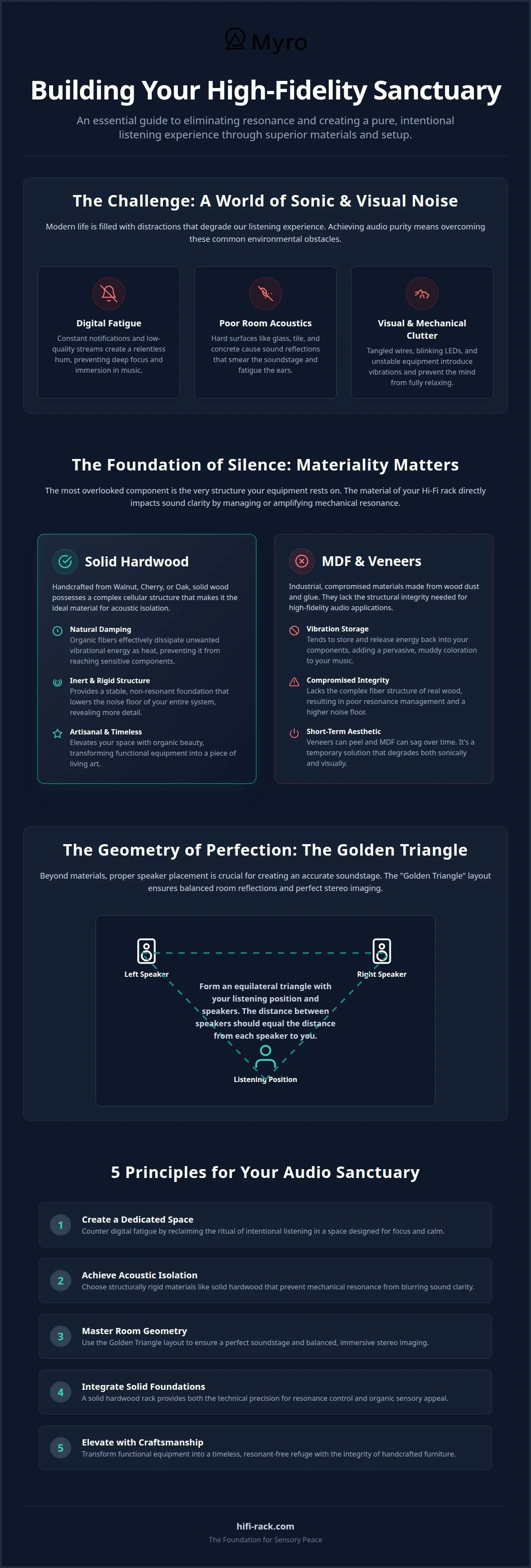
Modern homes often favor minimalist aesthetics with hard surfaces like glass, tile, and polished concrete. While these look clean, they are the natural enemies of high-fidelity sound. These surfaces cause reflections that smear the soundstage and fatigue the ears. To truly understand why this happens, it's helpful to look at the science of room acoustics. Sound waves need soft textures and rigid foundations to behave correctly in an enclosed space.
Visual clutter is another hidden distraction. A room filled with blinking LEDs and tangled wires prevents the mind from fully immersing itself in the performance. In this audio rack setup guide, we advocate for a quiet visual palette. By using natural materials like solid hardwood, you provide a resting place for the eyes that matches the warmth of the sound. It's about removing the obstacles between you and the artist's original intent.
Materiality and the Science of Silence
Acoustic isolation is the prevention of unwanted vibrations from reaching sensitive audio components. It's the silent partner in every high-fidelity system. While many enthusiasts obsess over cables and DACs, they often overlook the very foundation holding their gear. This audio rack setup guide aims to correct that oversight by focusing on the structural integrity of your furniture. Without a rigid, inert foundation, even the most expensive electronics will struggle to reach their full potential.
Modern industrial materials like MDF and veneers are often the hidden cost of a compromised soundstage. These materials lack the natural damping properties required to manage energy effectively. Instead, they tend to store vibrations and release them back into your equipment, adding a subtle but pervasive coloration to your music. When you are building and tuning listening rooms, the choice of material dictates the noise floor of your entire system. Solid hardwood offers an organic alternative that bridges the gap between engineering and art.
Solid Wood vs. MDF: An Audiophile’s Choice
We strictly avoid MDF and veneers in our manufacturing process. These industrial products are born from compromise; they don't possess the complex cellular structure of living timber. Solid walnut, cherry, and oak are selected not just for their beauty, but for their specific resonance management profiles. These woods act as natural damping agents, utilizing organic fibers to dissipate energy before it reaches your components. You can explore the technical differences in our detailed comparison, The Truth About Audio Furniture: Solid Hardwood vs. MDF.
Managing Mechanical Resonance
Mechanical resonance is a subtle thief of clarity. It originates from internal sources like power transformers and turntable motors, as well as external sources like the air pressure generated by your speakers. These micro-vibrations degrade signal clarity by introducing noise into the delicate circuitry of tube amplifiers and the sensitive needles of record players. Mass plays a critical role in stabilizing this equipment. Dissonance occurs when the structural vibrations of a support system clash with the precise frequencies of the audio signal, resulting in a clouded and unfaithful reproduction. For those seeking the ultimate in isolation, the Reference Myro HiFi Rack provides the mass and structural integrity needed to ground your system in absolute silence.
Designing for Sensory Perfection: Layout and Isolation
Geometry is the invisible architecture of sound. Even the finest components will fail to move you if they are placed haphazardly within a room. To achieve a perfect soundstage, we rely on the Golden Triangle. This means your seating position and your speakers should form an equilateral triangle, ensuring that the phantom center image is stable and the stereo width is immersive. It's a simple rule, but it's the first step in any serious audio rack setup guide.
Managing first reflections is the next challenge. When sound waves bounce off side walls, they arrive at your ears slightly after the direct sound, blurring the timing and clarity of the music. You don't need to turn your sanctuary into a dead, windowless studio. Often, a well-placed bookshelf or a heavy wool rug is enough to scatter these reflections while keeping the room's natural energy alive. For those who want to maximize both privacy and acoustic diffusion, a handcrafted bookcase system from Hide-A-Way Doors can serve as a functional hidden entrance to your listening room. It's about finding harmony between a live space and a controlled environment.
Isolation also requires a choice between decoupling and coupling. Coupling, often achieved through sharp spikes, anchors your equipment to the mass of the floor. This is ideal for carpeted surfaces where you want to pierce through to the solid subfloor. Decoupling uses softer materials to break the physical connection, preventing floor-borne vibrations from traveling back up into your rack. Choosing the right method depends entirely on your room's construction and the sensitivity of your gear.
The Role of the Reference Myro HiFi Rack
A modular, solid wood rack serves as the structural heart of your entire system. Unlike fixed industrial shelves, The Reference Myro HiFi Rack allows you to optimize shelf spacing. I've found that leaving at least two or three inches of clearance above tube amplifiers is essential for both cooling and vibration management. This airflow prevents heat soak, which can shorten the life of your delicate internal components and affect their thermal stability.
Isolation Techniques for Every Component
Protecting the analog signal is a specialized task, especially if you live in a home with bouncy wooden floors. Footfalls can easily disrupt a turntable's tracking, leading to audible distortion or skipping. You might need to explore The Ultimate Guide to Turntable Isolation Platforms to find a solution that works for your specific environment. Additionally, speaker stands are non-negotiable for bookshelf monitors. Placing speakers directly on the same surface as your turntable or electronics is a recipe for acoustic feedback. Dedicated stands decouple the speakers from the rest of your system, allowing the music to breathe without interference.
The Ritual of Sound: Curating Your Personal Space
A listening sanctuary is more than the sum of its technical components. It's a physical manifestation of your respect for the music. While the previous chapters of this audio rack setup guide focused on the physics of vibration and layout, we must also consider the psychological environment. Creating a ritual around your listening sessions transforms the experience from a background activity into a deep, meditative practice. This transition begins the moment you step into the room and dim the lights.
Lighting serves as an invisible acoustic tool. By reducing the visual stimulation in the room, you allow your brain to reallocate its processing power to your auditory senses. Soft, warm pools of light help you settle into the "sweet spot" and focus entirely on the soundstage. Similarly, cable management is about more than just safety. Tangles of wires create visual noise that can subconsciously distract you from the performance. Using discrete routing paths keeps the focus on the artisanal beauty of your equipment rather than the industrial clutter behind it.
Curating your collection is another vital part of the sanctuary aesthetic. Displaying a few select vinyl jackets on your rack isn't just for show. It grounds the digital or analog signal in a physical, tactile reality. The presence of natural materials, like the solid hardwood of your furniture, reinforces this connection. There's a profound sense of peace that comes from being surrounded by raw, high-quality materials that feel as good as they look.
Furniture as a Vital Instrument
Your furniture should be as well-crafted as your speakers. There's a specific aesthetic union that occurs when the organic grain of solid walnut or oak meets the precision-machined lines of high-end audio gear. You aren't just placing components on a shelf; you're housing them in a structure that respects their purpose. Whether you choose from our Reference, Classic, or Minimal Myro designs, you're investing in a piece of functional art. This choice defines the visual and tactile character of your sanctuary for years to come.
Creating a Life-Altering Passion Space
Moving from casual listening to a dedicated daily ritual is a life-altering transition. It's about the longevity of the space you build. Solid wood furniture, handcrafted with integrity, is built to last a lifetime. It doesn't just hold your gear; it ages with you, its character deepening alongside your appreciation for the music. The right environment changes your perception of recorded music, making every session feel like a private performance. When the room is balanced and the visual noise is gone, the music finally has the space it needs to breathe. Explore our full collection to begin curating your personal listening sanctuary with a foundation built for excellence.
Handcrafted Integrity: Why Your Sanctuary Deserves Solid Hardwood
In the heart of Novi Sad, a multi-generational woodworking tradition meets a modern obsession with high-fidelity sound. This isn't just manufacturing; it's a legacy of craftsmanship that understands how raw materials interact with the soul of music. When you follow an audio rack setup guide, you eventually face a choice between mass-produced convenience and artisanal integrity. We believe your sanctuary deserves the latter. A piece of furniture born from an industrial assembly line can't offer the same acoustic or emotional resonance as one carved by a master craftsman who shares your passion.
Our commitment to excellence extends to how we source our timber. We prioritize responsibility and sustainable material sourcing because a true sanctuary should exist in harmony with the natural world. By selecting only the finest solid hardwoods, we ensure that your setup is free from the chemical off-gassing and acoustic compromises inherent in industrial composites. We frame the union of performance and aesthetics as a definitive promise, ensuring that your furniture is as technically precise as it is visually stunning.
The Artisanal Difference
Manual craftsmanship differs fundamentally from industrial assembly. An assembly line prioritizes speed and uniformity. A master craftsman, however, listens to the wood. We refuse to use veneers or chemical-heavy composite woods because they lack the density required for a high-end listening environment. Every Reference Myro HiFi Rack is built with a passion for sound that's palpable in its weight and finish. It's a vital instrument, not just a storage solution. This human element is what transforms a room into a refuge.
Building Your Sanctuary Today
Starting your sanctuary build requires an honest assessment of your current room's structural weaknesses. Look for unstable surfaces or hollow materials that might be vibrating along with your speakers. Once you've identified these gaps, selecting the right wood finish is the final step in creating visual harmony. Whether you prefer the deep warmth of walnut or the classic strength of oak, your choice should complement your existing decor while providing a lifetime of performance. It's about creating a space that feels personal and permanent.
This audio rack setup guide has shown that a true refuge is built from the ground up. The Reference Myro HiFi Rack represents the ultimate investment in your passion, offering a foundation that's as enduring as the music you love. Now's the time to transition from a casual listener to a devoted connoisseur who values the craft. Visit the HiFi Rack Shop to begin your sanctuary build.
Build Your Eternal Sanctuary
Establishing a listening sanctuary is a journey toward sensory perfection. It requires a deep commitment to structural integrity and a rejection of industrial compromises. By prioritizing solid hardwood foundations and precise room geometry, you eliminate the mechanical noise that often masks the true soul of your music. Every component in your high-fidelity system deserves a stable, inert home that respects its technical purpose.
This audio rack setup guide has explored how to bridge the gap between high-end engineering and organic beauty. We take immense pride in our heritage. Each rack is handcrafted in Novi Sad with multi-generational expertise, adhering to a strict zero MDF or veneer policy for pure acoustic performance. No matter where you're located, we offer worldwide shipping to help you ground your passion in excellence. It's time to elevate your daily ritual and experience your record collection with newfound clarity and emotional weight.
Explore the Handcrafted Reference Myro Collection and begin your transformation today. Your pursuit of harmony between form and function is a life-altering passion. Your music is waiting to be heard exactly as the artist intended.
Frequently Asked Questions
What is the most important element of a listening room sanctuary?
The foundation of structural integrity is the most vital element. Without a rigid, resonance-free base, even the finest electronics will suffer from mechanical noise. A true sanctuary begins with a foundation that grounds your equipment in silence, allowing the music to emerge from a pitch-black background. This structural stability is what separates a casual room from a dedicated high-fidelity refuge.
Why is solid wood better than MDF for audio furniture?
Solid wood possesses a complex, organic cellular structure that naturally dissipates energy. Industrial materials like MDF are essentially compressed dust and glue; they tend to store vibrations and release them back into your components. By choosing solid walnut or oak, you utilize the wood's natural damping properties to manage resonance, resulting in a cleaner and more authentic sound signature.
How does a HiFi rack improve the sound of my system?
A dedicated rack improves sound by lowering the noise floor through mechanical isolation. This audio rack setup guide emphasizes that protecting sensitive internal circuitry from micro-vibrations preserves signal clarity. When your turntable or tube amplifier is isolated from floor-borne energy, you'll notice a more defined soundstage and greater detail in the higher frequencies. It's a technical upgrade that yields immediate emotional rewards.
Can I create a listening sanctuary in a small apartment?
You can absolutely create a sanctuary in a limited space by focusing on precise layout and isolation. Small rooms actually benefit from the structural mass of a solid wood rack, which helps stabilize the environment against acoustic reflections. By following a disciplined audio rack setup guide and using near-field speaker placement, you can achieve an intimate, high-fidelity experience that rivals much larger rooms.
What is the difference between decoupling and coupling audio equipment?
Decoupling uses soft, compliant materials to break the physical path of vibrations between your gear and the floor. Coupling uses rigid spikes to anchor the equipment's mass to a solid subfloor. Decoupling is generally preferred for homes with bouncy wooden floors to prevent skipping, while coupling is ideal for concrete or carpeted surfaces where you want to drain energy away from the rack.
How high should my speakers be placed for the best soundstage?
Speakers should be positioned so the high-frequency drivers, or tweeters, are at the same height as your ears when seated. For most listeners, this means a height of 24 to 28 inches from the floor. Using dedicated Speaker Stands is the most effective way to reach this height while ensuring the monitors are decoupled from the room's surfaces to prevent bass bloating.
Why does HiFi Rack avoid using veneers in their products?
We avoid veneers because they are often used to hide industrial-grade MDF or plywood cores that compromise acoustic performance. Our commitment to integrity means every shelf is solid hardwood through and through. This ensures that the damping properties are consistent across the entire structure, providing a pure, uncolored foundation that veneers simply can't replicate. We value the raw, honest beauty of the grain.
How do I choose between the Reference and Classic Myro racks?
The Reference Myro HiFi Rack is engineered for the ultimate connoisseur who requires maximum isolation for heavy, sensitive components. It's our flagship instrument for peak performance. The Classic Myro HiFi Rack offers a timeless balance of artisanal beauty and technical excellence for standard systems. If your setup includes a high-end turntable or heavy tube power amps, the extra mass of the Reference model is a wise investment.