

Guide to Choosing High-Performance HiFi Racks
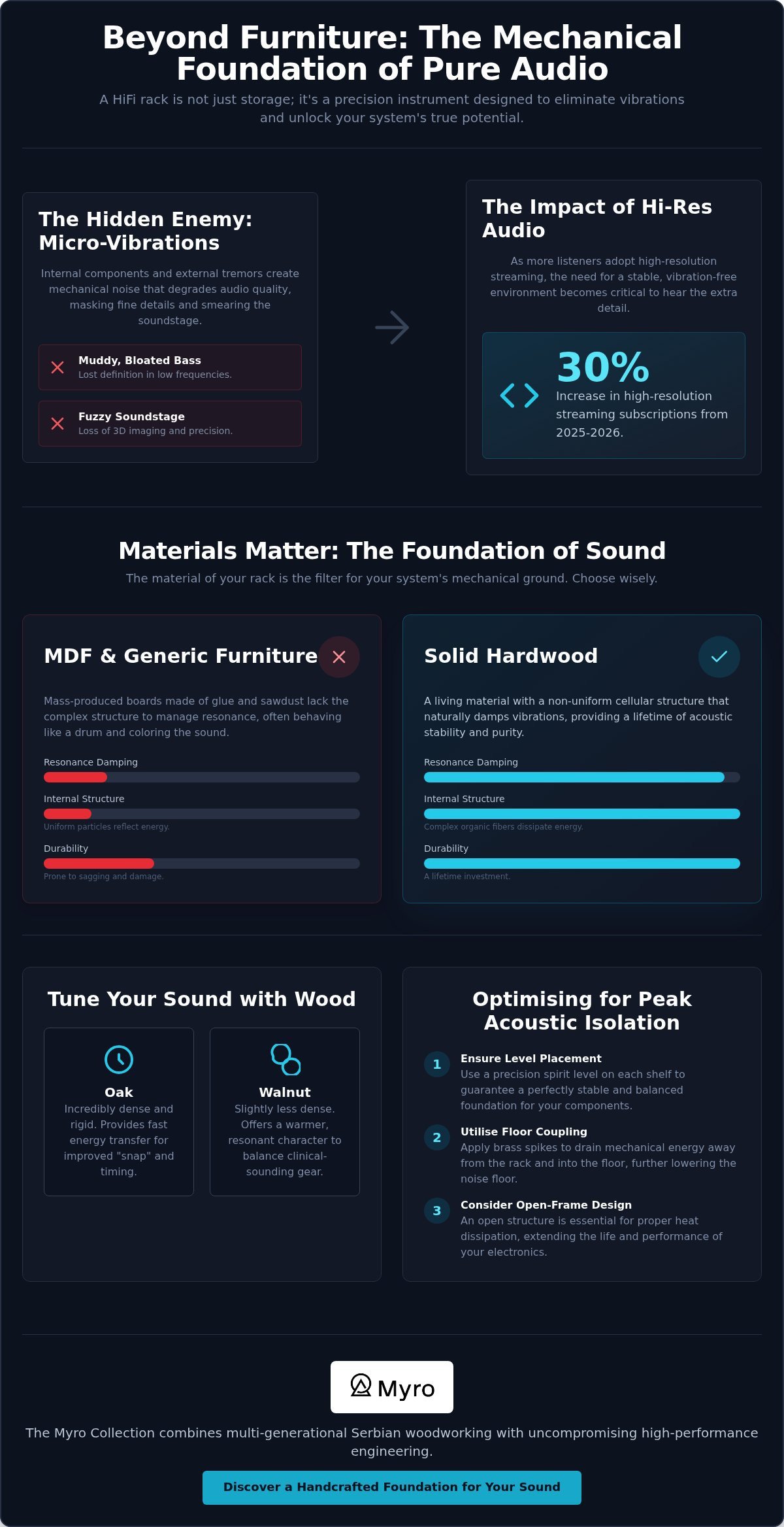
Could a piece of furniture be the most critical component in your signal chain? We often view hifi racks as mere storage, but they are actually the mechanical ground of your entire audio system. You've likely felt the frustration of a needle skipping because of a nearby footstep or noticed a muddy, bloated bass response that obscures the fine details of a high-resolution recording. As subscriptions to high-resolution streaming services rose by 30 percent between 2025 and 2026, the need for a stable environment to capture that extra detail has never been more apparent. Generic furniture that vibrates or looks cheap next to premium gear simply won't suffice for a true enthusiast.
I believe that a listening sanctuary requires a foundation as meticulously crafted as the components it supports. This guide explores how the right support system transforms your experience by eliminating destructive micro-vibrations and anchoring your gear in solid hardwood. You'll learn how to achieve total acoustic isolation and select a visual centerpiece that offers both lifetime durability and peak performance. We'll examine the technical necessity of open-frame designs for heat dissipation and the tactile beauty of artisanal craftsmanship, ensuring your system finally sounds as good as it looks.
Key Takeaways
Redefine your equipment support as a precision instrument that manages mechanical energy to lower the noise floor and preserve signal purity.
Explore why the unique cellular structure of solid hardwood provides superior resonance damping compared to the acoustic limitations of mass-produced MDF.
Compare the structural rigidity of the Reference, Classic, and Minimal hifi racks to find a modular foundation that grows with your evolving audio collection.
Master the technical nuances of acoustic isolation, from using a precision spirit level to the strategic application of brass spikes for floor coupling.
Gain insight into the artisanal heritage of the Myro Collection, where multi-generational Serbian woodworking meets uncompromising high-performance engineering.
Table of Contents
Beyond Furniture: The Mechanical Role of HiFi Racks
I remember the first time I moved my turntable from a standard desk to a dedicated support. The difference wasn't subtle; it was transformative. We must stop viewing hifi racks as mere storage solutions. They are the mechanical ground of the entire audio system. While your electronics are active sources of energy, the rack is the receptive anchor that manages it. Without this stable foundation, your gear is essentially fighting against itself.
Every transformer and vacuum tube in your system generates micro-vibrations. Without a dedicated path to dissipate, this energy stays within the chassis, degrading the signal floor and masking fine details. Unlike a standardized 19-inch rack built for industrial utility, a high-performance audio rack is tuned to handle the specific frequencies of music playback. It's the difference between a warehouse shelf and the resonance-tuned body of a fine violin.
The Problem with Micro-Vibrations
Why a Standard Sideboard Fails
Most home furniture isn't built for acoustic performance. A standard sideboard often features thin panels or hollow-core construction that behaves like a drum. When your speakers move air, these large flat surfaces vibrate, creating a feedback loop that colors your sound and introduces unwanted resonance. We prioritize material integrity because solid timber naturally damps these vibrations rather than reflecting them. Generic furniture simply lacks the density and structural rigidity required to anchor a high-end system for a lifetime of listening.
Materials Matter: Why Solid Hardwood Trumps MDF and Veneer
If the hifi rack is the mechanical ground of your system, the material it's built from is the filter that determines the purity of that ground. I've seen many enthusiasts invest thousands in components only to rest them on mass-produced boards made of glue and sawdust. While Medium Density Fibreboard (MDF) is popular for its low cost and uniform density, it lacks the complex cellular structure required to truly manage resonance. Solid hardwood is a living, breathing material that possesses a natural ability to damp vibrations before they reach your sensitive electronics.
The transition from engineered wood to solid timber isn't just about aesthetics; it's a technical upgrade. Solid wood possesses a non-uniform internal structure that prevents the buildup of specific resonant frequencies. This organic complexity is what allows the rack to act as a quiet partner to your gear. When you choose a foundation built from authentic materials, you're choosing a lifetime of acoustic stability. You can explore our commitment to these premium materials by visiting our responsibility page.
The Science of Vibration Damping
Different wood species offer distinct acoustic signatures. Oak is incredibly dense and rigid, providing a fast energy transfer that suits systems needing a bit more "snap" and timing. Walnut is slightly less dense, offering a warmer, more resonant character that can help balance out clinical-sounding digital components. This choice allows you to tune your environment to your specific taste.
Grain orientation also plays a vital role in performance. By carefully aligning the natural grain of the wood, we can break up standing waves within the rack tiers. This prevents mechanical energy from "pooling" in one spot and vibrating back into the equipment feet. This approach aligns with broader NIST principles of vibration isolation, which emphasize the importance of material properties in controlling unwanted movement.
The "No Veneer" Philosophy
We believe in honesty in construction. Many high-end hifi racks use a thin layer of expensive-looking wood over an MDF core, but these veneers are prone to peeling and bubbling over time. More importantly, they create a boundary layer where vibrations can reflect rather than dissipate. A solid wood tier is uniform throughout its entire thickness, ensuring that mechanical energy moves through it predictably.
Solid wood acts as a low-pass filter for mechanical noise, absorbing high-frequency chatter that would otherwise smear your soundstage. It also embraces authentic imperfections like knots and unique grain patterns that tell the story of the tree. This creates a visual centerpiece that matches the soul of your music. If you're ready to move beyond mass-produced compromises, you might find the perfect foundation in our collection of handcrafted racks.
Structural Rigidity: Reference vs. Minimalist HiFi Rack Designs
Choosing between different hifi racks is often a balance between the physical demands of your equipment and the aesthetic of your listening room. I've found that the structural architecture of a rack dictates how well it handles extreme mass. While some systems require the heavy-duty stability of a flagship model, others benefit from a more streamlined profile. It's about finding the right skeleton to support your system's unique soul.
Mass distribution is a critical factor in performance. By placing your heaviest components, usually power amplifiers, on the lower tiers, you lower the overall center of gravity. This makes the entire structure more resistant to lateral movement and external disturbance. It's a foundational principle; a grounded system is a quiet system. Beyond weight, we must consider heat. Class A amplifiers are notorious for generating significant thermal energy. An open architecture design isn't just about looks; it's a functional necessity. It ensures constant airflow, preventing sensitive internal components from heat-soaking and losing their linear performance over long listening sessions.
Modularity is another key benefit of high-performance designs. Your journey as an enthusiast doesn't stand still. A modular rack allows your system to grow with your collection. You can add tiers as you introduce new sources or dedicated power supplies without needing to replace your entire foundation. This adaptability ensures your investment lasts a lifetime, evolving alongside your passion for sound.
If your passion for high-fidelity audio eventually leads you toward professional performance, understanding how to scale your environment—as discussed by Book a DJ Studio in their guide on moving from a hobby to the stage—is the next logical step in your journey.
Reference Performance for Heavy Gear
When your power amplifiers exceed 30kg, a standard shelf will bow and introduce stress into the frame. The Reference Myro HiFi Rack is engineered to handle these extreme loads with absolute composure. It provides the rigid skeleton needed to anchor heavy gear, ensuring that even the most massive components remain perfectly level and isolated. This design prevents the structural fatigue that often plagues mass-produced furniture when subjected to the weight of high-end audio engineering.
The Minimalist Approach for Modern Spaces
Not every room requires a massive footprint. For those using high-quality bookshelf systems or compact streamers, a Minimal Myro HiFi Rack offers the same material integrity in a more slender profile. It maintains the essential isolation properties of solid wood while fitting seamlessly into modern living spaces. You can learn more about these distinctions in our guide comparing Reference vs. Classic HiFi Rack designs. This approach proves that sophisticated performance doesn't always require significant bulk.
Optimising Your Setup for Peak Acoustic Isolation
Once you have selected a foundation built from solid timber, the final step in your journey is the precise execution of the setup. I believe that even the finest hifi racks can only perform at their peak when they are perfectly calibrated to their environment. This is where the transition from furniture to instrument is completed. It is a process that requires patience, a keen eye, and a deep respect for the physics of sound.
To achieve a truly black background and a focused soundstage, follow these four foundational steps:
Step 1: Leveling. Use a precision spirit level to ensure every tier is perfectly horizontal. This is non-negotiable for turntable tracking and ensures that the weight of your gear is distributed evenly across the solid wood grain.
Step 2: Spiking. Implement the included spikes to manage the interface between your rack and the floor. This creates a definitive path for mechanical energy to exit the system.
Step 3: Placement. Position your heaviest power amplifiers at the very bottom to lower the centre of gravity. Reserve the top tier for your turntable, keeping it away from the electromagnetic fields of large power transformers.
Step 4: Cable Dressing. Organise your signal cables so they don't touch power lines or the rack itself. This prevents mechanical vibrations from the floor or the rack from being "injected" back into your sensitive interconnects.
The Role of Precision Machined Spikes
I prefer brass for isolation spikes because of its high density and unique damping characteristics. When you are setting up on a concrete floor, you want to "couple" the rack to the earth, creating a rigid connection that drains energy away. On suspended wooden floors, the strategy shifts toward "decoupling" to prevent footfall from traveling up into the tiers. Understanding these nuances is vital for performance. You can find more detail in our guide on how to level your modular HiFi rack for peak performance.
Turntable Specific Isolation
The top of the rack is often referred to as the analogue altar. It is the most sensitive point in your system. While solid wood tiers do an excellent job of filtering high-frequency noise, a dedicated turntable shelf provides the ultimate defense against low-frequency footfall. This extra layer of isolation ensures that the delicate stylus remains undisturbed by the movement of people in the room. For a deeper dive into this specific challenge, read the ultimate guide to turntable isolation platforms and shelves (2026). If you are ready to build your foundation, you can explore our full range of handcrafted racks to find the perfect match for your gear.
The Myro Collection: Handcrafted Foundation for Your Sound
I believe that the pursuit of high-fidelity sound is a lifelong journey. It is a path that requires more than just high-end electronics; it demands a foundation that respects the music as much as you do. The Myro Collection was born from this exact philosophy. We don't build generic storage. We create instruments of isolation that serve as the mechanical ground for your system. Whether you choose the Reference Myro HiFi Rack for a heavy-duty system, the Classic Myro HiFi Rack for its timeless balance, or the Minimal Myro HiFi Rack for a streamlined aesthetic, you are investing in a piece of engineering that values harmony between form and function. Just as we prioritize these fine details, you can learn more about The Roast Haus Coffee Co. and their dedication to artisan, small-batch coffee that enhances any listening session.
Our story is rooted in the rich tradition of multi-generational woodworking in Serbia. This heritage isn't something you can mass-produce. It's a skill passed down through hands that understand the weight, the grain, and the soul of the timber. Because every audio system is unique, we offer customization options to tailor dimensions to your specific high-end components. We want your rack to fit your gear perfectly, like a bespoke suit for your amplifiers. To ensure your complete peace of mind, we offer a 15-day money-back guarantee. It's an invitation to audition our hifi racks in your own room, where the acoustics matter most.
Artisanal Pride and Technical Confidence
The process begins long before the first cut. I personally oversee the selection of lumber, looking for uniform colour and a grain pattern that promises structural integrity. We avoid stains that mask the wood's natural beauty. Instead, we use natural oils to highlight what I call the 3D glare of the timber. This finish protects the wood while allowing its organic character to shine through, creating a tactile experience that feels as premium as it sounds. You can see the results of this meticulous process in our HiFi Rack Shop.
Built to Last a Lifetime
Choosing solid hardwood is a commitment to sustainability and longevity. Unlike the disposable nature of modern veneer furniture, our racks are built to be heirloom pieces. There is a profound emotional reward in seeing this level of craftsmanship every time you sit down to listen. It elevates your personal sanctuary and reinforces your connection to the artists you love. A Myro rack isn't just a purchase; it's the final piece of the puzzle. It's time to explore the full Myro collection and build your foundation today.
Secure the Foundation of Your Sound
Your audio system is only as strong as its weakest link. We've seen that high-performance hifi racks are much more than storage; they're the mechanical ground that preserves the soul of your recordings. By choosing solid hardwood over mass-produced MDF and mastering the nuances of isolation, you're removing the invisible veil of vibration that smears your soundstage. It's the definitive promise of our craft: the perfect union of technical performance and organic beauty.
I invite you to bring this level of artisanal integrity into your home. Every piece in our collection is handcrafted in Novi Sad, drawing on multi-generational expertise to ensure your gear is anchored in excellence. We don't use veneers or engineered wood, only raw timber. With our 15-day money-back guarantee on standard sizes, you can audition the difference in your own sanctuary without risk. View the Reference Myro HiFi Rack and Shop the Collection to begin the next chapter of your audio journey. Your music has never been in better hands.
Frequently Asked Questions
Do HiFi racks actually make a difference in sound quality?
Yes, a dedicated support lowers the noise floor by managing mechanical energy. When you use hifi racks designed for isolation, you prevent micro-vibrations from smearing the delicate signals in your signal chain. This results in a tighter bass response and a more defined soundstage. It isn't magic; it is physics. A stable foundation allows your components to perform exactly as their engineers intended.
Why is solid wood better than MDF for audio furniture?
Solid wood possesses a complex, non-uniform cellular structure that naturally damps resonance. Unlike mass-produced MDF, which is a composite of glue and sawdust, natural timber doesn't have a single resonant frequency. This prevents mechanical energy from "pooling" and feeding back into your gear. It acts as a natural low-pass filter, ensuring your music remains pure and free from the "boxy" coloration often found in engineered boards.
How many tiers should my HiFi rack have?
You should choose a rack with enough tiers for your current components plus one additional shelf for future growth. Modularity is a cornerstone of our design philosophy, allowing your foundation to evolve alongside your passion. If you use a turntable, always reserve the top tier for this "analogue altar" to maximize isolation from the electromagnetic fields of power amplifiers located on the lower shelves.
Can I use a HiFi rack for my home cinema receiver?
Yes, high-performance hifi racks are excellent for home cinema receivers which often house large power transformers. These components generate significant heat and vibration, both of which are managed effectively by a solid wood, open-frame structure. The structural rigidity ensures that even heavy multi-channel AVRs are anchored securely, preventing the chassis flex that can occur on generic, thin-shelled media consoles.
What is the best wood for a HiFi rack—Oak, Walnut, or Cherry?
The choice depends on your aesthetic preference and the tonal balance of your system. Oak is incredibly dense and provides a "fast" sound with excellent timing. Walnut offers a slightly warmer, more resonant character that complements clinical digital systems. Cherry sits beautifully in the middle, offering a balanced response. Each species brings its own artisanal soul to your listening room without compromising technical performance.
Do I need spikes if my HiFi rack is on a carpeted floor?
Spikes are essential for carpeted floors because they pierce through the soft fibers to reach the solid subfloor. This creates a rigid mechanical ground, preventing the rack from "swaying" on the carpet pile. Without this direct connection, the isolation properties of the timber are compromised. Spikes ensure that your system remains perfectly level and stable, regardless of the thickness of your floor coverings.
How do I clean and maintain a solid wood audio rack?
Maintenance is simple and requires only a soft, dry microfiber cloth for regular dusting. Since we use natural oils to highlight the wood's grain, you should avoid aggressive chemical sprays or silicone-based polishes. Every few years, you can apply a small amount of high-quality furniture oil to rejuvenate the 3D glare of the timber. This keeps the wood hydrated and maintains its sophisticated, artisanal finish for a lifetime.
Is it better to have an open or closed HiFi rack for valve amplifiers?
Open racks are mandatory for valve amplifiers to ensure proper thermal management. Vacuum tubes generate intense heat that must be dissipated to prevent internal damage and maintain signal linearity. A closed cabinet traps this energy, creating a "heat-soak" effect that shortens the life of your valves. Our open-frame designs provide the necessary airflow to keep your amplifiers running at their peak temperature without overheating.