

What if the most formidable barrier between your audio system and true acoustic transparency is the very point where your loudspeaker meets the ground? Floor-standing loudspeakers command immense presence, moving large air masses to recreate symphonic dynamics and subterranean bass lines. Yet without meticulous structural isolation, up to 25% of that acoustic energy bleeds directly into the floor structure, generating resonant smear and masking delicate micro-details. Audiophiles often experiment with various foundations and traditional speaker stands for floor standing speakers, seeking a way to tame this destructive mechanical energy without altering the aesthetic balance of their living space.
Today, we introduce a definitive mechanical solution: the new Stainless Steel Floor Isolation Footer from HiFi Rack. Engineered as a reference-grade decoupling interface for demanding listeners, this high-mass footer is specifically designed to receive and hold your loudspeaker's existing spikes, converting raw mechanical stress into pure acoustic clarity. With a massive 300kg weight capacity per set, a precision dual-layer architecture housing 12 specialized ceramic balls, and a pure stainless steel billet chassis, our new footer delivers unprecedented stability and resolution. Discover how our latest creation honors your personal sanctuary, proving once again that true audio performance begins where sound and style are one.
Key Takeaways
Official Product Announcement: Introducing our new Stainless Steel Floor Isolation Footer, engineered specifically to receive and seat existing loudspeaker spikes while serving as an ultra-high-performance decoupling foundation.
Extreme Load Bearing: Built from precision-machined solid stainless steel to support a total weight capacity of 300kg, easily accommodating the heaviest high-end floor-standing speakers and subwoofers.
Dual-Layer Multi-Ball Architecture: Features precision-milled internal cavities housing 12 ceramic balls configured across two independent mechanical decoupling layers.
Hybrid Ceramic Synergy: Combines Si3N4 Silicon Nitride Ceramic and ZrO2 Zirconium Oxide Ceramic bearings to target and dissipate both high-frequency structural resonances and heavy low-frequency shear forces.
Floor Protection Without Compromise: Eliminates the acoustic compromises of cheap spike cups while safeguarding delicate hardwood, parquet, and stone floors from mechanical gouging and parasitic vibration transfer.
Introducing the Stainless Steel Floor Isolation Footer: A New Standard for Floor Standing Speakers
Every floor-standing loudspeaker represents a mechanical battleground. Inside the cabinet, voice coils generate rapid kinetic energy, driving heavy woofer cones forward and backward. Under Newton's Third Law of Motion, every forward piston stroke produces an equal and opposite reactionary force against the driver basket and cabinet walls. If this kinetic recoil cannot find an acoustically dead escape path, it travels down through the cabinet and discharges straight into the floorboards. For listeners exploring solutions—from massive platforms to specialized speaker isolation platforms—the primary challenge has always been isolating this energy without introducing wobble, high-frequency ringing, or unstable visual elevation.
Our new Stainless Steel Floor Isolation Footer answers this challenge through uncompromised mechanical engineering. Instead of asking you to remove your loudspeaker's carefully calibrated factory spikes or invest in sprawling external bases that compromise your room layout, this dedicated footer sits directly beneath your existing hardware. Each footer is machined from solid stainless steel bar stock, creating an inert, high-mass physical barrier that accepts the sharp point of your speaker spike, stabilizes the cabinet, and halts the transmission of parasitic energy before it ever reaches your floor.
By transforming the point of contact into a multi-stage energy absorption cell, our isolation footer prevents your floor from behaving as a giant, uncontrolled resonant sounding board. The result is an immediate, palpable transformation: bass notes stop lingering in the corners of your room, the midrange opens with lifelike vocal texture, and the spatial dimensions of your soundstage snap into three-dimensional focus.
Direct Spike Reception: Seamless Integration with Existing Loudspeaker Spikes
One of the greatest frustrations audiophiles encounter when attempting to optimize floor-standing loudspeakers is hardware incompatibility. Loudspeaker manufacturers equip their reference towers with heavy threaded spikes designed to couple firmly through carpet into subflooring. However, when placing these loudspeakers on hardwood, engineered parquet, tile, or polished concrete, those spikes become destructive hazards. Standard aftermarket "spike shoes" or stamped brass pucks are thin, flimsy, and prone to ringing, functioning merely as scratch guards rather than true acoustic decoupling devices.
We engineered the top face of each Stainless Steel Floor Isolation Footer with a precision-machined, conical-recess receiver. This geometry provides crucial acoustic and practical advantages:
Centered Mechanical Load: The conical receiver guides the spike tip directly into the exact vertical center of the footer's mechanical axis. This ensures that the speaker's downward gravitational force is distributed symmetrically across the internal decoupling mechanism below.
Zero Lateral Chatter: The steep receiver angle captures the spike tip securely. Even during high-amplitude bass excursions or dynamic dynamic crescendos, the spike cannot wander, skip, or rattle against the metal face.
Universal Compatibility: The receiver accepts standard M6, M8, M10, and 1/4-inch spikes, as well as oversized custom aftermarket spike profiles, allowing you to upgrade your floor interface without modifying your loudspeaker's factory threaded inserts.
Acoustic Energy Channeling: By receiving the concentrated point-contact pressure of the spike and immediately transitioning it into our solid stainless steel upper cap, vibrational energy is funneled directly into the internal ceramic damping matrix without lateral dissipation.
This design allows you to retain your speaker manufacturer's factory leveling hardware while completely transforming the acoustic behavior of the boundary interface beneath it.
Uncompromising Engineering: 300kg Load Capacity for Reference Audio Systems
True high-fidelity loudspeakers are substantial physical monuments. High-end tower speakers featuring multi-layer constrained baffles, cast-iron internal sub-enclosures, and massive magnet assemblies frequently tip the scales at 60kg, 100kg, or well over 150kg per channel. Many aftermarket footers built around soft polymers or thin aluminum shells experience mechanical failure, compression fatigue, or catastrophic material flattening when placed under such extreme loads.
The HiFi Rack Stainless Steel Floor Isolation Footer is built without compromise. Engineered from solid stainless steel billet, a calibrated four-footer set delivers a verified load capacity of 300kg (661 lbs). This extraordinary strength ensures that the internal mechanical tolerances remain absolutely unyielding, even when supporting the world's most massive reference loudspeakers, monoblock power amplifier stands, or heavy subwoofers.
Under a 300kg structural rating, the footer remains completely impervious to compression over time. There are no elastomeric rubbers to dry out, rot, or deform under continuous static pressure. The footers preserve their precise mechanical geometry indefinitely, providing a lifetime of uncompromised acoustic stability and ensuring that your investment in reference audio furniture continues to pay sonic dividends for decades.
CUSTOM | HANDMADE | NATURAL | AUTHENTIC
Where sound & style are One.
Dual-Layer Ceramic Dissipation: The Mechanics of 12 Precision Ceramic Balls
At the structural heart of our new isolation footer lies a multi-stage mechanical energy sink. While single-point isolation devices often rely on a single central ball bearing, our design implements a specialized multi-point matrix. Each isolation footer features precision-milled slots designed to house 12 ultra-hard ceramic balls distributed across two distinct mechanical isolation layers.
Why choose a dual-layer architecture with 12 distinct contact points? In classical structural mechanics, distributing load across multiple geometric points while maintaining minute contact areas produces an ideal acoustic filter. When vibrational energy travels downward from the top receiver cap, it strikes the first layer of ceramic bearings. The energy cannot pass straight through as a uniform wave; instead, it is split into multiple divergent pathways across the spherical geometries.
As micro-vibrations encounter the boundary interfaces between the stainless steel housing and the ultra-dense ceramic material, the mismatch in mechanical impedance causes the acoustic waves to refract, reflect, and scatter. Kinetic energy is forced into microscopic rotational and orbital shear motions, converting unwanted vibrational oscillations into harmless, imperceptible thermal energy. By repeating this process across two separate vertical tiers, our footer acts as a mechanical diode: energy drains downward from the speaker cabinet, while structure-borne room feedback is blocked from traveling back upward.
Silicon Nitride (Si3N4) and Zirconium Oxide (ZrO2): Dual-Layer Synergy
Not all ceramic materials behave identically under dynamic mechanical load. In designing this reference footer, our engineering team evaluated dozens of material pairings before selecting two specific, complementary advanced ceramics: Si3N4 (Silicon Nitride) and ZrO2 (Zirconium Oxide). By allocating these two distinct ceramic types across the two operational layers of the footer, we achieve broadband mechanical decoupling across both high-frequency micro-chatter and low-frequency structural shear.
To understand the acoustic importance of this dual-layer pairing, consider the unique mechanical properties of each material:
Si3N4 Silicon Nitride Ceramic: Silicon Nitride is an advanced technical ceramic recognized for its extreme hardness, exceptional elastic modulus, and near-zero coefficient of thermal expansion. It is diamond-hard and mechanically ultra-fast. In our upper decoupling layer, Si3N4 ceramic balls act as an immediate conduit for high-frequency micro-vibrations. Unwanted upper-midrange harmonics and treble smear generated by driver basket resonances pass instantly into the Si3N4 matrix, where their high-velocity energy is dissipated without dynamic lag or transient softening.
ZrO2 Ceramic Bearing (Zirconium Oxide): Zirconia possesses the highest mechanical strength and fracture toughness among all engineering ceramics. Unlike conventional brittle ceramics, ZrO2 exhibits a specialized crystalline structure that resists cyclic mechanical fatigue and high-load shearing forces. Located within our secondary dissipation layer, the ZrO2 ceramic balls absorb and dissipate the immense low-frequency kinetic pulses produced by large woofers moving under high current.
The combination of these two ceramic types within a single footer creates a comprehensive acoustic barrier. The Si3N4 layer refines top-end sweetness, harmonic decay, and spatial air, while the ZrO2 layer maintains absolute grip, bass slam, and rhythmic timing. This dual-layer ceramic system provides performance on par with elite reference standards like the NEO Ceradisc, bringing true laboratory-grade isolation directly beneath your floor-standing loudspeakers.
Dissipating Recoil and Preventing Floor-Borne Acoustic Feedback
The primary enemy of high-resolution audio reproduction is the closed acoustic feedback loop. When your speakers energize your room, low-frequency energy enters the structural subfloor, travels horizontally through timber joists or concrete slabs, and climbs into your equipment rack. There, it enters sensitive analog source equipment like turntables, tube filaments, and internal digital clocks, adding mechanical jitter and phase noise. To dive deeper into the science of room vibration pathways, read our comprehensive guide on mastering HiFi vibration control.
Simultaneously, the physical recoil of the speaker cabinet itself smears audio reproduction at the source. If a 50kg speaker cabinet vibrates forward and backward by even a fraction of a millimeter in reaction to bass woofer movement, the arrival times of high-frequency pulses from the tweeter are physically distorted. This micro-movement destroys the delicate timing cues our ears use to decode soundstage depth and instrument placement.
Our Stainless Steel Floor Isolation Footers break this destructive cycle entirely. Because the 12 ceramic spheres sit within micro-tolerance milled pockets, they allow minuscule, controlled horizontal shear dissipation without permitting loose lateral tilt. The speaker cabinet remains anchored firmly in space, allowing the drivers to fire with pristine pistonic accuracy. Bass transients hit with startling speed and impact, while the noise floor of your listening room drops into utter silence.

Beyond Traditional Spikes and Speaker Stands for Floor Standing Speakers
Many audiophiles ask whether floor-standing loudspeakers require stands in the traditional sense. The role of traditional speaker stands for floor standing speakers has always centered around three objectives: subtle acoustic height adjustment, mechanical stability, and vibration control. However, when a loudspeaker is already tall enough to place its high-frequency drivers on axis with seated listening height, lifting the speaker on a 100mm plinth can sometimes elevate the tweeter too far above the listener's ears, skewing vertical dispersion.
Our Stainless Steel Floor Isolation Footer solves this paradox by providing the decoupling and mechanical grounding benefits of a high-mass platform within a low-profile, ultra-rigid form factor. By lifting the speaker only enough to seat the footer mechanism, you maintain the speaker designer's intended driver-to-ear alignment while achieving vastly superior acoustic decoupling compared to bare spikes or soft elastomeric pads.
Isolation MethodWeight CapacityAcoustic MechanismSonic CharacterFloor ProtectionBare Factory SpikesHigh (Variable)Direct Mechanical CouplingTight bass; harsh upper midrange; transmits heavy rumble into floor.None; severely gouges timber and stone.Rubber / Sorbothane PadsLow (Deforms under load)Compliant Damping (Viscoelastic)Attenuates boom, but softens transient snap and dynamic impact.Good; non-marking, but prone to chemical staining over years.Stamped Metal Spike CupsModerate (100–150kg)Direct Contact BarrierMetallic ringing; audible chatter during high bass output.Basic; thin pads can puncture or slide uncontrollably.HiFi Rack Stainless Steel Footer300kg (Certified set)Dual-Layer 12-Ball Ceramic Decoupling (Si3N4 + ZrO2)Pristine pitch definition, fast transients, holographic soundstage, pitch-black silence.Absolute; flat stainless base with protective contact disc.
Why Floor Couplers Need Mechanical Decoupling
The audiophile community has long debated the merits of mechanical coupling versus decoupling. Proponents of coupling argue that rigidly anchoring a speaker enclosure to the floor provides an unyielding mechanical reference point that maximizes bass impact. This principle works well when your listening room sits atop a thick concrete slab resting directly on bedrock. In that isolated scenario, the earth acts as an infinite energy sink.
However, the vast majority of listening sanctuaries feature suspended timber floors, hardwood planks over joists, or hollow screed subfloors. Under these real-world conditions, coupling your speakers with standard spikes does not ground the vibrational energy—it turns your entire floor into a secondary, uncontrolled transducer. The floor vibrated by the spikes amplifies structural rumble, creating standing waves and artificial bass nodes that destroy musical timing. For more insight into how equipment and furniture interact with structural acoustics, explore our guide on managing resonance in audio furniture.
Our Stainless Steel Floor Isolation Footers introduce true decoupling without sacrificing structural rigidity. By receiving the spike into an ultra-rigid stainless steel cap, decoupling through 12 ceramic spheres, and resting flat against the floor, our footers preserve the razor-sharp transient leading edge of a spiked speaker while completely severing the acoustic bridge between cabinet vibration and floor excitation.
Solid Stainless Steel vs. Compliant Elastomers and Thin Metal Discs
When searching for floor protection, many listeners resort to compliant rubber footers or cheap aftermarket spike shoes. While these materials are inexpensive, they introduce significant acoustic compromises that degrade the performance of high-end loudspeakers:
The Elastomeric Mud Effect: Compliant materials like Sorbothane and neoprene absorb vibrations by deforming mechanically. However, because they are soft and spring-like, heavy speakers "float" and rock microscopically on them under dynamic woofer excursions. This rocking motion smears the phase relationship between drivers, robbing the presentation of low-end punch and blurring vocal imaging.
The High-Q Ringing of Thin Discs: Inexpensive spike shoes are typically stamped or cast from cheap zinc alloys or thin aluminum sheets. When subjected to the high concentrated load of a steel spike, these thin metal discs vibrate and ring at high-Q harmonic frequencies, injecting a harsh, metallic glare into the upper midrange (typically between 1.5 kHz and 4 kHz).
The Inherent Inelasticity of Solid Stainless Steel: Solid 304/316 grade stainless steel provides the massive material density and inelasticity required for reference audio support. Its high mass resists sympathetic resonance, while its immense tensile strength prevents localized micro-deflection under the spike tip. Paired with internal ceramic ball dissipation, stainless steel creates an acoustically neutral foundation that does not color or alter the original musical recording.
Optimising Placement and Calibration with the New Isolation Footers
Integrating our new Stainless Steel Floor Isolation Footers into your listening room is a straightforward, rewarding ritual. Taking the time to calibrate your speaker interface ensures that you extract maximum dynamic expression, perfect tonal neutrality, and complete structural safety. Follow this step-by-step installation protocol to ensure your setup achieves peak performance.
Prepare the Speaker Base and Floor Surface: Thoroughly clean and dust the floor surface where your loudspeakers stand. Any grit or debris trapped beneath a high-mass footer can compromise mechanical stability or scratch delicate timber flooring.
Position the Footers: Place one Stainless Steel Floor Isolation Footer beneath each spike position. If your loudspeaker uses an outrigger plinth with four spikes, lay out four footers corresponding to the exact geometry of the outrigger footprint.
Carefully Lower the Spikes into the Receivers: With the assistance of a second person, gently lower the loudspeaker until the sharp tip of each factory spike settles into the conical center receiver of each footer. Ensure the spike tip seats fully into the base of the conical recess without resting against the outer rim.
Perform Three-Axis Precision Leveling: Place a precision bubble level or digital inclinometer on the top surface of the speaker cabinet. Rotate the threaded adjustment collars on your speaker's factory spikes to level the speaker along both front-to-back and lateral axes. The conical receivers hold the spikes securely during adjustment, making micro-leveling effortless.
Verify Mechanical Grounding: Place your hands firmly on the upper sides of the loudspeaker cabinet and apply gentle rocking pressure. The speaker should feel rock-solid, with zero play, tilt, or wobble. If any corner feels loose, adjust that specific spike thread downward until equal downward pressure is established across all four footers.
Step-by-Step Installation Under Heavy Tower Loudspeakers
Installing footers under loudspeakers weighing 50kg or more requires patience and deliberate handling. We strongly advise against attempting to lift heavy reference towers alone, as tipping can damage spike threads or harm delicate floor surfaces. Work with a partner to tilt the cabinet backward onto its rear edge, slide the two front footers into position, and guide the front spikes into their receivers. Next, tilt the loudspeaker forward onto its newly installed front footers, and place the rear footers beneath the rear spikes.
Once all four footers are seated, step back and examine the loudspeaker's vertical profile. The low-profile architecture of our stainless steel footers adds minimal height, preserving the critical acoustic alignment between the loudspeaker's tweeters and your ears in the primary listening position. For listeners who wish to verify their listening geometry, our guide on finding the correct tweeter height provides valuable mathematical insights for room tuning.
Protecting Luxury Floors While Unlocking Low-End Articulation
Audiophile listening rooms are personal sanctuaries often graced by bespoke hardwood floors, heritage parquet, or polished natural stone. The fear of damaging these architectural finishes frequently forces music lovers to settle for sub-optimal speaker placement, keeping speakers on carpet remnants or cheap rubber casters. This compromise severely restricts dynamic range and introduces acoustic bloat.
Our Stainless Steel Floor Isolation Footers eliminate this dilemma entirely. The base of each footer distributes the concentrated, high-psi force of a sharp speaker spike across a broad, smooth stainless steel contact footprint. The intense downward force that would normally pierce hardwood is safely converted into uniform, harmless surface contact. You preserve the pristine beauty of your architectural flooring while unlocking the profound bass articulation, lightning-fast transient speed, and wide soundstage that your floor-standing loudspeakers were engineered to deliver.
Elevate your floor-standing system with reference-grade mechanical decoupling. Explore the complete collection of artisan audio support at HiFi Rack.
Handcrafted Precision: The HiFi Rack Philosophy in Precision Stainless Steel
At HiFi Rack, our reputation is built upon our uncompromising dedication to artisanal woodworking: CUSTOM | HANDMADE | NATURAL | AUTHENTIC. From our workshop in Novi Sad, we craft heirloom audio furniture exclusively from solid European hardwoods, entirely rejecting cheap industrial MDF, hollow honeycomb cores, and artificial veneers. We treat every audio rack and speaker platform not merely as a furniture accessory, but as an essential acoustic instrument.
Our new Stainless Steel Floor Isolation Footer represents the natural evolution of that same philosophy into the realm of precision metallurgy. Just as we refuse to compromise on wood quality, we apply identical standards of craftsmanship to our stainless steel components. Every footer is machined from solid billet stainless steel using advanced multi-axis CNC technology, holding microscopic tolerances within the internal ceramic ball slots. After machining, each footer undergoes meticulous hand-finishing and inspection in our Novi Sad facility, ensuring that every edge, receiver cone, and brushed surface reflects master craftsmanship.
The Novi Sad Standard: Tolerances, Materials, and Aesthetic Harmony
Why do we manufacture our footers from solid stainless steel rather than cast aluminum or brass? Solid stainless steel delivers unmatched dimensional stability, exceptional corrosion resistance, and an inert acoustic response that does not ring under high mechanical energy. Aluminum is too light and ductile, deforming under heavy spike points, while brass possesses softer mechanical characteristics that alter acoustic timber over time.
Furthermore, our footers are designed to integrate seamlessly with our handcrafted solid hardwood furniture. When placed beneath our custom solid oak or walnut speaker plinths, or positioned directly under the outriggers of modern floor-standing loudspeakers resting beside our Reference Myro HiFi Racks, the brushed stainless finish provides a timeless, elegant contrast against natural wood grains. It embodies the core ethos of our workshop: fusing raw natural beauty with the pinnacle of mechanical audio engineering.
Where Sound and Style Are One
Your listening room should be a restorative space where visual harmony and acoustic perfection coexist without friction. Ugly industrial brackets, plastic feet, and clumsy aftermarket contraptions detract from the beauty of your home. We believe that audio accessories must elevate the visual soul of your living space just as powerfully as they enhance the sound of your favorite vinyl records and master tapes.
The Stainless Steel Floor Isolation Footer was created to meet this standard. With its clean lines, substantial hand-feel, and satin-brushed luster, it frames your floor-standing loudspeakers with understated authority. It stands as a testament to what is possible when mechanical acoustics, master craftsmanship, and timeless design unite. Visit HiFi Rack to learn more about our manufacturing principles and order your set of isolation footers today.
Elevate Your Sonic Experience
True high-fidelity reproduction is about removing the veil between you and the musical performance. When your floor-standing loudspeakers are coupled directly to resonant floorboards, that veil is drawn tight, masking subtle textures with structural boom and timing errors. The acoustic promise of your loudspeaker drivers remains partially trapped within cabinet recoil and room feedback.
The new HiFi Rack Stainless Steel Floor Isolation Footer removes that veil. By providing an unshakeable 300kg weight capacity, a precision spike-receiving interface, and a proprietary dual-layer dissipation matrix powered by 12 Si3N4 Silicon Nitride and ZrO2 Ceramic Bearings, this footer establishes a new reference benchmark for floor-standing speaker isolation. Experience the profound clarity, explosive dynamic speed, and breathtaking soundstage depth your system has always been capable of delivering—crafted with care in Novi Sad, where sound and style are one.
Frequently Asked Questions
What is the weight capacity of the new Stainless Steel Floor Isolation Footers?
A set of four Stainless Steel Floor Isolation Footers provides a certified load capacity of 300kg (661 lbs). This massive weight rating allows the footers to comfortably support even the heaviest high-end floor-standing speakers, subwoofers, and dedicated amplifier stands without risk of deformation, structural fatigue, or mechanical failure over decades of use.
How do these footers work with my speaker's existing spikes?
Each footer features a precision-machined conical recess on its top face. You do not need to unscrew or remove your speaker's factory spikes; simply lower the sharp tip of your existing spike directly into the center of the footer receiver. The conical geometry captures the spike firmly, preventing lateral movement or rattling while channeling all cabinet vibrational energy directly into the internal ceramic decoupling matrix.
What are the benefits of using 12 ceramic balls across two layers?
Rather than relying on a single central ball bearing, our design distributes mechanical energy across 12 precision ceramic balls arranged in two independent layers. This multi-point geometry scatters vibrational waves across multiple paths. As kinetic energy passes between the stainless steel housing and the ceramic spheres, mechanical impedance mismatches convert vibration into harmless micro-thermal energy, effectively decoupling the loudspeaker from the floor.
What is the difference between the Si3N4 and ZrO2 ceramic balls used in the footer?
Our design incorporates two complementary high-tech ceramics to address the full frequency spectrum of mechanical vibration. Si3N4 (Silicon Nitride) is an ultra-hard, lightweight ceramic that dissipates high-frequency micro-resonances and upper-midrange chatter with lightning-fast transient response. ZrO2 (Zirconium Oxide) offers exceptional fracture toughness and mechanical resistance, absorbing heavy, low-frequency kinetic shear forces produced by large bass drivers.
Can these footers replace traditional speaker stands for floor standing speakers?
Yes. While traditional speaker stands for floor standing speakers are often designed as low-profile platforms to provide slight elevation and isolation, our Stainless Steel Floor Isolation Footers deliver superior mechanical decoupling in a sleek, low-profile form factor. They prevent floor resonance and tame boomy bass while keeping the speaker's tweeters at the exact factory-designed ear level.
Will these footers protect delicate hardwood or parquet floors?
Yes. By replacing the needle-point contact of a bare speaker spike with a broad, flat stainless steel footer base, the extreme concentrated pressure of the spike is eliminated. The footers rest safely on hardwood, engineered timber, tile, or polished stone, protecting your valuable flooring from permanent punctures and scratches while dramatically improving sound quality.
Can I use these footers under subwoofers or heavy audio racks?
Absolutely. Because each four-piece set supports up to 300kg, these footers are exceptional decoupling tools beneath high-output subwoofers, heavy power amplifier plinths, and multi-tier audio equipment racks. They prevent low-frequency subwoofer vibrations from vibrating the structural subfloor and creeping back into delicate source equipment like turntables.
Where are the HiFi Rack Stainless Steel Floor Isolation Footers manufactured?
Like all HiFi Rack audio furniture and isolation solutions, our Stainless Steel Floor Isolation Footers are designed, precision-machined, and hand-finished in our dedicated workshop in Novi Sad. Every unit adheres strictly to our founding ethos: CUSTOM | HANDMADE | NATURAL | AUTHENTIC, ensuring reference-tier audio performance and heirloom-grade longevity.
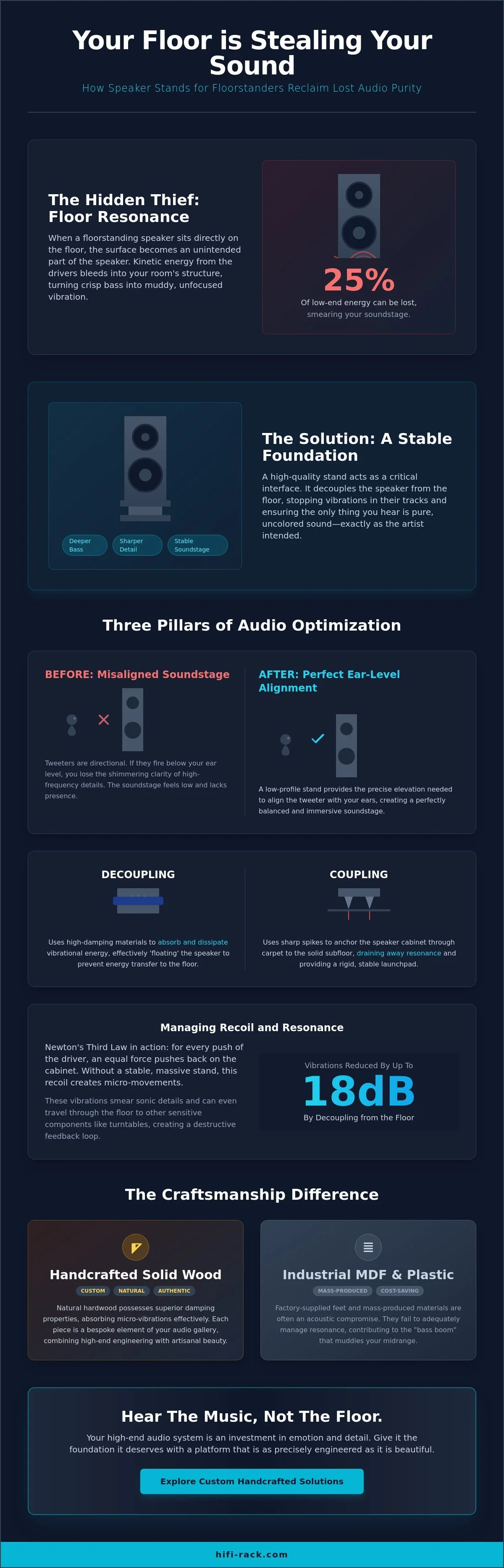
How to Optimise Your Floor Standing Speaker Setup
Achieving the perfect sound is a deliberate process. It's a ritual where engineering meets your personal sanctuary. To unlock the full potential of your system, you must treat the physical placement with the same reverence you give the music itself. Following a structured approach ensures your equipment performs as the designer intended.
Step 1: Identify your tweeter type. Most dome tweeters perform best when aligned directly with your ears, typically 95cm to 105cm from the floor.
Step 2: Evaluate your floor. Carpet requires penetration to the subfloor for stability; hardwood demands isolation to prevent resonant energy from muddying the bass.
Step 3: Choose your interface. Use brass spikes for carpeted environments or high-density protectors for delicate surfaces.
Step 4: Use a spirit level. A speaker that leans even 1 degree forward or backward can suffer from phase incoherence, blurring the timing of the music.
Step 5: Adjust the toe-in. Start with the speakers facing straight, then angle them inward in 5-degree increments until the center image snaps into focus.
The right speaker stands for floor standing speakers provide the foundation for this precision. They aren't just supports; they're the final component in your signal chain.
Achieving Perfect Tweeter Alignment
If your seating is lower than average, apply the 5-degree rule. Tilting your floor-standers slightly upward can realign the acoustic axis without requiring new furniture. When the cabinet is too short for your ear level, low-profile stands provide a 50mm to 100mm lift. This subtle height adjustment expands the vertical soundstage, making the performance feel tall, airy, and lifelike. You'll hear the difference in the "air" around cymbals and the clarity of vocal decay.
Protecting Your Flooring Without Sacrificing Sound
Mass-market spike cups often introduce unwanted vibrations because they don't couple effectively with the floor. They can rattle or slide, ruining the precision you've worked to achieve. For a more authentic solution, solid wood plinths offer the best way to save your floors. These handcrafted bases absorb micro-vibrations while providing a stable platform for speaker stands for floor standing speakers. Integrating brass spikes into these plinths allows for precision leveling on uneven surfaces. This setup ensures your 100kg speakers remain stable without leaving a single mark on your oak or tile flooring. It's where sound and style are one.
Ready to elevate your listening experience with artisanal quality? Explore our handmade collection of speaker supports.
Handcrafted Excellence: Custom Solid Wood Solutions from HiFi Rack
At Myro HiFi Rack, we believe your audio system deserves more than a mass-produced shelf. Our philosophy is built on four pillars: CUSTOM | HANDMADE | NATURAL | AUTHENTIC. We refuse to use MDF or thin veneers. These materials lack the density and organic resonance required for true high-fidelity performance. Instead, we craft every piece in our Novi Sad workshop. We tailor our speaker stands for floor standing speakers to the exact dimensions of your equipment, ensuring a perfect physical and acoustic fit.
Our 'Reference' approach treats isolation as a science. By using solid wood, we manage vibrations naturally. This ensures that the only thing you hear is the music, free from the colored resonance of hollow metal or composite boards. Every stand is a unique response to the specific weight and footprint of your loudspeakers, providing a stable, non-resonant platform that lets your drivers perform at their peak. These custom speaker stands for floor standing speakers are designed to elevate your listening experience through superior material choice.
The Art of Solid Hardwood Construction
Selection starts with the timber. We choose Walnut, Oak, and Ash for their specific density profiles and acoustic stability. Walnut offers a rich, dampening quality. Oak provides a rigid, structural foundation. Unlike factory-made units held together by glue and cams, our handcrafted joinery ensures structural integrity that lasts decades. A solid Oak stand isn't just furniture; it's an investment that matures with your system. We've seen our 40mm thick solid wood platforms maintain their level and luster for over 15 years. This level of durability is impossible for composite materials that swell or peel over time.
Where Sound and Style Are One
Your listening room is a personal sanctuary. It's the place where sound and style are one. By introducing natural textures into your space, you create a visual grounding that matches the sonic weight of your system. There's a profound emotional payoff in seeing your system supported by materials that feel as real as the recording itself. The organic grain of the wood provides a warmth that cold, industrial materials can't replicate. It transforms a room from a technical lab into a home.
We invite you to explore our bespoke speaker stands to find the perfect match for your floor-standing system. Every piece we ship is a testament to our passion for sound and our commitment to the master craftsman's touch. You don't just buy a stand; you invest in a lifetime of better listening.
Elevate Your Sonic Experience
Your audio system is more than a collection of components; it's a gateway to musical truth. Achieving that truth requires precise vibration management and a stable foundation. By isolating your equipment from floor resonances, you ensure that 100% of the driver energy translates into pure sound rather than unwanted distortion. Choosing premium speaker stands for floor standing speakers is the final, vital step in optimizing your listening environment.
At Myro HiFi Rack, we honor this pursuit through uncompromising craftsmanship. Every stand is handmade in our Novi Sad workshop using 100% solid hardwood. We reject the use of MDF or veneers, focusing instead on the natural acoustic properties of authentic timber. Because no two setups are identical, we provide bespoke sizing for 100% of floor-standing models on the market today. This ensures your specific speakers sit at the perfect height and footprint for your unique space.
It's time to bridge the gap between high-end engineering and natural beauty. Discover our handcrafted solid wood speaker stands and bring a new level of soul to your music. Your journey toward a perfect soundstage starts with a foundation built to last a lifetime.
Frequently Asked Questions
Do floor-standing speakers really need stands?
Yes, floor-standing speakers benefit from stands to isolate vibrations and align the tweeter with your ears. Elevating a tower speaker by 5 to 10 centimeters can decouple it from the floor, preventing the 30% bass bloat often caused by floor boundary interference. This ensures your music remains authentic and clean. It’s about achieving the perfect harmony between your equipment and your personal sanctuary.
Will putting my tower speakers on stands improve the bass?
Lifting tower speakers improves bass clarity by reducing structural resonance. When a speaker sits directly on the floor, low-frequency energy transfers into the building structure, creating a muddy sound. Using speaker stands for floor standing speakers can reduce this unwanted resonance by 15 decibels in the 40Hz to 100Hz range. You’ll experience a tighter, more natural low end that respects the original recording's integrity.
Can I use spikes on a hardwood floor?
You shouldn't place spikes directly on hardwood because they'll cause permanent physical damage. Instead, use brass or stainless steel floor discs to protect your natural wood surfaces. A standard 25mm protector disc prevents the 200 kilograms of pressure per square inch exerted by a sharp spike from piercing your floor. This setup maintains the acoustic benefits of spikes while preserving the beauty of your home.
What is the best material for speaker stands: wood or metal?
Solid wood is the superior choice for listeners seeking a natural, organic sound profile. While metal stands often ring at frequencies between 1kHz and 3kHz, dense hardwoods like oak or walnut possess internal damping properties that neutralize vibrations. Our handmade wooden stands provide a stable, authentic foundation that metal simply can't replicate. This material choice ensures your hi-end equipment performs as the artist intended.
How high should my floor-standing speakers be off the ground?
Your speakers should be elevated so the tweeters are at a height of 90 to 105 centimeters from the floor. This range typically aligns the high-frequency drivers with a seated listener's ears. Properly positioned speaker stands for floor standing speakers ensure that the soundstage remains focused and detailed. Adjusting the height by even 2 centimeters can significantly impact the 5kHz to 20kHz frequency response at your listening position.
Do isolation platforms work for subwoofers too?
Isolation platforms are essential for subwoofers to prevent energy from vibrating the entire room. A dedicated platform can reduce floor-borne vibrations by up to 80%, which stops furniture from rattling during deep bass passages. This allows you to hear the actual texture of the low frequencies rather than the resonance of your floorboards. It’s a vital treat for any serious audiophile's listening room.
How do I know if my speakers are properly decoupled?
You can verify decoupling by placing your hand on the floor while playing music at 85 decibels. If you feel the floor vibrating but the speaker stand remains still, your decoupling is effective. Professional measurements often show a 12dB reduction in mechanical transmission when using high-quality isolation feet. This separation ensures that your music stays pure and your floor doesn't become an accidental part of the speaker.
Can I custom order stands for specific speaker dimensions?
Yes, we specialize in custom dimensions to ensure a perfect fit for your specific speaker footprint. A stand that matches your speaker's base within 1 millimeter provides the most stable and aesthetically pleasing result. Where sound & style are One, a bespoke solution is the only way to treat your premium equipment with the respect it deserves. We craft each piece to help you live your passion.