

Are Premium Audio Racks Worth the Investment? The Audiophile’s Reality Check
What if the most significant bottleneck in your high-fidelity system isn't the electronics, but the very surface they rest upon? You've spent years refining your signal path, yet you might still struggle with a muddy bass response or a turntable that catches every vibration in the floor. It leads many to ask are premium audio racks worth the investment, or are they just expensive pedestals for gear? To the master craftsman and the dedicated listener, the answer lies in the invisible physics of resonance and the pursuit of a truly silent foundation.
We agree that it's frustrating to see world-class components trapped in closed cabinets that stifle performance and build up heat. Your equipment deserves an environment that honors its engineering while elevating your personal sanctuary. This article reveals how a precision-engineered audio rack transforms vibrational energy into acoustic clarity. We'll examine the science of isolation and explain why a permanent, lifetime solution for your gear is the final piece of your sonic puzzle.
Key Takeaways
Understand how a dedicated rack serves as a precision energy management system, shielding your electronics from the destructive effects of microphony.
Learn why solid hardwood offers superior organic damping compared to the structural limitations and sonic ringing of MDF or metal furniture.
Use the 10-15% rule to evaluate your system's value and determine if premium audio racks are worth the investment for your specific listening environment.
Discover how artisan craftsmanship and high-mass foundations create a permanent, silent stage that allows your components to perform at their peak.
Identify which pieces of gear in your signal path are most vulnerable to vibration and how proper isolation unlocks their latent acoustic potential.
Table of Contents
The Hidden Compromise: Why Standard Furniture Limits Your Sound
The Science of Silence: Resonance, Mass, and Component Health
Material Integrity: Why Solid Hardwood Outperforms MDF and Veneer
Evaluating Your System: When Does the Investment Make Sense?
The Hidden Compromise: Why Standard Furniture Limits Your Sound
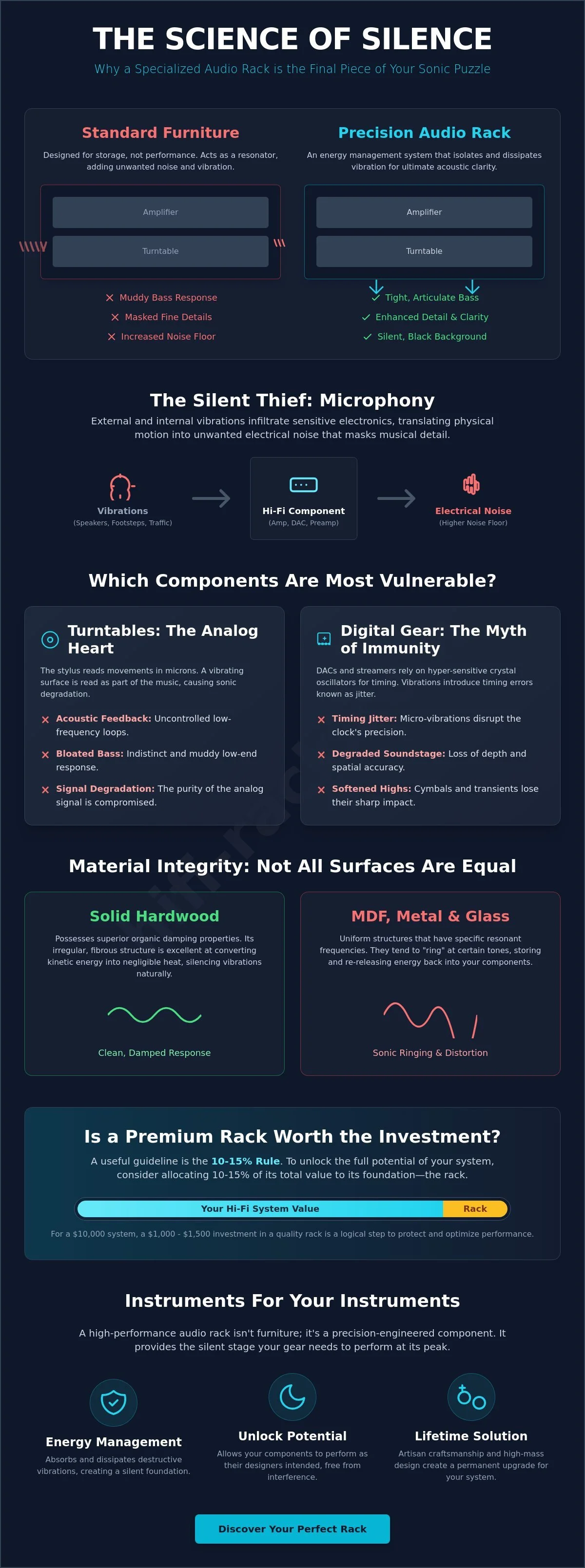
Placing a high-performance amplifier or a delicate pre-amplifier on a standard bookshelf is a common oversight. Most household furniture is designed for aesthetics or storage, not for the complex task of energy management. In the world of high-fidelity sound, a rack must do more than hold weight. It must act as a dedicated instrument that drains away unwanted kinetic energy. When you ask are premium audio racks worth the investment, you're really asking if your gear is being allowed to perform without the interference of its own environment.
Mechanical interference is a silent thief of clarity. External vibrations from speakers, footsteps, or even passing traffic infiltrate sensitive electronic circuits. This phenomenon, known as microphony, occurs when components within your gear vibrate and translate that motion into electrical noise. This noise raises the "noise floor," masking the fine details and micro-dynamics that give music its life. A purpose-built stand provides a level of stability that standard cabinets simply cannot match, ensuring that the only thing moving in your room is the air itself.
The Turntable Sensitivity Factor
For the vinyl enthusiast, the relationship between the stylus and the groove is sacred. The stylus is designed to detect movements measured in microns. If your turntable sits on a shelf that flexes or vibrates, those movements are added to the musical signal. This often results in acoustic feedback loops or a bloated, indistinct bass response. A solid foundation is non-negotiable here. By applying the principles of vibration isolation, a premium rack ensures the stylus tracks only the music, preserving the integrity of the analog signal.
Digital Components and Micro-Vibrations
It's a persistent myth that digital gear is immune to mechanical stress. While there's no physical needle, digital-to-analog converters and streamers rely on crystal oscillators for precise timing. These oscillators are sensitive to micro-vibrations. When subjected to mechanical stress, they can experience fluctuations that lead to jitter. This subtle timing error degrades the soundstage and softens the impact of high frequencies. When considering if are premium audio racks worth the investment, remember that even your digital signal path requires a silent, stable home to achieve true transparency. Understanding the science of vibration damping is the first step toward reclaiming the lost nuances of your collection.
The Science of Silence: Resonance, Mass, and Component Health
True silence is more than the absence of sound; it's the absence of interference. In a high-fidelity system, structural rigidity is the silent partner of sonic clarity. When a rack lacks sufficient mass, it becomes a secondary resonator, vibrating in sympathy with the music and blurring the stereo image. High-mass structures act as energy sinks, absorbing and dissipating kinetic energy before it can reach the sensitive internal circuits of your equipment. This scientific reality is why enthusiasts often ask are premium audio racks worth the investment when a simple wooden shelf is so much cheaper. The difference isn't found in the look of the furniture, but in the depth of the soundstage and the precision of the transients.
Finding the right balance between decoupling and coupling is essential for your specific environment. On a suspended wooden floor, you might require decoupling to block the energy of footfalls from reaching your turntable. Conversely, on a solid concrete floor, coupling your gear with high-tensile spikes can drain internal transformer hum and mechanical energy directly into the ground. A holistic rack system manages both, providing a stable foundation that allows your components to breathe and perform without the constant stress of mechanical noise.
Vibration Dissipation vs. Isolation
There's a vital distinction between blocking vibrations and draining them away. Isolation focuses on preventing floor-borne energy from entering the rack, while dissipation involves moving energy out of the component's chassis. Flimsy, lightweight stands often act as resonators, amplifying certain frequencies and adding a "ringing" quality to the sound. Precision-engineered floor protectors and specialized spikes are vital for this energy exchange. They provide a high-pressure contact point that facilitates the rapid exit of kinetic energy, leaving the music untouched by mechanical artifacts.
Thermal Management in High-End Audio
Component health is an often overlooked benefit of a professional setup. Heat is the primary enemy of capacitor longevity and overall amplifier stability. Built-in cabinets and closed furniture are the natural enemies of Class A and vacuum tube gear, which generate significant thermal energy. Open-architecture designs utilize natural convection cooling, allowing air to flow freely around heat sinks and delicate valves. By optimizing shelf spacing, you ensure that your gear operates within its ideal thermal window, extending the life of your electronics. If you're building a system meant to last a lifetime, exploring the Reference Myro HiFi Rack provides a masterclass in how mass and airflow work together to protect your investment.
Material Integrity: Why Solid Hardwood Outperforms MDF and Veneer
Choosing the right material for your system is a fundamental decision in audio engineering. While glass and metal are popular for their modern aesthetic, they often introduce a distinct "ringing" into the signal path. Glass shelves, in particular, act as reflective surfaces that can emphasize harshness in the upper frequencies. In contrast, solid hardwood possesses a complex, non-uniform grain structure. This organic composition acts as a natural damping agent, absorbing micro-vibrations before they can reach your components. When you wonder are premium audio racks worth the investment, the answer is often found in the material's ability to remain sonically neutral.
MDF and veneer are common in mass-market furniture, but they fail the audiophile's reality check. MDF is essentially compressed sawdust and resin. It lacks the internal tension and structural rigidity required to support heavy high-end gear without eventually bowing under the weight. Unlike solid timber, MDF doesn't dissipate energy; it tends to store it, releasing it back into the chassis of your equipment over time. For a deeper look at these structural differences, read our guide on Solid Hardwood vs. MDF: The Truth About Audio Furniture.
The Sonic Signature of Materials
Every material has a voice. Metal stands can sound fast but lean, while glass often sounds clinical or bright. We've found that solid oak, walnut, and ash provide the most balanced foundation for high-fidelity sound. These hardwoods offer a unique combination of high mass and internal damping that lets the music's natural warmth and detail shine through. This is why we never use MDF or thin veneers in our Reference Myro HiFi Rack designs. We believe the purity of the material should match the purity of the sound.
Handcrafted Longevity
Beyond the acoustic benefits, solid wood represents a commitment to longevity. A rack made from solid timber is a lifetime investment. It can be refinished and restored, unlike veneer-clad boards that inevitably peel or chip at the edges. Bespoke woodworking allows for tighter tolerances and more robust joinery than any assembly line can offer. It also reflects a sense of responsibility toward the environment. By choosing sustainable, high-quality materials, you're investing in a piece of furniture that respects both the craft and the planet. This level of integrity is a core reason why many enthusiasts decide that are premium audio racks worth the investment.
Evaluating Your System: When Does the Investment Make Sense?
Deciding at what point a system "earns" a high-performance foundation is a common dilemma for the growing enthusiast. We often suggest the 10-15% rule as a baseline for a balanced setup. If your total component value has reached a level where a single cable or accessory upgrade costs more than a precision stand, it's time to look at the rack itself. You wouldn't put racing tires on a sedan, nor would you put a world-class turntable on a hollow coffee table. When asking are premium audio racks worth the investment, consider whether your current furniture has become the weakest link in your signal path.
Your listening environment plays a significant role in this decision. If your speakers are within three feet of your equipment, the acoustic energy they generate is directly impacting your electronics. Hardwood floors and high-traffic areas also introduce mechanical noise that can muddy the soundstage. A modular rack offers the distinct advantage of growing with your passion, allowing you to add levels as your collection of separates expands over time. It's a way to ensure your organization remains as refined as your sound.
The 5-Point System Audit
Before making a change, take a moment to honestly assess your current setup. If you answer yes to more than two of these points, your gear is likely being held back by its foundation:
Surface Resonance: Does your gear sit on a hollow or thin-walled cabinet that vibrates when you tap it?
Speaker Proximity: Are your components being bombarded by low-frequency energy from nearby subwoofers?
Sonic Clarity: Do you notice a collapsed soundstage or "bloated" bass when you turn up the volume?
Structural Integrity: Is your current shelving visibly sagging under the weight of heavy power transformers?
Mechanical Feedback: Does your turntable pick up "thumps" or feedback from footsteps in the room?
Scaling Your Investment
Not every system requires a full-scale reference solution from day one. Many enthusiasts find that starting with the Classic Myro HiFi Rack provides the essential isolation needed for a high-quality integrated amp and streamer. As you move toward heavy Class A monoblocks or high-mass turntables, the Reference Myro HiFi Rack becomes the necessary choice for ultimate energy management. Completing the acoustic environment with dedicated speaker stands ensures that every part of your system is properly decoupled from the floor. If your audit reveals that your gear is struggling for air or stability, it's time to explore our collection of handcrafted racks and give your instruments the home they deserve.
The HiFi Rack Philosophy: Instruments for Your Instruments
The pursuit of high-fidelity sound is a journey toward harmony. It's an intimate search for the moment when the equipment disappears and only the music remains. In our Novi Sad workshop, we approach every build with this specific reverence. We treat the rack not as a storage solution, but as a vital instrument designed to support and enhance your electronics. This artisanal philosophy ensures that every joint and every surface serves the ultimate goal of acoustic transparency. When enthusiasts ask are premium audio racks worth the investment, they're often looking for a solution that solves both mechanical noise and aesthetic clutter permanently.
Most components in your system will eventually be replaced. Digital-to-analog converters evolve, and streamers are updated with new protocols. However, a solid wood foundation remains constant. It's a legacy piece built to outlast the very electronics it holds. Our "No MDF" commitment is central to this longevity. By rejecting engineered boards and thin veneers, we ensure that your rack never loses its structural integrity or its sonic neutrality. It's this enduring value that truly answers the question: are premium audio racks worth the investment?
The Harmony of Form and Function
A minimalist aesthetic shouldn't come at the cost of technical performance. We believe that a rack should be as beautiful to the eye as it is beneficial to the ear. There's a profound sensory payoff in the ritual of listening, from the tactile warmth of natural walnut to the way a clean, organized space calms the mind. When your gear is presented with such intentionality, the act of selecting a record or adjusting a dial becomes a more grounded, soulful experience. It transforms your listening room into a personal sanctuary where form and function exist in perfect balance.
Your Next Step in Sonic Perfection
If you've spent years refining your signal path, don't let a resonant shelf be the final compromise. The foundation you choose today will define the clarity of your system for decades to come. We invite you to explore the HiFi Rack Shop to find the specific model that fits your collection and your space. Whether you require a standard configuration or a bespoke manufacturing solution tailored to unique dimensions, we provide global shipping for every boutique piece we create. A precision rack isn't just an accessory; it's the bedrock of your acoustic reality. It's time to give your music the silent, steady home it deserves.
Reclaim the Purity of Your Sound
Building a high-fidelity system is an act of curation. You've selected each component for its voice and its precision. Now, you must decide if those instruments will be allowed to perform at their peak. We've explored how mechanical noise and material resonance can mask the very details you've worked so hard to uncover. When you finally ask are premium audio racks worth the investment, the answer is found in the silence between the notes. It's the clarity of a soundstage that no longer collapses under the stress of vibration.
Our workshop in Novi Sad remains committed to a zero MDF or veneer policy. We believe that only handcrafted solid hardwood construction provides the structural integrity and organic damping your gear requires. This isn't just furniture; it's a legacy piece designed to serve as the permanent bedrock for your passion. With worldwide shipping available, your next step in sensory perfection is within reach. Explore the Reference Myro Collection and build your foundation today. Give your music the silent, steady home it has always deserved.
Frequently Asked Questions
Does a HiFi rack really improve sound quality?
A dedicated HiFi rack improves sound quality by providing a silent foundation that drains mechanical energy away from sensitive circuits. This reduction in microphony allows for a clearer soundstage and sharper micro-dynamics. By lowering the noise floor, you hear details that were previously masked by vibrational interference. It's an essential upgrade for anyone seeking the full potential of their electronics.
Is solid wood better than metal for audio racks?
Solid wood is generally superior because its non-uniform grain structure acts as a natural damping agent. Metal frames can ring like a tuning fork unless they're high-mass and filled with damping material. Hardwood provides a neutral, organic tone that avoids the clinical harshness often associated with glass or hollow metal stands. It offers a perfect balance of rigidity and energy absorption.
How much should I spend on an audio rack?
A reliable industry benchmark is to invest roughly 10 to 15 percent of your total system's value into your foundation. This ensures your rack is proportional to the quality of your electronics. When you consider are premium audio racks worth the investment, remember that a handcrafted hardwood solution is a lifetime purchase. It protects your gear while maximizing its performance for decades to come.
Can I just use a heavy bookshelf instead of a dedicated rack?
Standard bookshelves often act as energy reservoirs that store and reflect vibrations back into your equipment. They also lack the open-architecture design needed for natural convection cooling, which can lead to component overheating. A dedicated rack is specifically engineered for energy dissipation and thermal management. These are two critical functions that mass-market furniture simply cannot provide for high-end gear.
Do digital components need vibration isolation?
Digital components are sensitive to micro-vibrations that can affect the timing stability of their internal crystal oscillators. This mechanical stress leads to jitter, a timing error that blurs the stereo image and softens high-frequency detail. Providing a stable, isolated home for your DAC or streamer is essential for maintaining digital signal integrity. Even gear without moving parts benefits from a silent environment.
What is the best way to isolate a turntable on a rack?
The best way to isolate a turntable is by using a high-mass shelf coupled with precision decoupling footers or spikes. This combination drains internal motor noise while blocking floor-borne energy from reaching the delicate stylus. Placing the turntable on the top shelf of a solid hardwood rack ensures it remains isolated from the mechanical energy of other components in your signal path.
Why does HiFi Rack avoid using MDF and veneer?
We avoid MDF and veneer because these materials lack the structural rigidity and natural damping properties of solid timber. MDF is susceptible to sagging under the weight of heavy power transformers and tends to store rather than dissipate vibrational energy. Solid hardwood offers a permanent, high-mass solution that honors both the craft of woodworking and the technical requirements of high-fidelity sound.
How do spikes and floor protectors work together?
Spikes create a high-pressure contact point that facilitates the rapid drainage of kinetic energy out of the rack and into the floor. Floor protectors prevent damage to your hardwood or stone surfaces while maintaining the integrity of that energy exit path. When asking are premium audio racks worth the investment, these precision-engineered interfaces are the key to successfully decoupling your system from the room's environment.