

Arranging HiFi Components for Optimal Performance: The Audiophile’s Guide
The most influential component in your signal chain isn't your amplifier or your turntable; it's the physical architecture that supports them. We often spend years chasing the perfect tone through circuitry, yet we overlook how micro-vibrations and electromagnetic interference can quietly erode the clarity of a performance. Mastering the art of arranging hifi components for optimal performance is the final, essential step in transforming high-end gear into a personal sanctuary of sound.
It's a shared frustration when a blurred soundstage or an intermittent hum stands between you and the music. You've invested in quality, and you expect the results to match. This guide shares the precise architectural logic needed to eliminate vibration, reduce interference, and unlock the true potential of your system. We will explore how a thoughtful layout creates a dead-quiet noise floor and improved instrument separation. Together, we'll find the harmony between structural integrity and acoustic perfection, ensuring your equipment performs with the same integrity with which it was crafted.
Key Takeaways
Learn why solid hardwood provides the essential mechanical ground required to absorb micro-vibrations that synthetic materials cannot.
Master the vertical hierarchy of your system by arranging hifi components for optimal performance through strategic weight distribution and heat management.
Identify electromagnetic noise zones and implement the 90-degree cable rule to maintain a dead-quiet noise floor.
Understand the nuanced application of coupling and decoupling to either ground energy into your rack or isolate sensitive electronics.
Discover how a handcrafted, bespoke support like the Reference Myro HiFi Rack functions as the final active instrument in your signal chain.
Table of Contents
The Foundation of Sound: Why Rack Materials Dictate Component Performance
The Vertical Hierarchy: Arranging Components by Weight and Thermal Output
Coupling vs. Decoupling: Precision Tuning with Spikes and Feet
The Myro Solution: Why Handcrafted Solid Wood is the Final Component
The Foundation of Sound: Why Rack Materials Dictate Component Performance
We often think of the rack as mere furniture. In reality, it acts as the mechanical ground for every piece of gear you own. Without a stable foundation, even the most expensive electronics struggle to achieve true High-fidelity sound reproduction. When you begin arranging hifi components for optimal performance, the material of your support system is the first decision that determines your success. A rack should never be a passive observer; it must be an active participant in managing energy.
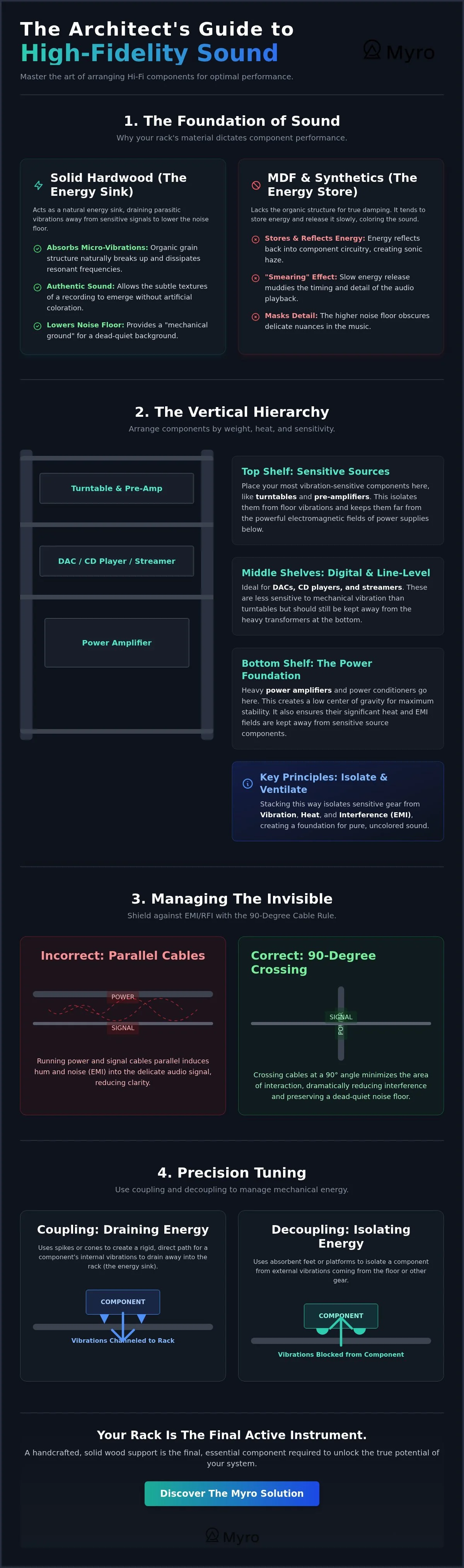
Every component generates internal mechanical energy through its transformers and moving parts. If this energy has nowhere to go, it reflects back into the circuitry, creating a sonic haze that obscures detail. A high-quality solid wood rack acts as a natural energy sink. It drains these parasitic vibrations away from sensitive signals, effectively lowering the noise floor of your entire room. This physical connection between the component and the floor is what we call the mechanical ground.
Solid Hardwood vs. MDF: The Acoustic Reality
Many mass-market racks rely on Medium Density Fibreboard (MDF) or thin veneers. While these are cost-effective, they lack the organic cellular structure needed for true damping. MDF tends to store energy and release it slowly. This creates a "smearing" effect in the timing of your audio. We choose solid hardwoods like walnut, cherry, and oak because their varying grain densities naturally break up resonant frequencies. This inherent damping allows the subtle textures of a recording to emerge without artificial coloration. Handcrafted wood furniture doesn't just look better; it sounds more authentic as it ages.
Structural Rigidity and Mass
Stability is paramount, especially for analog sources. High mass prevents the micro-movements that cause a turntable needle to mistrack. However, mass alone isn't the complete answer. An open-architecture design is vital for resonance escape and consistent airflow. It ensures that heat doesn't build up, which is a major part of The Science of Vibration Damping in Solid Hardwood. This combination of rigidity and breathability ensures your system remains as visually stunning as it is sonically precise. By prioritizing these raw materials, you create a permanent sanctuary for your sound.
The Vertical Hierarchy: Arranging Components by Weight and Thermal Output
Achieving structural harmony requires more than just choosing the right materials. It demands a logical vertical strategy. When arranging hifi components for optimal performance, we must respect the laws of physics: gravity, heat, and electromagnetic flux. A well-ordered rack ensures that heavy power supplies don't compromise stability, while sensitive signals remain clear of thermal and electrical noise. This thoughtful layering transforms a stack of gear into a unified musical instrument.
The core principles of Component Placement suggest that the most demanding electronics should dictate the rack's layout. By establishing a low center of gravity, we anchor the entire system. This provides a steadfast platform for the delicate work of music reproduction, ensuring that the foundation of your sound remains unshakable.
Step 1: The Power Foundation
Power amplifiers are the heavyweights of any system. Their massive toroidal transformers and heat-intensive circuitry require the most stable, well-ventilated space. Placing them on the bottom shelf ensures the rack remains grounded and prevents the heat from Class A or AB amplification from rising through other sensitive electronics. For those with particularly substantial gear, the Reference Myro HiFi Rack for heavy components provides the uncompromising rigidity needed for these high-current foundations.
Step 2: The Digital Middle Ground
The middle tiers are the ideal home for DACs, streamers, and CD transports. While these components lack the physical mass of a power amp, they are sensitive to high-frequency jitter. Digital clocks require a stable environment to maintain timing accuracy. Even though digital gear doesn't move, it still benefits from high-mass shelving that isolates it from the mechanical hum of nearby power supplies. This middle ground acts as a buffer zone, keeping digital noise away from your analog stages.
Step 3: The Analog Apex
The top shelf is reserved for the most delicate instruments: the turntable or the preamplifier. This placement offers ergonomic ease, but it comes with a challenge. The top shelf is the most vulnerable to airborne vibrations from your speakers. Protecting a turntable requires precision tuning, often involving specialized support. If you're looking to refine this setup, consider exploring The Ultimate Guide to Turntable Isolation Platforms to ensure your needle stays perfectly in the groove. Balancing performance with ease of use is a personal journey, and a thoughtfully arranged rack makes your system a joy to interact with every day.
Managing the Invisible: Shielding Against EMI and RFI
Beyond the physical tremors of micro-vibration, we must contend with a more elusive adversary: electromagnetic noise. In our modern homes, saturated with 5G signals and Wi-Fi networks, the air itself is cluttered. When we talk about arranging hifi components for optimal performance, we're really discussing the management of invisible fields. A dead-quiet noise floor isn't just a technical specification; it's the canvas upon which the music is painted. Without proper shielding and spacing, the most delicate nuances of a recording are lost to a sea of electronic haze.
The most effective shield against interference isn't a costly boutique cable, but simple physical distance. Inductive coupling follows the inverse square law; doubling the distance between a noise source and a sensitive signal path reduces the interference by a factor of four. This is why we advocate for open-back racks. They allow for the necessary "air gap" that serves as a natural barrier against hum. By thoughtfully spacing your gear, you provide the breathing room required for signal integrity.
Cable management is the final piece of this invisible puzzle. We follow the 90-degree rule: whenever power and signal cables must meet, they should cross at right angles. This orientation minimizes the transfer of noise between them. When arranging hifi components for optimal performance, keeping your digital, analog, and power looms separate ensures that the high-frequency switching noise of a streamer doesn't bleed into the pure analog output of your turntable.
Transformer Proximity and Shielding
Large toroidal transformers are the heart of power amplifiers, but they're also the primary source of magnetic flux. You should never place a sensitive phono stage directly above or below a high-current power amp. These "noise zones" can induce a persistent hum that no amount of grounding can fix. To test your setup, turn your volume up with no music playing and move your components slightly. If the hum changes in intensity, you've found an inductive loop. Creating a vertical buffer between these units is essential for a clean signal.
Cable Management for Open Racks
Open-architecture designs, like the Minimal Myro HiFi Rack, offer unparalleled access for cable routing. Heavy, high-end cables often suffer from "connector strain," where the weight of the wire pulls at the delicate inputs of your components. We recommend securing these cables to the rack structure itself to relieve tension. Solid wood is a natural partner here. Unlike metal or plastic, it doesn't hold a static charge, which helps maintain a stable environment for your signal paths. This combination of structural support and electrical neutrality is what defines a truly high-performance listening space.
Coupling vs. Decoupling: Precision Tuning with Spikes and Feet
The final stage of arranging hifi components for optimal performance is the art of the interface. We often focus on the internal circuitry of our gear, yet the physical contact points between your equipment and the shelf dictate the final character of the sound. This is where we choose between coupling and decoupling. Coupling involves creating a rigid mechanical path to "ground" energy, while decoupling uses isolation to block external vibrations from entering a sensitive component. Both techniques are essential for a balanced system.
Coupling is most effective when you have a high-mass, naturally damping support like solid hardwood. By using precision-machined spikes, we concentrate the weight of a component onto a tiny surface area. This extreme pressure creates a one-way exit for mechanical energy, allowing it to drain into the rack rather than reflecting back into the signal path. In our workshop, we've found that brass spikes offer a unique synergy with oak and walnut. Brass provides the necessary rigidity for grounding without the aggressive ringing often found in lower-grade steel alloys.
The Role of Precision-Machined Spikes
Spikes aren't just for aesthetics; they're functional conduits. They concentrate the kinetic energy generated by transformers and motors, directing it away from delicate analog stages. In our Myro series racks, we utilize a combination of brass and stainless steel to ensure a stable, non-resonant connection. This mechanical grounding is particularly vital for speakers, where controlling cabinet resonance is the difference between a muddy bass response and a punchy, articulate low end. You can explore more about this in our guide on Speaker Feet and Acoustic Isolation.
Levelling for Performance
Precision levelling is a non-negotiable requirement for high-end audio, especially for analog sources. A turntable that isn't perfectly level will suffer from uneven bearing wear and tracking errors, leading to a distorted soundstage. When arranging hifi components for optimal performance, we use adjustable spikes to ensure a rock-solid, perfectly horizontal foundation. This eliminates "micro-wobble," a subtle instability that can plague taller racks and blur instrument separation. Once your rack is perfectly level, the music gains a sense of calm and focus that's immediately apparent.
If you're ready to provide your system with the stable, vibration-free foundation it deserves, you can explore our range of precision-crafted support systems to find the perfect match for your listening room.
We understand that performance shouldn't come at the cost of your home's aesthetics. For those with delicate hardwood floors, we recommend using high-mass floor protectors. These small discs sit beneath your spikes, preserving your floor while maintaining the mechanical integrity of the coupling. This ensures your listening room remains a sanctuary for both your eyes and your ears, where every detail is respected.
The Myro Solution: Why Handcrafted Solid Wood is the Final Component
In the quiet of a listening room, the smallest details matter. After you've mastered the nuances of cable routing and thermal management, you realize that arranging hifi components for optimal performance requires one final, definitive element. At Myro, we believe the rack is not merely a stage for your electronics; it's the final active component in your signal chain. Every shelf we produce is born from a multi-generational tradition of Serbian woodworking, where the natural damping properties of the timber are respected and harnessed to elevate your auditory experience.
Our philosophy is rooted in uncompromising rigidity. While mass-produced alternatives prioritize shipping efficiency, we prioritize the art of listening. We build each piece with the understanding that it will be a permanent part of your home. Serbian craftsmanship ensures that every joint is precise and every surface is finished to a standard that matches the finest high-end electronics. This isn't furniture built for a season; it's a legacy piece designed for a lifetime of sensory perfection. We offer bespoke manufacturing because we know that your system is unique, allowing us to tailor dimensions to your specific equipment.
Artisanal Pride Meets Technical Excellence
We refuse to use MDF or veneers. These materials lack the organic cellular structure needed to truly ground a high-fidelity system. There is a profound sensory reward in touching raw, high-quality hardwood that has been hand-selected for its density and grain. This commitment to materials is part of Our Responsibility and Philosophy. We believe in creating products that respect the environment as much as they respect the music; this ensures that your sanctuary of sound is built on a foundation of integrity and longevity.
Choosing Your Myro: Reference, Classic, or Minimal?
Every system has its own architectural needs. When arranging hifi components for optimal performance within a dedicated listening space, selecting the right model is essential. The Reference Myro HiFi Rack offers the ultimate in mass and isolation for heavy, multi-component setups. For those who value a more understated aesthetic without sacrificing performance, the Classic and Minimal series provide the same solid wood benefits in a more compact form.
The Minimal Myro is particularly suited for smaller rooms where space is at a premium but sound quality is non-negotiable. You can Browse the Myro Collection to find the specific support that will unlock the true potential of your system. When you choose Myro, you aren't just buying a rack; you're partnering with a master craftsman in the pursuit of harmony between form and function.
Refining Your Personal Sanctuary
The journey to high-fidelity sound is a pursuit of harmony between technical precision and organic beauty. By prioritizing the structural logic of your layout, you've learned that the foundation of your system is as active as the electronics themselves. Mastering the art of arranging hifi components for optimal performance ensures that every note is delivered with the clarity it deserves. From providing thermal breathing room for your amplifiers to the precise mechanical grounding of your turntable, these small adjustments culminate in a transformative listening experience.
Our workshop in Novi Sad remains dedicated to this craft. We handcraft every shelf from solid hardwood, refusing the compromises of MDF or veneer to provide reference-grade vibration damping. We ship globally to ensure your system has the support it needs to truly breathe. Explore the Reference Myro Collection for Unmatched Acoustic Isolation and take the final step in your audiophile journey. Your music is waiting to be heard in its purest, most authentic form.
Frequently Asked Questions
Should I stack my HiFi components directly on top of each other?
You should avoid stacking components whenever possible. Direct contact allows electromagnetic interference from transformers to bleed into sensitive signal paths, while heat trapped between units can degrade internal capacitors over time. Each piece of gear needs its own shelf to breathe and to maintain mechanical isolation from neighboring vibrations, ensuring that your electronics operate within their ideal thermal and electrical parameters.
Is it better to have a tall rack or two shorter racks?
Two shorter racks are usually superior to one tall tower because they offer greater structural stability and a lower center of gravity. Tall racks are more susceptible to sway and airborne vibrations, which can affect delicate analog sources. Placing your equipment side by side also makes cable management more intuitive and reduces the risk of micro-wobble during high volume listening sessions in your sanctuary.
Does the type of wood in a HiFi rack actually change the sound?
The specific wood species absolutely influences the sonic outcome. Hardwoods like walnut and oak possess organic cellular structures that dissipate resonant energy differently than softwoods or synthetic boards. When arranging hifi components for optimal performance, choosing a solid wood rack ensures that the natural damping characteristics of the timber help clarify the mid-range and tighten the bass response by absorbing parasitic micro-vibrations before they reach your ears.
How much space should I leave between components for ventilation?
Aim for a minimum of five to ten centimeters of clearance above any component that generates heat, such as a power amplifier. Proper airflow prevents thermal throttling and ensures the longevity of your electronics. If your rack has an open-architecture design, this passive cooling is much more effective, allowing heat to dissipate naturally without the need for noisy external fans that could disrupt your listening experience.
Should I put my turntable on the top shelf or a separate wall shelf?
A separate wall shelf is the gold standard for turntables if your listening room has flexible floorboards. By mounting the player to a load-bearing wall, you bypass floor-borne vibrations entirely. However, if you have a concrete floor, the top shelf of a high-mass, solid wood rack like the Reference Myro provides an excellent mechanical ground that effectively drains internal motor noise away from the stylus.
Can I use a regular TV stand instead of a dedicated HiFi rack?
A regular TV stand is rarely sufficient because most are constructed from hollow materials or MDF that store and reflect energy. Dedicated HiFi racks are engineered specifically to manage the mechanical and electrical challenges of audio gear. While a TV stand might hold the physical weight, it won't provide the vibration damping or the energy sink properties necessary to lower your system's noise floor and reveal hidden details.
How do I stop my turntable from skipping on bouncy wooden floors?
To stop skipping on bouncy floors, you must decouple the turntable from the floor's movement. A wall-mounted shelf is the most effective solution, but high-mass isolation platforms can also help. When arranging hifi components for optimal performance on traditional wooden floors, using a heavy rack with adjustable spikes can help concentrate pressure into the joists, providing a more stable foundation for your analog playback and protecting the delicate stylus.
What is the best way to manage heavy power cables on an open rack?
The best way to manage heavy power cables on an open rack is to secure them to the frame using non-constricting ties. This prevents the weight of the cable from putting strain on the component's rear connectors. Keeping your power looms physically distant from your signal cables, and crossing them at ninety-degree angles when they must meet, ensures that electromagnetic hum doesn't enter your signal path and cloud the music.