

How a HiFi Rack Improves Sound Quality: The Science of Acoustic Isolation
Your HiFi rack is not a piece of furniture; it's a vital mechanical filter that sits at the heart of your audio chain. You've likely spent years refining your collection of amplifiers and speakers, yet you still find yourself battling a muddy bass response or a soundstage that feels frustratingly narrow. It's a common frustration for the dedicated listener who senses their system is holding something back.
Understanding exactly how a hifi rack improves sound quality is the key to unlocking the true potential of your components. A precision-engineered rack acts as a silent instrument. It works to eliminate the micro-vibrations that blur the soul of your music, revealing a depth and clarity you might have thought was missing from your favorite recordings. By isolating your gear from both internal and environmental interference, you allow every note to breathe.
This article explores the science of acoustic isolation and the transformative power of solid hardwood foundations. We'll look at how moving beyond simple storage leads to crisper imaging, tighter low-end frequencies, and an aesthetic that finally matches the excellence of your gear. It's time to treat your system with the reverence it deserves.
Key Takeaways
Identify the "invisible enemy" of micro-vibrations and how they infiltrate sensitive electronics to compromise your system's signal purity.
Learn why solid hardwood acts as a superior mechanical filter compared to MDF or metal, effectively dissipating energy rather than storing it.
Understand the role of mass and rigidity in lowering resonant frequencies to prevent your furniture from acting like a noise-amplifying drum skin.
Discover exactly how a hifi rack improves sound quality by resolving common audio pains like bloated bass and restricted soundstage depth.
Explore how the Reference, Classic, and Minimal series combine multi-generational woodworking expertise with precision acoustic engineering for a lifetime of performance.
Table of Contents
The Silent Saboteur: How Vibrations Degrade Your Audio Signal
The Mechanics of Sound: Why Rigidity and Mass Change What You Hear
Beyond Aesthetics: Why Solid Hardwood Outperforms MDF and Metal
Evaluating Your Setup: Signs Your Equipment Needs Better Support
The Myro Philosophy: Crafting Instruments for Your Instruments
The Silent Saboteur: How Vibrations Degrade Your Audio Signal
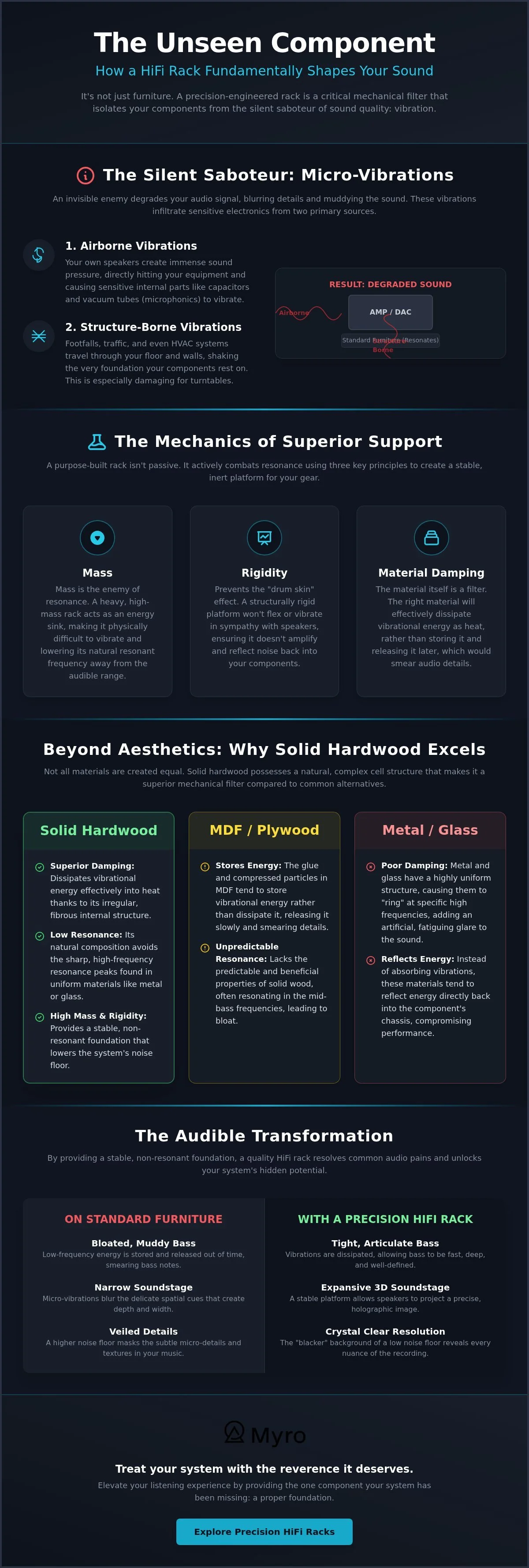
In the pursuit of auditory perfection, we often focus on the signal path we can see. We obsess over silver-clad cables and the warm glow of vacuum tubes. Yet, an invisible enemy works tirelessly to erode the clarity of your music. Vibrations, both those rising from the floor and those pulsing through the air, infiltrate your sensitive components. This is why understanding how a hifi rack improves sound quality is essential for any serious listener. It transforms the support system from a static shelf into a vital mechanical filter.
These vibrations aren't just subtle tremors; they're destructive forces at a microscopic level. Within your amplifier or DAC, micro-vibrations interfere with the delicate operation of capacitors and circuit boards. In vacuum tubes, this manifests as microphonics, where the internal elements of the tube actually vibrate, adding a layer of artificial noise to your music. When these components are left unprotected, the resulting distortion blurs the sharp edges of your soundstage.
A standard piece of household furniture often acts as a resonant chamber, storing energy and reflecting it back into your gear. In contrast, a dedicated HiFi rack serves as a mechanical ground. It provides a deliberate path to drain parasitic energy away from the signal path. While a decorative cabinet might look the part, it lacks the specialized engineering required for effective Vibration isolation. By providing a stable, inert foundation, a precision rack ensures that your components perform exactly as their designers intended.
Mechanical Resonance and the Noise Floor
Mechanical resonance is the unintended vibration of a component at its natural frequency. When your equipment vibrates in sympathy with the environment, it raises the noise floor. This parasitic noise masks the micro-details that create a sense of realism. By ensuring structural rigidity, you achieve a "blacker" background. This silence between the notes allows the true texture of the recording to emerge, providing the contrast needed for high-fidelity sound.
Airborne vs. Structure-Borne Interference
Your speakers are often the biggest threat to your system's stability. They create immense sound pressure that hits your equipment directly. At the same time, structure-borne interference from footfalls or HVAC systems travels through the building's frame. These external forces disrupt delicate analog signals, especially in turntables where the stylus must track microscopic grooves. To dive deeper into the material science behind this, explore The Science of Vibration Damping in Solid Hardwood.
The Mechanics of Sound: Why Rigidity and Mass Change What You Hear
When you place high-end audio components on lightweight, flimsy furniture, you're inadvertently introducing a "drum skin" effect into your listening room. Standard shelving often lacks the structural integrity to remain inert. Instead, it vibrates in sympathy with your speakers, effectively amplifying noise and reflecting it back into your gear. This is a fundamental reason why a hifi rack improves sound quality; it replaces a resonant surface with a high-mass foundation that refuses to join the performance.
The science of vibration and sound production teaches us that mass is the enemy of resonance. By increasing the mass of the support system, we lower its natural resonant frequency. A heavy, rigid rack doesn't just sit there. It acts as a massive energy sink that absorbs parasitic vibrations before they can reach the sensitive internal architecture of your equipment. This stability is the silent partner in creating a holographic soundstage. When your components are truly still, your speakers can project a more precise, three-dimensional image, allowing you to pinpoint every instrument with startling clarity.
Protecting the Analog Signal
In the world of vinyl, the turntable cartridge is a miracle of precision engineering. It's designed to track microscopic grooves, often smaller than a human hair. Any external movement, no matter how slight, causes the stylus to deflect. This unwanted movement creates an acoustic feedback loop that results in "bloated" bass and a loss of fine detail. A high-mass rack provides the unwavering platform necessary for the stylus to track with absolute accuracy. For those seeking the pinnacle of analog performance, pairing a rigid stand with a specialized turntable isolation platform ensures that the only thing your cartridge picks up is the music.
Solid Foundations for Digital and Solid-State Gear
It's a common misconception that digital equipment is immune to the effects of vibration. In reality, the timing of a digital signal, or jitter, is highly sensitive to mechanical stability. CD players and DACs rely on precise clocking; when these components are subjected to external tremors, the resulting jitter can lead to a harsh, fatiguing sound. Furthermore, constant micro-vibrations can eventually weaken sensitive internal solder joints over years of use. A rigid rack preserves the longevity and performance of your solid-state gear by maintaining a calm environment. If you're ready to provide your system with the foundation it deserves, exploring the Reference Myro HiFi Rack is a natural next step in your journey toward sensory perfection.
Beyond Aesthetics: Why Solid Hardwood Outperforms MDF and Metal
While mass and rigidity provide the structural baseline, the material itself dictates the character of the silence. Many manufacturers opt for industrial composites or metal frames because they're easier to mass-produce. However, these materials often carry a sonic cost. Metal can ring with high-frequency resonance, while synthetic boards lack the complex internal structure needed to dissipate energy effectively. This choice is central to how a hifi rack improves sound quality; it's about selecting a medium that works with the music rather than against it.
Solid hardwood possesses natural self-damping properties that industrial materials cannot replicate. The organic, irregular grain of a timber like walnut or ash acts as a labyrinth for vibrations. As energy enters the wood, it's broken up and converted into heat by the friction of the fibers. This process is far more sophisticated than the simple reflection of energy seen in harder, uniform materials. Different woods offer unique sonic signatures: the high density of oak provides a fast, rhythmic response, while the slightly softer structure of cherry can add a touch of organic warmth to the presentation.
The Problem with MDF and Veneer
Many entry-level supports rely on Medium Density Fiberboard (MDF) finished with a thin layer of veneer. Because MDF is essentially wood dust held together by a high volume of synthetic glue, it tends to over-dump certain frequencies. This creates a "dead" or "clinical" sound that robs the music of its natural bloom. Over time, the structural integrity of veneer often fails. Under the weight of a heavy tube amplifier, the compressed fibers can sag or de-laminate. We believe in a different path. Our commitment to artisanal pride and raw materials ensures that every shelf is carved from a single, high-quality board. This provides the strength needed for a lifetime of use.
The Acoustic Harmony of Solid Hardwood
The density of the wood you choose subtly influences the "warmth" or "speed" of your system's presentation. Solid wood naturally breaks up standing waves within the shelf, preventing internal echoes from coloring the signal. Beyond the technical benefits, there's an emotional reward in the touch of a hand-finished surface. It creates a premium, intimate environment for your listening sessions. For a deeper look into these material truths, read The Audiophile’s Guide to Custom Hardwood Audio Furniture. Choosing solid wood isn't just a design preference; it's an investment in how a hifi rack improves sound quality for decades to come.
Evaluating Your Setup: Signs Your Equipment Needs Better Support
Recognizing the limitations of your current foundation is the first step toward sonic clarity. If your listening sessions are marred by a "bloated" or "one-note" bass response, your furniture is likely part of the problem. When a shelf lacks proper damping, it vibrates at a specific frequency, emphasizing certain bass notes while masking others. This creates a muddy, indistinct low-end that robs the music of its rhythmic drive. Understanding how a hifi rack improves sound quality begins with auditing these subtle distortions in your own room.
The "Knock Test" provides immediate, tactile feedback about your current support. Use your knuckles to firmly tap the shelf holding your amplifier or turntable. If you hear a hollow ring or a sustained vibration, that energy is being fed directly into your components. In a high-fidelity environment, you want to hear a dull, quick thud. This indicates that the material is effectively absorbing energy rather than storing it. For those with vacuum tube amplification, high-volume listening can reveal microphonic feedback, a ringing or whistling sound caused by the tubes picking up mechanical tremors from the shelf.
Don't ignore the visual indicators of an inadequate setup. Sagging shelves under the weight of heavy power supplies are a clear sign of structural failure. Similarly, if your equipment is housed in a cabinet with glass doors that rattle during bass-heavy passages, you're introducing unwanted percussion into your music. These built-in solutions often prioritize aesthetics over the rigid, inert environment your gear requires to thrive.
The Bouncy Floor Dilemma
Wooden floors are notorious for transmitting seismic energy, especially the impact of footfalls. If your turntable skips when you walk across the room, your gear is essentially sitting on a trampoline. While wall-mounting is an option, a high-mass floor rack equipped with precision-machined spikes can often solve the issue. These spikes act as mechanical diodes, decoupling the rack from the room's vibrations and ensuring that floor-borne energy doesn't travel upward into your sensitive analog signal.
Cable Management and Signal Interference
A cluttered nest of wires behind a closed cabinet does more than just look messy. It creates a breeding ground for electromagnetic interference (EMI) and crosstalk. Open-architecture racks allow for the physical separation of power cables and sensitive signal interconnects. By keeping these paths distinct, you reduce the risk of hum and noise infiltrating your audio chain. The Reference Myro HiFi Rack is designed with this spatial harmony in mind, providing the room your components need to breathe and perform without interference. If your current setup fails the tests mentioned above, it's time to invest in a foundation built for performance. Explore our handcrafted HiFi racks to restore the integrity of your listening experience.
The Myro Philosophy: Crafting Instruments for Your Instruments
At Myro, we don't view a support system as a static object. Instead, we see it as an extension of the audio chain itself. Our Novi Sad-based workshop is built on multi-generational woodworking expertise, where we combine tradition with a deep-seated passion for high-fidelity sound. This heritage ensures that every rack is more than furniture; it's a vital instrument designed to protect the integrity of your music. By adhering to a "no compromise" approach, we ensure that every piece of timber is selected for its acoustic properties and structural integrity. We strictly avoid MDF and veneers, choosing instead the raw, organic beauty of solid hardwood.
This commitment to excellence is the final piece of the puzzle in achieving sensory perfection. When you've invested in world-class electronics, placing them on anything less than a precision-engineered foundation is a disservice to the craft. Every joint we carve and every surface we hand-finish is a testament to our reverence for the art of listening. This is how a hifi rack improves sound quality at its most fundamental level; it provides the undisturbed environment your components need to reveal their true soul. To ensure the rest of your space matches this standard, ReModern Living provides a curated collection of contemporary European furniture that elevates the entire listening environment.
Reference Myro: The Ultimate Acoustic Filter
The Reference series represents the pinnacle of our engineering and artisanal pride. It provides the extreme stability and mass required for the most demanding audiophile components, acting as a definitive barrier against parasitic energy. By utilizing thick, solid boards, the Reference Myro HiFi Rack serves as a massive energy sink. It's an artisanal masterpiece that reveals the true depth of your system, ensuring that high-end performance and organic beauty exist in perfect harmony.
Classic and Minimal: Sophisticated Simplicity
Not every listening sanctuary requires the same footprint. The Classic Myro HiFi Rack offers a timeless balance of performance and traditional aesthetics. It's designed for those who value a heritage look while demanding the technical benefits of solid wood isolation. For more modern, sleek environments, the Minimal Myro HiFi Rack provides essential damping in a streamlined form. Each series demonstrates how a hifi rack improves sound quality by grounding your equipment in a foundation of silence. Your music deserves a sanctuary. Explore our full shop to find yours.
A Sanctuary for Your Sound
Your audio system is a delicate ecosystem where every micro-vibration matters. We've explored how a dedicated foundation eliminates the "invisible enemy" of resonance, providing the silence needed for micro-details to flourish. By choosing high-mass, rigid supports over resonant household furniture, you transform your listening room into a true sanctuary. It's the difference between simply hearing a recording and experiencing a live performance.
The science is clear: solid hardwood and reference-grade acoustic isolation are essential for revealing the true depth of your recordings. We don't believe in shortcuts; that's why we use zero MDF or veneer in our construction. Every piece is handcrafted in Novi Sad with multi-generational expertise to ensure your gear performs at its absolute peak for a lifetime. Understanding how a hifi rack improves sound quality is the first step toward reclaiming the soul of your music.
It's time to provide your instruments with the stage they deserve. Elevate your listening experience with a handcrafted Myro HiFi Rack. Rediscover your collection with the clarity, depth, and organic warmth it was always meant to have.
Common Questions About Acoustic Isolation
Does a HiFi rack really make a difference in sound quality?
A dedicated rack makes a profound difference by lowering the noise floor and preventing mechanical vibrations from reaching sensitive components. By isolating your gear from floor-borne and airborne interference, you allow the system to reveal micro-details that were previously masked. This results in a cleaner, more holographic soundstage where every instrument occupies its own distinct, stable space within the room.
Is solid wood better than metal for a HiFi rack?
Solid hardwood is often superior due to its natural self-damping properties, whereas metal structures can sometimes ring or sustain high-frequency resonance. The organic fiber structure of timber converts kinetic energy into heat rather than reflecting it back into your electronics. While metal offers high rigidity, solid wood provides a more harmonious balance of mass and energy dissipation for a natural sound.
Why should I avoid MDF or veneer in my audio furniture?
You should avoid MDF because its glue-heavy composition tends to over-damp certain frequencies, resulting in a "dead" or clinical sonic signature. Veneer is often a cosmetic mask for these inferior industrial materials that lack the structural integrity and natural damping of solid boards. True high-fidelity performance requires authentic materials that dissipate energy without robbing the music of its natural, organic bloom.
How does a HiFi rack help my turntable perform better?
A precision rack provides an inert, high-mass platform that is essential for accurate stylus tracking. Because a turntable cartridge is sensitive to movements smaller than a human hair, even minor tremors can cause deflection and acoustic feedback. By grounding the unit on a stable foundation, you eliminate bloated bass and allow the stylus to retrieve the full dynamic range of the vinyl.
What is the "Knock Test" for audio shelving?
The "Knock Test" is a simple diagnostic where you tap the shelf with your knuckles to listen for its resonant signature. A hollow, ringing sound indicates that the shelf will store and reflect vibrations into your gear. In a high-quality setup, you want to hear a quick, dull thud. This signifies that the material is effectively absorbing and dissipating energy rather than vibrating in sympathy.
Do digital components like DACs need a specialized HiFi rack?
Digital components like DACs and CD players are highly sensitive to vibration, which can induce timing errors known as jitter. Specialized isolation ensures the internal clocking remains precise, leading to a smoother and less fatiguing sound. Understanding how a hifi rack improves sound quality for digital gear is key to achieving a more natural, analog-like presentation from your high-resolution digital files.
Can I just use a heavy sideboard instead of a dedicated rack?
While a heavy sideboard offers mass, it usually lacks the specialized isolation and open-architecture design required for peak audio performance. These pieces of furniture often act as resonant chambers that trap heat and electromagnetic interference around your components. While you might choose The Mensa Table Company for a robust, high-quality dining surface, a dedicated HiFi rack focuses specifically on energy drainage and cable management, providing a much cleaner signal path than general domestic furniture can offer.
How do spikes and floor protectors improve the sound?
Spikes improve the sound by acting as mechanical diodes that decouple the rack from the floor's seismic energy. They concentrate the weight of the system onto a tiny surface area to ensure the rack remains perfectly still during playback. This mechanical grounding is a primary factor in how a hifi rack improves sound quality, especially in rooms with suspended wooden floors that are prone to bouncing.