

Speaker Stand Placement for Optimal Soundstage: The Master Craftsman’s Guide
Why does a pair of world-class speakers often sound like a flat, two-dimensional wall of noise rather than a living, breathing performance? It is a common frustration for the dedicated enthusiast. You invest in premium components, yet the music remains stubbornly glued to the speaker baffles, lacking the depth you crave. Achieving the perfect speaker stand placement for optimal soundstage is rarely about luck; it is about the quiet discipline of geometric precision and mechanical integrity.
We understand that a vague stereo image or muddy bass can make even the finest recordings feel uninspired. You deserve a listening experience that feels intimate and authentic, where every instrument occupies its own defined space in a 3D landscape. This guide will show you how to master the art of positioning and isolation to transform your room into a holographic sanctuary. We will walk through the essential physics of placement and the artisanal details that ensure your speakers finally disappear, leaving only the music behind.
Key Takeaways
Learn why moving beyond mere height to precise positioning reduces early reflections and unlocks true soundstage depth.
Master the geometry of the equilateral triangle to establish a rock-solid baseline for your listening sweet spot.
Discover how to manage boundary interference through strategic speaker stand placement for optimal soundstage and pinpoint instrument clarity.
Understand why the mechanical integrity of solid hardwood outperforms engineered materials by naturally damping unwanted resonances.
Apply the 'Master Set' method to perform final, incremental calibrations that lock in center-fill and vocal presence.
Table of Contents
Beyond Height: Why Speaker Stand Placement Dictates Soundstage Depth
The Geometry of Perfection: Mapping the Equilateral Triangle
Managing Boundary Interference: The Science of Room Interaction
Mechanical Integrity: Why Stand Material and Isolation Outperform Simple Positioning
Final Calibration: Integrating Reference Stands into Your Listening Space
Beyond Height: Why Speaker Stand Placement Dictates Soundstage Depth
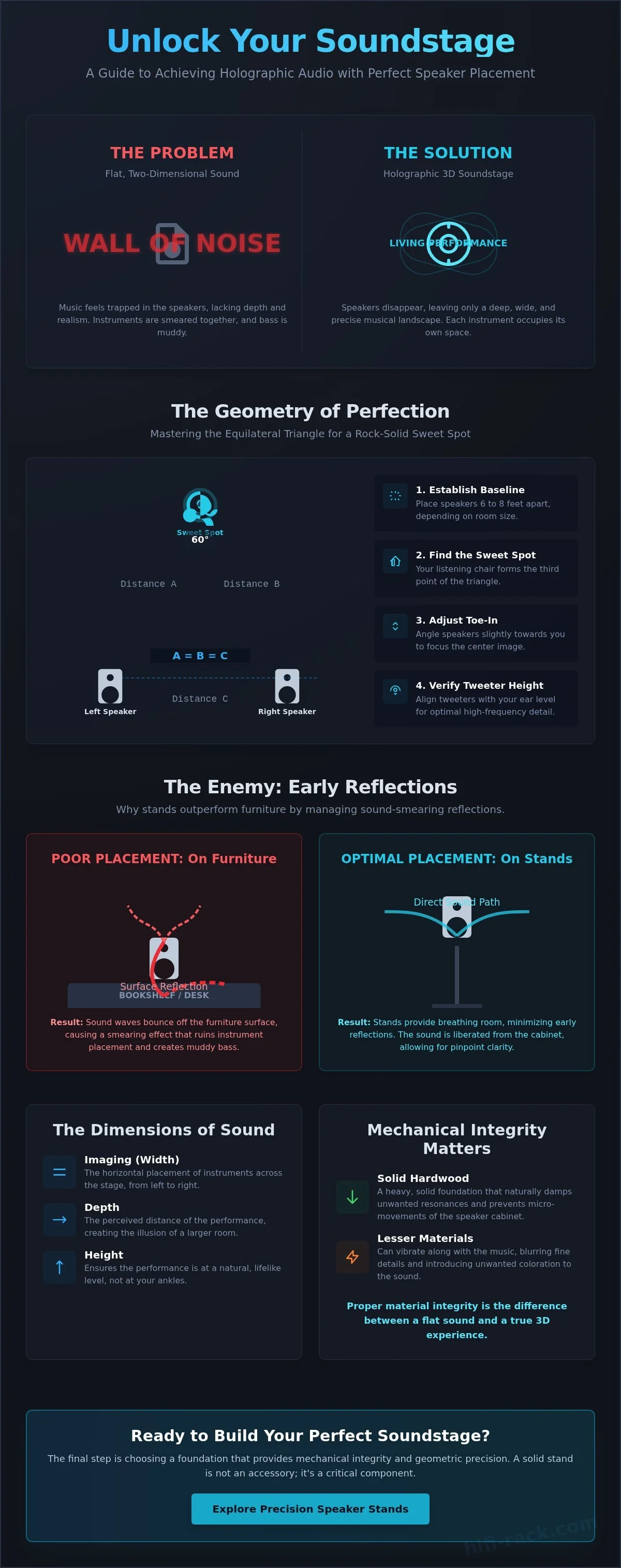
A soundstage is the three-dimensional architecture of your music. It is the invisible stage where the percussion sits behind the vocals and the strings bloom from the far corners of the room. Achieving the perfect speaker stand placement for optimal soundstage is about more than just finding the right height for your tweeters. It is about liberating the sound from the physical constraints of the cabinet and allowing it to breathe within your personal sanctuary.
When I first positioned my monitors on a pair of dedicated Speaker Stands, the change was visceral. The speakers seemed to vanish entirely. This "disappearing act" occurs when the brain can no longer localize the sound to a specific box. Instead, you are left with a holographic image that feels deeply authentic. This psychological shift transforms listening from a passive activity into a private concert, creating a soulful connection to the artist's original intent.
Stereo Imaging vs. Soundstage Depth
We often use these terms interchangeably, but they serve different roles in sensory perfection. Imaging refers to the horizontal placement of instruments across the stage. A well-placed system allows you to point exactly to where the guitarist is standing. Depth, however, is the perceived distance of the performance behind the back wall. It creates the illusion that your room has expanded. The foundations of Stereophonic sound rely on these spatial cues to trick the ear into perceiving a real environment. Proper placement also dictates the height of the image, ensuring the soloist isn't performing at your ankles but at a natural, lifelike level.
The Role of Early Reflections
One of the primary reasons stands outperform bookshelves is the management of early reflections. When a speaker sits on a flat piece of furniture, sound waves bounce off that surface almost instantly. This creates a smearing effect that ruins pinpoint instrument placement. Stands allow for the breathing room that furniture lacks. By moving the speaker away from boundaries, you reduce the intensity of first reflection points on the side walls. The mass of the stand also plays a critical role. A solid, heavy support stabilizes the acoustic center of the speaker. It prevents micro-movements of the cabinet that can blur the fine details of a recording. This mechanical integrity is the difference between a flat sound and a three-dimensional experience.
The Geometry of Perfection: Mapping the Equilateral Triangle
Geometry is the silent language of high-fidelity sound. It provides the skeletal structure upon which a holographic image is built. When we approach speaker stand placement for optimal soundstage, we aren't just moving furniture; we are aligning the physics of your room with the intent of the recording engineer. This process requires patience, a measuring tape, and a keen ear for the subtle shifts in the "phantom center."
Establish the baseline. Begin by determining the distance between your two speaker stands. A common starting point is six to eight feet, depending on your room size.
Measure the sweet spot. Your listening position should form the third point of the triangle. Ensure your chair is centered perfectly between the two stands.
Calculate the equilateral triangle. The distance between the speakers should ideally equal the distance from each speaker to your ears. This symmetry is the foundation of a balanced image.
Adjust toe-in. Angle the speakers slightly toward your seat. This snaps the central vocals into focus and prevents the sound from feeling "hollow."
Verify tweeter height. Verifying tweeter height is the final step in refining speaker stand placement for optimal soundstage, as it aligns the most delicate frequencies with your senses.
The 60-Degree Rule and Variations
The 60-degree angle is the traditional benchmark for stereophonic listening. It balances width and focus beautifully. However, the unique properties of Room acoustics often require small adjustments. If your room is narrow and highly reflective, narrowing the triangle can reduce side-wall interference. Conversely, widening the stance can enhance the scale of the performance, provided you don't lose the weight of the center image.
Toe-In: The Art of Pointing the Sound
Toe-in is the final touch of the master craftsman. By angling the speakers directly at your ears, you maximize high-frequency detail. If the sound feels too bright or aggressive, try "crossing" the speakers slightly behind your head. This off-axis listening often yields a smoother, more natural tonal balance. To ensure symmetry, I often use the "string method," running a line from the tweeter to the listening chair. For a deeper look at the vertical dimension, explore our guide on The Correct Height for Audiophile Speaker Stands. Our handcrafted Speaker Stands are designed to facilitate these precise adjustments, offering the stability needed for a truly locked-in image.
Managing Boundary Interference: The Science of Room Interaction
Every listening room possesses a unique acoustic personality. While geometry provides the map, the physical boundaries of your walls and floor dictate the final clarity of the performance. Boundary interference is the friction between your speakers and the room. When we refine speaker stand placement for optimal soundstage, we are essentially negotiating with these surfaces to ensure the music retains its intended purity. Without this negotiation, even the most expensive system can sound congested and small.
Rear walls are the primary guardians of soundstage depth. Shoving a speaker too close to the back wall often results in a collapsed image where the music feels trapped. Providing "breathing room," usually at least two to three feet, allows the acoustic image to develop behind the speakers. Similarly, side wall proximity causes reflections that arrive at your ears only milliseconds after the direct sound. This creates a "smearing" effect, making it difficult to pinpoint where one instrument ends and another begins. To combat these issues, many enthusiasts rely on practical speaker placement methods like the 1/3rd or 1/5th rules. These mathematical ratios help place your stands in positions where room modes and standing waves are naturally minimized.
Boundary gain is another factor to manage. Placing speakers in corners artificially inflates bass response. While this might seem beneficial at first, it almost always comes at the expense of texture and speed. The result is a "one-note" bass that masks the delicate mid-range frequencies. By moving your stands away from corners, you trade artificial weight for a clean, tight, and authentic low-end response.
Comb Filtering and Acoustic Smearing
Comb filtering occurs when reflected waves cancel out specific frequencies, leaving "holes" in the sound. You can find these trouble spots using a simple mirror; if you can see the speaker's reflection from your seat, that wall point needs attention. In my experience, the material of the stand is just as vital as its position. Solid wood stands help dampen floor-borne reflections more effectively than hollow metal alternatives. The organic grain structure of hardwood naturally dissipates energy, preventing the floor from becoming a secondary radiator of sound.
Optimizing for Small vs. Large Rooms
In compact spaces, a near-field setup is often the most rewarding path. This involves sitting closer to the speakers to minimize the room's influence. Choosing a long-wall placement can sometimes offer a wider soundstage, though it requires careful management of rear-wall reflections. For those working with limited square footage, The Slim HiFi Rack: High Isolation in a Compact Profile provides an elegant solution for maintaining mechanical integrity. Mastering speaker stand placement for optimal soundstage in a large room often involves more aggressive experimentation with the 1/5th rule to ensure the sound feels intimate rather than distant.
Mechanical Integrity: Why Stand Material and Isolation Outperform Simple Positioning
I have often observed enthusiasts spend weeks obsessing over speaker stand placement for optimal soundstage, only to ignore the mechanical foundation supporting the weight. A stand isn't just a pedestal; it's a critical component of the acoustic circuit. Every support structure possesses a resonant signature that either clarifies or obscures the delicate layers of a recording. If your stands vibrate in sympathy with the music, they become secondary sound sources. This vibration blurs the pinpoint instrument placement we worked so hard to achieve in the previous sections.
Mechanical integrity is about more than just a sturdy build. It is about the management of kinetic energy. When a speaker driver moves, it creates an equal and opposite force on the cabinet. Without a high-mass, well-damped stand, this energy results in "cabinet talk." These micro-vibrations are the enemy of a holographic soundstage. While the geometry we discussed earlier is vital, the mechanical integrity of your support system is what allows speaker stand placement for optimal soundstage to truly reach its potential. True high-fidelity sound isn't found in a single component but in the harmony of four pillars: precision, isolation, material, and soul.
The Problem with MDF and Veneer
Many commercial stands rely on MDF or thin veneers. These engineered materials often store energy and release it slowly, which smears the time-alignment of the sound. It's a subtle effect, but one that robs the music of its life. In contrast, solid hardwoods like oak, walnut, and cherry possess natural grain structures that act as internal dampers. This organic complexity dissipates resonance before it can reach the floor. We believe that the union of high-end engineering and organic beauty is the definitive promise of a transformative listening experience. You can explore the specific nuances of these materials in our guide on Solid Wood vs. Metal Speaker Stands: Sound Signature.
Spikes and Floor Protectors
Effective isolation requires a dual approach: decoupling the speaker from the stand and coupling the stand to the floor. For carpeted rooms, high-quality spikes are essential to penetrate the fibers and establish a mechanical ground with the subfloor. This prevents the stand from swaying, even by a fraction of a millimeter. If you are listening on hardwood, I recommend using brass protectors. They preserve your flooring while maintaining the rigid connection needed for a stable acoustic image. For a deeper technical dive, refer to Speaker Feet and Acoustic Isolation: The Complete Audiophile Reference. To see how these principles are embodied in our own workshop, explore our collection of handcrafted Speaker Stands.
Final Calibration: Integrating Reference Stands into Your Listening Space
The final calibration is where the science of acoustics meets the intuition of the listener. After establishing your baseline geometry and securing your mechanical foundation, the 'Master Set' method becomes your primary tool for soundstage lock-in. This involves making tiny, incremental movements of just a few millimeters at a time. We are looking for the "center fill," that magical moment when a vocalist seems to materialize in the room with startling realism. It is a process that requires a quiet mind and a patient ear, but the reward is a holographic experience that transcends the equipment itself.
Your listening room should feel like a sanctuary. While we often focus on the technical aspects of speaker stand placement for optimal soundstage, the visual and tactile elements are just as vital. A handcrafted stand, carved from honest materials, elevates the emotional energy of the space. It creates a sense of permanence and pride. When your eyes rest on the natural grain of the wood, it prepares your mind for the sensory journey ahead. This union of performance and artisanal beauty is what transforms a simple hobby into a life-altering passion.
The Iterative Listening Process
Choose tracks you know intimately. I often recommend recordings with a single, centered vocalist and minimal processing. Listen for the width of the stage first, then the depth. If the center image feels vague, move the stands closer together in one-inch increments. If the soundstage feels cramped, widen the stance. Patience is the master craftsman's most important tool during this phase. Always record your final measurements once you find the "lock." This allows you to return to your reference setup if you ever decide to experiment with different room treatments later on.
The HiFi Rack Commitment
We believe that every part of the signal chain should be an instrument of excellence. This is why we choose solid wood over veneer for every Speaker Stand we craft. Natural timber doesn't just look better; it performs with an integrity that engineered boards cannot match. For those seeking a unified aesthetic, matching your stands to a Reference Myro HiFi Rack ensures that your entire system is grounded in the same philosophy of mechanical isolation. By refining your speaker stand placement for optimal soundstage within this holistic environment, you aren't just setting up a system; you are curating a legacy of sound.
Cultivating Your Personal Sanctuary of Sound
The journey to a holographic soundstage is one of quiet discipline and technical precision. By mastering the geometry of your listening space and understanding the science of boundary interaction, you move beyond mere audio reproduction. You begin to experience music as the artist intended. Every millimeter of adjustment in your speaker stand placement for optimal soundstage brings you closer to that elusive "disappearing speaker" effect, where the equipment fades and only the performance remains.
This transformation requires a foundation built on mechanical integrity. In our Novi Sad workshop, we rely on multi-generational woodworking traditions to craft supports that offer absolute structural rigidity. We never use MDF or veneer; instead, we favor solid hardwoods that naturally dampen resonance. It's a commitment to excellence that ensures your system remains a source of inspiration for a lifetime. Our designs prioritize acoustic isolation to protect the purity of your signal chain, allowing the organic beauty of the music to shine through.
Discover our handcrafted Speaker Stands and Reference Racks
Take the time to slow down and appreciate the finer details of your setup. Your pursuit of sensory perfection is a noble one, and we're honored to be a partner in your high-end pursuit.
Frequently Asked Questions
How far should speaker stands be from the back wall for the best sound?
Aim for a distance of two to three feet between the rear of your speakers and the back wall. This spacing provides the necessary "breathing room" to prevent bass energy from reflecting too quickly, which often results in a muddy or congested low end. Proper distance allows the acoustic image to develop behind the speakers, creating the depth required for a truly holographic soundstage.
Should I toe-in my speakers towards my ears?
Most speakers benefit from being angled slightly toward your listening position to focus the high-frequency energy. This adjustment helps snap the phantom center into place, making vocals feel like they are hovering directly in front of you. I suggest starting by pointing the speakers at a spot just behind your head and then adjusting in tiny increments until the stereo image feels both wide and stable.
Are wood speaker stands better than metal for sound quality?
In our experience, solid wood is the superior choice for damping unwanted vibrations. Unlike hollow metal stands that can ring or resonate like a bell, solid hardwoods like oak or walnut possess natural grain structures that dissipate micro-vibrations. This organic integrity ensures that your speaker stand placement for optimal soundstage isn't compromised by the stand's own resonant signature, resulting in a cleaner, more authentic performance.
How high should my speaker stands be?
Your speaker stands should be tall enough to bring the tweeters to the same level as your ears when you are seated. High-frequency sounds are directional; even a small vertical deviation can result in a loss of fine detail and clarity. Most listeners find that a height of 24 to 28 inches provides the ideal alignment for standard lounge seating, ensuring the soloist performs at a natural, lifelike height.
What is the 'Sweet Spot' in a listening room?
The sweet spot is the precise location in your room where the stereo image is most vivid, balanced, and three-dimensional. It is typically the apex of an equilateral triangle formed by your two speakers and your head. In this position, the arrival times of the sound from both channels are perfectly synchronized, allowing you to experience the full architectural depth of the original recording.
Do I need spikes if I have hardwood floors?
You shouldn't use bare spikes on hardwood floors because they will cause permanent damage to the wood. Instead, utilize brass floor protectors or specialized isolation feet to preserve your flooring while maintaining a rigid connection. These accessories provide the mechanical grounding required for a stable acoustic image without sacrificing the aesthetic beauty of your personal sanctuary.
Can I use bookshelf speakers on a desk instead of stands?
Using bookshelf speakers on a desk is rarely ideal because the flat surface creates immediate early reflections that smear the sound. These reflections often bloat the bass and blur instrument placement. Moving your monitors to dedicated Speaker Stands decouples them from the furniture and allows for much more flexible speaker stand placement for optimal soundstage, liberating the music from the confines of your desk.