

How to Choose the Right Wood for an Audio Rack: An Audiophile’s Guide
Is your audio rack a silent partner or a noisy intruder? For years, I believed that as long as a shelf was level and sturdy, it was doing its job. I was wrong. Your rack isn't just a place to rest your gear; it's a complex acoustic filter defined by its cellular density and grain structure. If you've ever felt a "muddiness" in your mid-range or watched a turntable needle jump because of a bouncy floor, you know that unwanted resonance is the enemy of high-fidelity sound. It's frustrating to spend thousands on precision electronics only to have their performance masked by the very furniture supporting them.
I understand the struggle of separating marketing hype from the physical reality of vibration management. In this guide, I'll show you how to choose the right wood for an audio rack by diving into the science of timber. You'll discover how Janka hardness ratings directly influence vibration damping and learn why specific hardwoods like walnut, oak, and cherry offer distinct sonic signatures. By the end, you'll have the clarity needed to select a timber that elevates your system's performance and serves as a lifetime investment for your personal sanctuary.
Key Takeaways
Understand the audio rack as a vital instrument in your signal chain that uses its unique cellular structure to absorb and filter unwanted resonance.
Learn why solid hardwoods outperform energy-dampening composites like MDF by managing vibration and heat more effectively for clearer sound.
Discover how to choose the right wood for an audio rack by matching species like European Walnut or rigid Oak to your system’s specific tonal requirements.
Identify the critical relationship between shelf thickness and your system’s noise floor to ensure a lifetime of stable, high-fidelity performance.
Explore the philosophy of artisanal craftsmanship and why choosing raw, solid timber is an investment in both sensory perfection and structural integrity.
Table of Contents
The Acoustic Signature of Solid Wood: Why Material Choice Matters
Evaluating Audiophile Hardwood Species: Walnut, Oak, and Cherry
The HiFi Rack Philosophy: Artisanal Excellence from Novi Sad
The Acoustic Signature of Solid Wood: Why Material Choice Matters
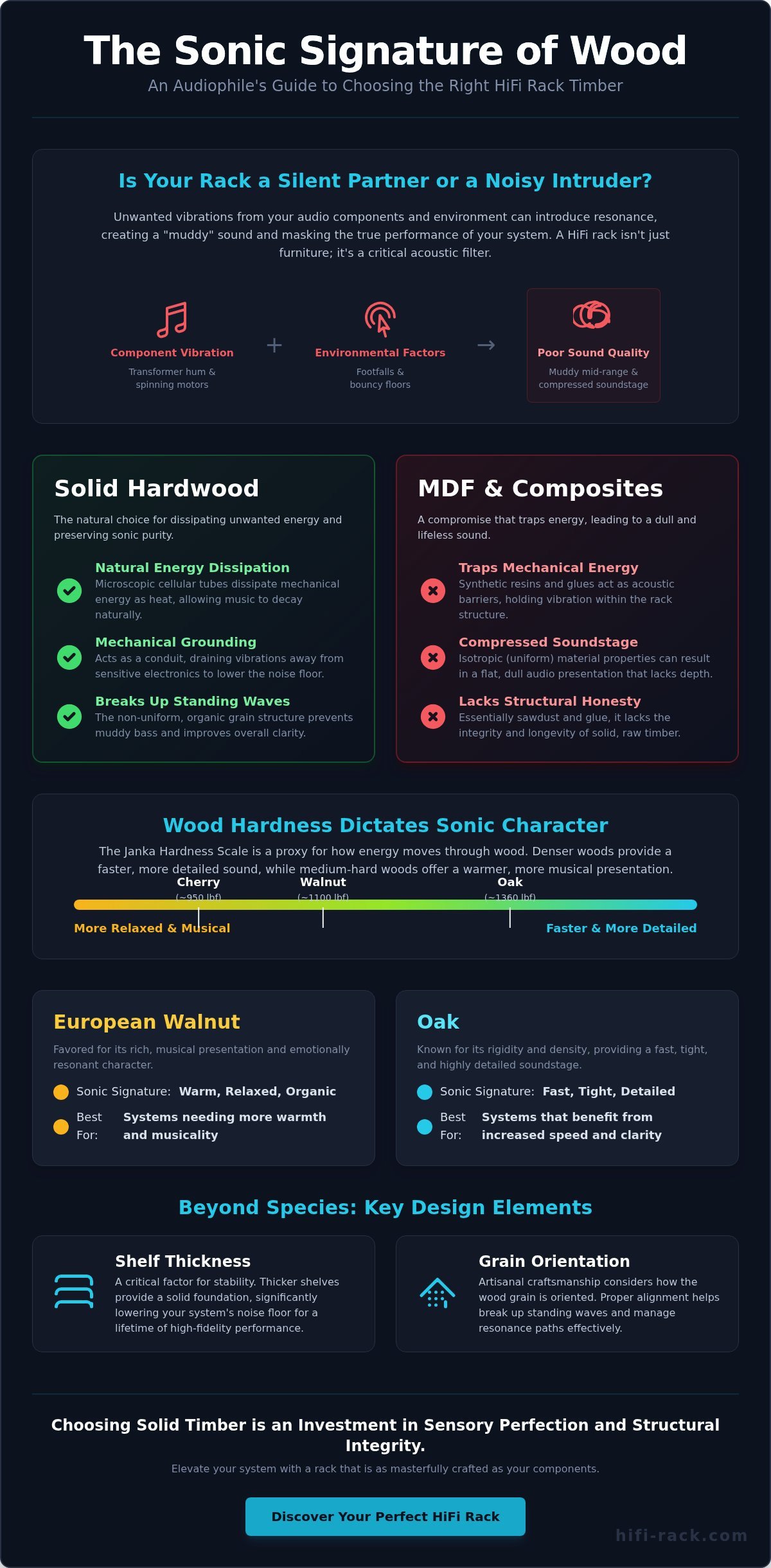
Your HiFi rack acts as the final stage of your system's mechanical grounding. It's a vital instrument in the signal chain, not just a shelf. Every transformer hum and spinning motor creates micro-vibrations that can color your audio signal. Solid wood manages these through its unique cellular structure. Unlike synthetic materials, wood is composed of millions of microscopic tubes that act as natural dampers. These tubes, which once transported water in a living tree, now serve to trap and dissipate mechanical energy. This is why knowing how to choose the right wood for an audio rack is essential for anyone pursuing sonic perfection.
Density and the Janka Hardness Scale
The Janka Hardness Scale measures the force required to embed a steel ball into wood. For an audiophile, this is a proxy for how energy moves through the rack. Higher density timber shifts the resonance frequency of the rack higher, effectively moving mechanical noise away from the delicate frequencies where our ears are most sensitive. Extremely hard woods provide a fast, tight soundstage with incredible detail. Medium-hard woods, such as walnut, tend to offer a more relaxed and musical presentation that many find more emotionally resonant. The choice depends entirely on whether your system needs more speed or more warmth.
Natural Resonance Damping vs. Artificial Damping
The magic lies in the relationship between lignin and cellulose. These organic polymers dissipate kinetic energy as heat. This process allows for a more natural decay in your music, preserving the air around instruments. While some designers aim for an acoustically dead rack using heavy dampening or lead-filled tubes, this often results in a sterile, lifeless sound. Solid wood provides a more nuanced balance of coupling and decoupling. It allows energy to flow out of your components while preventing floor-borne vibrations from entering. Understanding the acoustic properties of different wood species is the first step in mastering this balance. For a deeper dive into specific builds, consult The Ultimate Guide to Choosing a Solid Wood HiFi Rack. Learning how to choose the right wood for an audio rack means finding the harmony between structural rigidity and organic resonance. It's about letting the music breathe.
Why Solid Hardwood Outperforms MDF and Veneers
Many budget-conscious setups rely on Medium Density Fibreboard (MDF). It's inexpensive and easy to mass-produce. However, in the pursuit of sensory perfection, MDF is a fundamental compromise. It lacks the organic soul and structural honesty required to support high-fidelity components. When you understand how to choose the right wood for an audio rack, you realize that "neutrality" shouldn't mean "lifelessness." MDF is often marketed as an isotropic material, meaning it has the same properties in all directions. In the world of audio, this often translates to a dull, compressed soundstage that fails to let your music breathe.
The Energy Transfer Problem
MDF is essentially sawdust held together by high concentrations of synthetic resins and glues. These chemical binders act as acoustic barriers. They trap mechanical energy rather than allowing it to drain away from your sensitive electronics. Scientific research into the sound absorption properties of wood shows that solid timber offers a more complex and beneficial interaction with vibration. Solid hardwood acts as a natural conduit for mechanical grounding. The non-uniform path of natural grain breaks up standing waves. This prevents the "muddy" bass response often associated with composite racks. By providing a clear path for energy to dissipate, solid wood keeps the noise floor low and the clarity high.
Longevity and Structural Integrity
High-end audio gear is heavy. A high-bias Class-A amplifier or a heavy-platter turntable can easily exceed 30 kilograms. Over time, MDF shelves tend to sag under this constant load. It's a slow, inevitable failure that compromises the leveling of your system. Racks like the Classic Myro HiFi Rack are built to endure for generations. We use joinery that respects the wood's movement and inherent strength. Beyond durability, there's the question of environmental ethics. We prioritize the sustainability of solid wood over the chemical-laden production of composites. Choosing solid timber is an investment in a piece of art that lives in harmony with your home.
Veneers are merely a facade. They're thin slices of beauty glued over a cheap, unstable core. Eventually, they peel, bubble, or chip at the edges. Solid timber ages with grace. It develops a patina that tells the story of your listening journey. For a deeper look at these material differences, read The Audiophile’s Guide to Custom Hardwood Audio Furniture. If you're ready to move beyond the limitations of composites, explore our collection of handcrafted solid wood racks to find the perfect foundation for your system.
Evaluating Audiophile Hardwood Species: Walnut, Oak, and Cherry
Selecting a timber species isn't merely a matter of interior design. It's an intentional act of tuning your system's final output. If you're wondering how to choose the right wood for an audio rack, you must first understand that each species carries a unique sonic fingerprint. While the previous sections explored the physics of vibration, we now focus on the emotional and technical characteristics of the woods that define high-fidelity listening. From the crystalline precision of Oak to the soulful warmth of Walnut, your choice will dictate the atmospheric quality of your listening room.
Walnut: The Balanced Performer
European Walnut is widely considered the gold standard for audiophile furniture. It offers a sophisticated balance between warmth and transparency, allowing the true character of your components to shine through without adding unwanted coloration. Unlike American Black Walnut, the European variety often possesses a slightly higher density, providing superior structural rigidity for sensitive source components. Scientific studies on the acoustic properties of wood indicate that Walnut’s internal friction is ideal for dissipating high-frequency energy. European Walnut's specific gravity and internal damping characteristics make it the definitive choice for the Reference Myro HiFi Rack, providing a platform that eliminates micro-vibrations without sacrificing the natural decay of the recording.
Oak and Ash: For the High-Mass System
If your system features heavy Class-A power amplifiers or massive power supplies, Oak and Ash are your primary allies. These woods are defined by their incredible load-bearing capacity and high density. Sonically, Oak provides a fast and tight response, particularly in the lower frequencies. It’s a choice that favors precise imaging and a wide, holographic soundstage. Ash shares many of these characteristics but often presents a slightly different grain density that can be even more effective at breaking up standing waves. Both species excel at mechanical grounding, ensuring that the sheer mass of your equipment doesn't lead to energy storage that could blur the musical timing.
Cherry wood occupies a unique niche for those who prioritize vocal clarity and acoustic instruments. It has a slightly more resonant character than Oak, which some listeners describe as a "sweeter" sound. It's an evocative choice for jazz and chamber music, where the organic texture of the wood complements the timbres of the performance. Beyond the sound, the visual harmony of your space matters. To achieve a cohesive aesthetic and sonic environment, many enthusiasts choose to match their primary racks to their speaker stands. This creates a unified sanctuary where the craftsmanship of the furniture reflects the quality of the sound it supports. Understanding these nuances is the key to mastering how to choose the right wood for an audio rack that lasts a lifetime.
Beyond Species: Grain Orientation and Shelf Thickness
Selecting the timber species is the first movement in your system's acoustic tuning. The second movement is the architecture of the rack itself. When you are learning how to choose the right wood for an audio rack, you'll find that physical dimensions are just as critical as the wood's density. The thickness of a shelf isn't merely for visual presence. It's a calculated decision to lower the noise floor of your equipment. By increasing the mass of the support, we shift the resonant frequency lower, moving it away from the sensitive operating range of your components. This ensures that the energy from your speakers doesn't find its way back into your turntable's stylus or your amplifier's tubes.
Precision machining and grain orientation serve as the silent guardians of your audio signal. Wood is a living, breathing material that reacts to the humidity and temperature of your home. Without expert joinery and intentional grain alignment, even the finest hardwood can warp over time. This movement can compromise the perfect leveling required for high-end turntables. Our artisanal approach utilizes cross-grain construction to ensure that each shelf remains a stable, non-resonant platform for generations. This structural honesty is what separates a lifetime investment from a temporary furniture piece.
The Role of Mass in Vibration Control
Mass loading is essential for managing the kinetic energy generated by spinning motors and massive transformers. For a turntable isolation platform, we recommend a thickness of at least 40mm. This extra mass creates a high degree of inertia, making the shelf much harder to set into motion by external vibrations. In contrast, a 20mm shelf might be sufficient for lighter digital sources but can lack the damping capacity needed for heavy power amplifiers. The Reference Myro HiFi Rack utilizes this 40mm approach to provide an ultra-low center of gravity, effectively grounding your system to the floor.
Seasoning and Stability
Kiln-dried hardwood is non-negotiable for precision audio furniture. We ensure our timber is dried to a specific moisture content to prevent the wood from "fighting" itself once it's in your listening room. If the moisture content is too high, the wood will shrink and expand aggressively, leading to cracks and instability. This seasoning process also influences the acoustic resonance of the timber. Properly dried wood has a more predictable and pleasing decay, ensuring that your rack doesn't add unwanted ringing to your music. Maintaining this stability is how we guarantee your rack remains perfectly level for life.
Thermal management is another often-overlooked benefit of solid wood designs. Unlike metal or glass, which can reflect heat back into your components, solid timber allows for a more natural thermal exchange. If you are ready to provide your system with the foundation it deserves, explore our full range of handcrafted audio racks and discover the difference that precision woodworking makes to your sound.
The HiFi Rack Philosophy: Artisanal Excellence from Novi Sad
In our Novi Sad workshop, the art of listening meets a multi-generational legacy of woodworking. We don't see ourselves as furniture makers. We are instrument builders. Every cut we make is informed by a deep-seated passion for high-fidelity sound and a reverence for the materials we use. Understanding how to choose the right wood for an audio rack is only half the battle; the other half is finding a craftsman who refuses to compromise on the execution. This is why we strictly avoid MDF and veneers. We believe that true excellence cannot be built on a foundation of glue and sawdust. Our philosophy rests on four pillars: the integrity of the material, the precision of the joinery, the soul of the wood, and the purity of the sound.
The Reference Myro: Our Flagship Statement
The Reference Myro is our attempt to create a rack that simply disappears. We want you to hear your turntable, your tubes, and your recordings, not the shelf they sit on. The wood selection for this series is the result of exhaustive testing of grain patterns and density profiles. We look for timber that offers the perfect balance of rigidity and internal damping. This same dedication to artisanal excellence is present in our smaller designs. The Minimal Myro HiFi Rack provides the same high-end performance for compact spaces, ensuring that even a modest setup can benefit from the acoustic properties of solid hardwood. It's a bespoke solution for a global community that values quality over convenience.
Crafting Your Personal Sanctuary
Your listening room is more than a place for equipment; it's a personal sanctuary. The objects within it should reflect the transformative effect that music has on your life. There is a quiet confidence in the feel of hand-finished Walnut or Oak that mass-produced alternatives can never replicate. When you touch the surface of a hand-rubbed shelf, you feel a connection to the manual craftsmanship and the raw quality of the material. This sensory reward is the emotional payoff of an uncompromising pursuit of excellence. We don't treat your interest as a casual pastime; we treat it as a life-altering passion that deserves a worthy foundation.
By aligning high-end performance with natural aesthetics, we offer a definitive promise of sensory perfection. Your audio rack should be a lifetime investment, a piece of art that ages with grace alongside your most cherished components. We invite you to explore our full range of solid wood solutions and discover the difference that artisanal pride makes to your listening experience. Let us help you build a space where form and function exist in perfect harmony, allowing you to slow down and appreciate the finer details of the music you love.
Elevate Your Listening Experience
Your journey toward sensory perfection ends where the music begins: at the foundation. We've explored how cellular density acts as a natural acoustic filter and why solid hardwood provides a structural honesty that synthetic composites simply cannot match. By aligning the right timber species with precise shelf thickness, you move beyond mere equipment storage and into the realm of intentional acoustic tuning. Learning how to choose the right wood for an audio rack is about more than just physics; it's about honoring the art of listening through artisanal excellence.
In our Novi Sad workshop, we continue a multi-generational family woodworking tradition, handcrafting each piece from raw, solid timber. We strictly avoid MDF and veneers to ensure your rack remains a lifetime investment, and we ship our bespoke creations to audiophiles worldwide. Your system deserves a platform built with the same passion you bring to your music. It's time to provide your components with the sanctuary they deserve, where every note is allowed to breathe in its purest form.
Explore the Reference Myro and find your perfect hardwood match
Frequently Asked Questions
Is solid wood better than MDF for a HiFi rack?
Yes, solid wood is significantly better than MDF because it acts as a natural conduit for mechanical energy. While MDF uses synthetic resins that trap vibrations, solid timber utilizes its organic cellular structure to dissipate resonance as heat. This results in a cleaner signal and a more natural musical decay. Beyond sound, solid wood provides the structural integrity needed to support heavy high-end components without sagging over time.
Which wood has the best acoustic properties for audio equipment?
European Walnut is widely favored by connoisseurs for its exceptionally balanced acoustic profile. It manages to provide a sense of organic warmth while maintaining the transparency required for high-resolution systems. Other species like Oak or Ash are excellent for high-mass setups where maximum rigidity is required. The best wood depends on whether your system needs the fast, tight response of Oak or the soulful character of Walnut.
How does wood density affect the sound of a turntable?
Wood density dictates the speed at which vibrations move through the rack and the frequency at which the material resonates. Using a dense hardwood shifts the resonant frequency higher, effectively moving mechanical noise out of the range where it interferes with your turntable's delicate signal. This creates a lower noise floor, allowing you to hear subtle details in the soundstage that were previously masked by mechanical hum.
Should I choose a hard or soft wood for my audio furniture?
Hardwood is the only appropriate choice for high-fidelity audio furniture. Softwoods are too porous and lack the necessary mass to provide effective mechanical grounding. They also tend to store energy rather than dissipate it, which can result in a blurred or slow sound. Hardwoods like Walnut, Oak, and Cherry offer the structural stability and density required to keep your components isolated and your audio signal pure.
Does the thickness of the wood shelf matter for sound quality?
Shelf thickness is a critical factor in lowering your system's noise floor. A thicker shelf increases the mass of the support, which raises the amount of energy required to set the platform into motion. This is why we utilize 40mm shelving for our reference designs. It ensures that the rack remains an inert foundation, preventing external vibrations from coloring the sound of your sensitive electronics.
Can a solid wood rack help stop my turntable from skipping?
A solid wood rack helps prevent skipping by providing a high-inertia platform that absorbs floor-borne vibrations. By using dense timber and precision joinery, the rack becomes a stable anchor that isolates the turntable from footfalls and other mechanical shocks. When you understand how to choose the right wood for an audio rack, you can select a high-mass species that effectively grounds your turntable to the floor.
What is the Janka hardness scale and why should audiophiles care?
The Janka hardness scale measures the force required to embed a steel ball into wood, providing a verifiable metric for timber density. Audiophiles care about this scale because it helps predict how a specific species will manage resonance and vibration. A higher Janka rating typically indicates a wood that will provide a faster, more detailed sound, while a medium rating suggests a more relaxed and musical presentation.
Why does HiFi Rack avoid using veneers in their products?
We strictly avoid veneers because they are thin facades that hide unstable, low-quality cores like MDF. In our pursuit of sensory perfection, we believe every part of the rack must contribute to the acoustic performance. Veneers eventually peel or bubble, compromising both the aesthetic and the structural integrity of the piece. Solid timber is a lifetime investment that ages with grace and maintains its sonic signature for generations.