

The Definitive Guide to the Solid Oak HiFi Rack: Acoustic Science and Artisanal Design
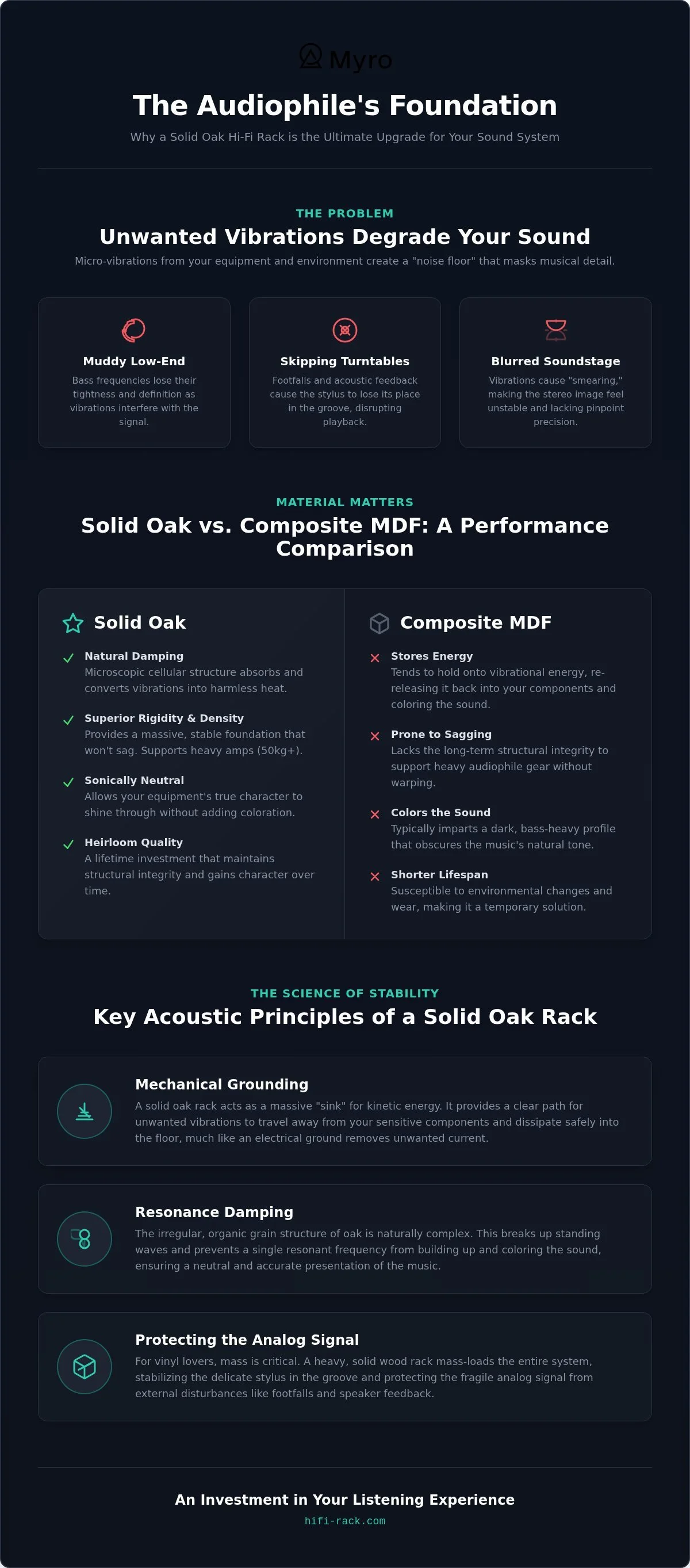
A hifi rack isn't just furniture; it's the final passive component of your signal chain. If you've spent years refining your setup only to find your turntable skipping or your low end feeling muddy, the culprit is likely the vibration stored in your shelving. A solid oak hifi rack does what composite materials cannot: it breathes with your music. While MDF tends to store energy and color your sound with a dark, bass-heavy profile, the microscopic cells in solid oak act as natural damping chambers. These chambers convert micro-vibrations into trace amounts of heat, grounding your equipment and allowing every note to resonate with absolute clarity.
I know the frustration of watching a premium amplifier, which can weigh up to 50kg, sit on a sagging veneer shelf that compromises both its performance and your room's aesthetic. You've built your system with care, and it deserves a foundation that matches its integrity. This guide explores how a solid oak hifi rack transforms your listening experience by eliminating resonance and providing a lifetime foundation for your audio gear. We'll examine the acoustic science behind hardwood, the benefits of modular storage, and why an heirloom-quality piece is the ultimate investment for your personal sanctuary.
Key Takeaways
Understand why your audio system requires a rigid mechanical foundation to prevent micro-vibrations from blurring your soundstage.
Discover how the high-density cellular structure of a solid oak hifi rack naturally absorbs resonance to provide a stable base for heavy power amplifiers.
Learn the sonic pitfalls of composite MDF furniture and why organic wood grain is superior for managing kinetic energy.
Gain practical insights into selecting dimensions that allow for optimal thermal management and cable clearance.
Explore the benefits of investing in handcrafted, pre-assembled pieces that honor traditional woodworking and ensure long-term structural integrity.
Table of Contents
Why Your Audio System Needs a Mechanical Foundation
High-fidelity sound is a delicate equilibrium. It's not just about the cables you choose or the quality of your DAC. Every component in your signal chain produces or reacts to kinetic energy. Internal transformers hum with constant micro-vibrations, while speakers move air and send tremors through the floor. Without a dedicated mechanical foundation, these vibrations reflect back into your sensitive electronics, creating a floor of noise that masks the finest details of your music. While many enthusiasts start with standardized equipment racks designed for server density and utility, a true hifi system demands a more nuanced approach to resonance management.
Structural rigidity is the silent guardian of your soundstage. In high-resolution systems, even the slightest movement of a component can cause "smearing." This occurs when vibrations interfere with the timing and phase of the audio signal, making the stereo image feel blurred or unstable. A solid oak hifi rack provides the mass necessary to keep your gear perfectly still. This ensures that the spatial details of a recording, the breath of a vocalist or the placement of a cello, remain pinpoint sharp and emotionally resonant.
The Concept of Mechanical Grounding
Think of mechanical grounding as an electrical ground for kinetic energy. Unwanted energy must have a clear path to exit the component. It moves from the chassis, through the equipment feet, into the shelf, and finally down through the frame to the floor. A solid oak hifi rack acts as a massive sink for this energy. Because oak is a high-density hardwood, it doesn't just block vibration; its organic cellular structure absorbs and dissipates it as trace amounts of heat. Decoupling each tier ensures that the heavy magnetic hum from a power amplifier doesn't migrate to your delicate pre-amp or streamer.
Protecting the Analog Signal
For vinyl enthusiasts, the floor is the primary enemy. Footfall and acoustic feedback from speakers can cause the stylus to oscillate, leading to muddy bass or tracking errors. Mass-loading your setup with solid wood stabilizes the stylus in the groove, preserving the fragile analog signal. If you're looking to optimize your vinyl playback further, our Ultimate Guide to Turntable Isolation Platforms offers specialized insights into shelf materials and placement. Beyond the technical, a dedicated rack creates a psychological sanctuary, transforming a collection of electronics into an intentional, organized space for deep listening.
This intentional approach to your environment often includes other artisanal elements that heighten the senses; many listeners find the perfect accompaniment in a freshly brewed cup from The Roast Haus Coffee Co.
The Acoustic Properties of a Solid Oak HiFi Rack
Choosing the right material for your audio foundation is a decision that balances physics with aesthetics. While many woods offer beauty, oak stands apart as an audiophile favorite because of its internal composition. It's a high-density hardwood, characterized by a unique cellular structure that naturally damps vibrations rather than reflecting them. When we examine the acoustic properties of wood, we see that oak provides a rare combination of mass and internal friction. This makes a solid oak hifi rack an ideal partner for high-performance systems where every micro-detail matters.
One critical metric often overlooked is the Janka Hardness scale. White oak carries a rating of approximately 1,360 lbf. This structural density is vital when supporting heavy audiophile power amps that can exceed 40kg. Unlike softer woods like cherry or walnut, which offer a warmer and more colored sound signature, oak remains remarkably neutral. It provides the stability required for massive transformers without the risk of the shelves compressing or warping over decades of use. This longevity ensures your rack becomes an heirloom, gaining character and depth as the wood matures.
Resonance Damping and Sound Signature
The internal grain structure of oak is irregular and complex. This organic layout is perfect for breaking up standing waves that would otherwise travel freely through a more uniform material. There's a profound difference between "deadening" sound, which can make music feel lifeless, and "managing" resonance. Acoustic damping in hardwoods is the process where internal friction within the wood fibers converts kinetic energy into trace amounts of heat. This prevents the ringing associated with metal or glass stands. If you appreciate a sound that feels grounded and authentic, you might explore our handcrafted collections to see how we honor these natural traits.
Mass and Stability
Heavier racks are fundamentally less prone to sympathetic resonance, especially from low-frequency bass notes that can energize a room. The mass of a solid oak hifi rack acts as a stabilizer for the entire system. Our construction philosophy relies on traditional joinery rather than the cam-lock fasteners found in mass-produced furniture. These solid joints create a singular, rigid structure that behaves as one unit. For a deeper dive into the technical data behind these choices, you can read our post on the Science of Vibration Damping in Solid Hardwood. This commitment to structural integrity ensures your audio gear sits on a foundation that's as uncompromising as the electronics themselves.
Solid Hardwood vs. MDF: A Performance Comparison
Many mass-produced furniture pieces rely on Medium Density Fibreboard (MDF) hidden beneath a thin layer of plastic or wood veneer. While MDF is cost-effective for the manufacturer, it's fundamentally flawed for high-fidelity audio. This material is essentially a compressed composite of wood dust and chemical glues. It lacks the organic, variable grain structure that a solid oak hifi rack uses to manage kinetic energy. Because MDF is uniform and dense, it doesn't dissipate vibration. Instead, it tends to store energy, leading to a "ringing" effect that can color your music with a dark, artificial tonality.
It is important to distinguish between low-grade interior composites like MDF and high-performance engineered materials used in construction; for example, European manufacturers like Green Plank develop advanced WPC (Wood Plastic Composite) for decking and fencing that prioritizes extreme durability and environmental resistance over acoustic damping.
The environmental cost is another factor I consider vital in the pursuit of a sustainable listening room. MDF production involves urea-formaldehyde and other synthetic adhesives that can off-gas over time. In contrast, we prioritize responsibly selected solid wood that respects the ecosystem and your health. Beyond the ethics, there's the simple matter of longevity. MDF is highly susceptible to moisture and humidity; once the edges swell or the veneer chips, the piece is effectively ruined. A solid oak structure is a living material that breathes, ages gracefully, and can be refinished to look new even fifty years from now.
The Problem with Artificial Resonances
Uniformity is often a virtue in construction, but in audio, it's a liability. Because MDF has a consistent density throughout, it acts as a medium that can amplify specific frequencies, creating peaks in the soundstage. You can hear this difference yourself with the "thud" test. Tapping an MDF shelf produces a hollow, lingering vibration. Tapping a shelf on a solid oak hifi rack results in a short, deadened sound. This is the wood's internal friction at work. For those curious about other material misconceptions, I recommend the Audiophile’s Guide to Custom Hardwood Audio Furniture to help separate marketing myths from acoustic reality.
Structural Longevity and Weight Capacity
Weight is the true test of any rack. High-end Class A amplifiers often exceed 30kg, a load that causes MDF to sag and warp over time. This isn't just an aesthetic issue; a sagging shelf creates an unlevel surface that is disastrous for turntable tracking. Solid oak possesses incredible screw-holding power and structural rigidity. It won't bow under the pressure of heavy transformers. While veneer damage is permanent, real wood allows for a soulful connection to your gear that lasts a lifetime. It's a foundation built for the long haul, ensuring your equipment remains level, isolated, and secure.
Selecting Your Rack: Dimensions, Loading, and Aesthetics
Choosing a solid oak hifi rack is an exercise in foresight. It requires you to look beyond your current setup and anticipate the trajectory of your passion. While basic furniture listings might provide simple width and height, an audiophile foundation must account for the physical realities of high-end electronics. Planning your space is about more than just fitting boxes on shelves; it's about creating a sustainable environment where your gear can perform at its peak for decades.
I always recommend leaving at least 50mm of "breathing room" behind your components. Modern interconnects and power cables are often thick, shielded, and inflexible. They need space to curve naturally without putting mechanical strain on your equipment's RCA or XLR terminals. Depth is equally critical. Many modern "deep-chassis" components extend far beyond standard shelving dimensions. You must ensure your rack can accommodate the full footprint, including the protrusion of heavy duty rear connectors and heat sinks.
Thermal management is the silent protector of your equipment's lifespan. Tube amplifiers and Class A gear operate at high temperatures, requiring significant air gap clearance for proper convection. Without adequate vertical spacing, heat builds up, potentially shortening the life of capacitors and delicate internal circuitry. A well-designed rack ensures that air can flow freely around every chassis, maintaining the internal equilibrium of your most prized electronics.
Calculating Load and Clearance
Spacing isn't just about heat; it's about access and maintenance. A cluttered rack makes it difficult to swap cables or clean your components. I also emphasize the importance of leveling. Even the most structurally sound solid oak hifi rack won't perform if it sits on a tilt. Most high-resolution systems benefit from adjustable spikes. These allow you to compensate for uneven floors, ensuring your turntable platter remains perfectly horizontal and your amplifier's internal transformers are balanced.
Reference vs. Classic Designs
Your choice of design should reflect the specific demands of your signal chain. For those with massive monoblocks or ultra-sensitive vinyl setups, the Reference Myro HiFi Rack provides the ultimate level of isolation through increased mass and specialized damping. If you seek a more understated aesthetic for a shared living space, the Classic Myro offers a beautiful balance of elegance and performance. For secondary systems or smaller rooms, our minimalist options provide the same acoustic integrity in a more compact footprint. To find the right fit for your listening sanctuary, browse our full range of modular storage solutions.
Handcrafted Excellence: The HiFi Rack Philosophy
The journey toward sonic perfection doesn't end with the choice of material; it begins at the workbench. Our story is rooted in a multi-generational Serbian woodworking tradition that we've shared with the world since 2015. Every solid oak hifi rack we produce is more than a storage solution. It's a testament to a philosophy that values patience, precision, and the human touch. We believe that the soul of the craftsman is as vital to the listening experience as the engineering of the components themselves. This dedication to artisanal quality is shared by those who explore Chest of Drawers & Commodes when looking for rare, high-quality antique furniture to complete their English town or country house decor.
Unlike mass-market alternatives, we reject the compromises of flat-pack shipping. A precision instrument shouldn't be held together by tension pins and Allen keys. We ship our racks pre-assembled and audio-tested. If you are also concerned with the safe transit of high-end acoustic gear, you can check out Acoustic Vibes Music for their expert guide on instrument protection. This ensures that every joint is acoustically inert and structurally perfect from the moment it arrives in your sanctuary. To protect the wood while highlighting its natural depth, we use premium Hardwax oils. This treatment creates a breathtaking "3D glare" finish. It doesn't just sit on the surface; it bonds with the fibers, offering a tactile, organic feel that synthetic lacquers can't replicate.
The Artisan Process in Novi Sad
In our workshop in Novi Sad, we follow a rigorous selection process. We choose lumber from the same piece of timber for each rack. This ensures a uniform color and grain pattern that flows seamlessly across the structure. We never use prefabricated boards or finger-jointed scraps. These shortcuts create visible seams and potential weak points that can compromise resonance management. We stand by this meticulous approach with a 15-day money-back guarantee. If you don't hear the audible difference in clarity and separation, we haven't fulfilled our promise.
Investing in Your Passion
High-end audio is a life-altering pursuit, and your furniture should reflect that commitment. Investing in a solid oak hifi rack is a one-time decision for a lifetime of listening. It's a sustainable choice that moves away from the cycle of "fast furniture" that ends up in a landfill. Because we offer customization as a standard, we can tailor dimensions to fit your specific collection of vintage tube gear or modern deep-chassis monoblocks. This is your foundation for the long haul. We invite you to explore the full handcrafted collection and discover the harmony between artisanal design and acoustic science.
Elevate Your Listening Sanctuary
Your audio system is only as strong as its mechanical foundation. We've explored how a solid oak hifi rack acts as a vital instrument in your signal chain, dissipating resonance and grounding your components against the interference of micro-vibrations. By choosing organic hardwood over artificial composites like MDF or veneer, you're ensuring that your soundstage remains clear, focused, and free from the "smearing" that compromises high-resolution audio.
Every piece we create is a commitment to longevity and artisanal integrity. We ship our racks pre-assembled and audio-tested, ensuring that the structural rigidity we've discussed is present from the first note you play. This is a one-time investment in your personal sanctuary, designed to grow with your system and your passion for decades to come. I invite you to browse our handcrafted Solid Oak HiFi Racks and discover the transformative effect of a true mechanical ground. With our 15-day money-back guarantee, you can listen with total confidence. Your pursuit of sensory perfection deserves a foundation that's as uncompromising as your ears.
Frequently Asked Questions
Is solid oak better than walnut for a hifi rack?
Solid oak is generally superior for high-resolution systems due to its higher density and neutrality. While walnut offers a beautiful aesthetic and a slightly warmer sound signature, oak's Janka hardness rating of approximately 1,360 lbf provides the structural rigidity needed for heavy amplifiers. It acts as a more effective mechanical ground, ensuring that your equipment remains stable and free from the coloration that softer woods might introduce.
Do hifi racks actually improve the sound quality of digital components?
Digital components are highly sensitive to micro-vibrations that can cause timing errors and jitter. Internal transformers in DACs and streamers create constant tremors that, if not managed, interfere with the fragile digital signal. A solid oak hifi rack provides the mass and damping necessary to sink this energy. This results in a blacker background and improved instrument separation even in all-digital signal chains.
Why should I avoid MDF and veneer in my audio furniture?
MDF is a composite material that lacks the organic grain structure required to dissipate kinetic energy. It tends to store vibrations and "ring" at specific frequencies, which can make your audio sound dark or bass-heavy. Additionally, veneer is a thin aesthetic layer that cannot be refinished if damaged. Solid wood is a living material that manages resonance through internal friction and lasts for generations.
How do I know if my floor can support a heavy solid wood rack?
Most modern residential floors can support the weight of a solid oak hifi rack, but you should consider the placement relative to your floor joists. Positioning the rack near a load-bearing wall or directly over a joist provides maximum stability. If you have suspended timber floors, using adjustable spikes with floor protectors helps distribute the load and prevents the rack from rocking on uneven surfaces.
What is the difference between coupling and decoupling equipment?
Coupling involves creating a rigid path for energy to escape a component into the rack, typically using spikes. Decoupling uses compliant materials like rubber or springs to isolate the component from external vibrations. A balanced system often uses coupling to sink internal transformer hum into the heavy oak shelves while using decoupling to protect sensitive gear like turntables from floor-borne tremors.
Can I get a custom size solid oak rack for my oversized amplifier?
Customization is a core part of our artisanal philosophy, and we can tailor dimensions to your specific needs. High-end monoblocks or vintage receivers often exceed standard shelf depths. Since we build each rack to order from solid timber, we can adjust the internal clearance and overall footprint to ensure your oversized gear has the "breathing room" it requires for both cables and cooling.
Does the finish on the wood affect the acoustic performance?
The finish plays a subtle but important role in how the wood behaves acoustically. Thick, plastic-like lacquers can "choke" the wood's natural ability to breathe and damp vibrations. We prefer premium Hardwax oils because they bond with the fibers rather than sitting on top. This maintains the wood's natural internal friction while providing a durable, breathable finish that enhances the grain's organic beauty.
How do I maintain and clean a solid hardwood hifi rack?
Maintenance is straightforward and requires nothing more than a soft, dry microfibre cloth for regular dusting. You should avoid using commercial aerosol sprays or harsh chemical cleaners that can strip the natural oils. Every few years, you might apply a fresh coat of Hardwax oil to nourish the timber and maintain that deep, 3D glare that defines high-quality, handcrafted audio furniture.