

Why Avoid MDF for High-End Audio: The Case for Solid Hardwood Foundation
Your high-fidelity system is an investment in sensory perfection, yet it might be resting on a foundation that actively works against your ears. Many enthusiasts spend years fine-tuning cables and cartridges only to wonder why their bass remains muddy or why the soundstage lacks that final, holographic shimmer. You might eventually ask yourself why avoid MDF for high end audio when it seems so ubiquitous in the furniture world. The truth is that while medium-density fiberboard is a convenient commodity for mass production, it often acts as an acoustic sponge that stores and smears energy rather than managing it with precision.
We understand the pursuit of the perfect listening sanctuary because we live it every day. In this article, you'll discover the acoustic, structural, and aesthetic reasons why serious audiophiles reject MDF in favor of a solid hardwood foundation. We will examine the physics of resonance, the long-term stability of premium timber, and how a dedicated rack achieves the total sonic isolation your sensitive components deserve. It's time to stop compromising your music with industrial composites and embrace a foundation built to last a lifetime.
Key Takeaways
Learn how the energy storage properties of composite boards can smear your soundstage and muddy low-end clarity.
Understand why avoid MDF for high end audio to protect your investment from structural sagging and the irreversible effects of humidity.
Discover how the irregular cell structure and high inertia of solid hardwood provide a superior foundation for vibration management.
Explore the engineering benefits of mass and rigidity that allow your sensitive components to achieve total sonic isolation.
Connect with an artisanal philosophy that treats audio furniture as a vital instrument in your pursuit of sensory perfection.
Table of Contents
The Ubiquity of MDF in Audio Furniture: A Commodity Compromise
Walk into any high-end audio showroom. You'll see sleek, polished racks holding thousands of dollars of electronics. It's a quiet industry secret that nearly 90% of these stands are constructed from veneered MDF. This choice has little to do with your listening experience. It has everything to do with the manufacturer's bottom line. For the serious listener, the question of why avoid MDF for high end audio starts with understanding that your gear is only as good as the surface it rests upon.
What is MDF and why is it the industry default?
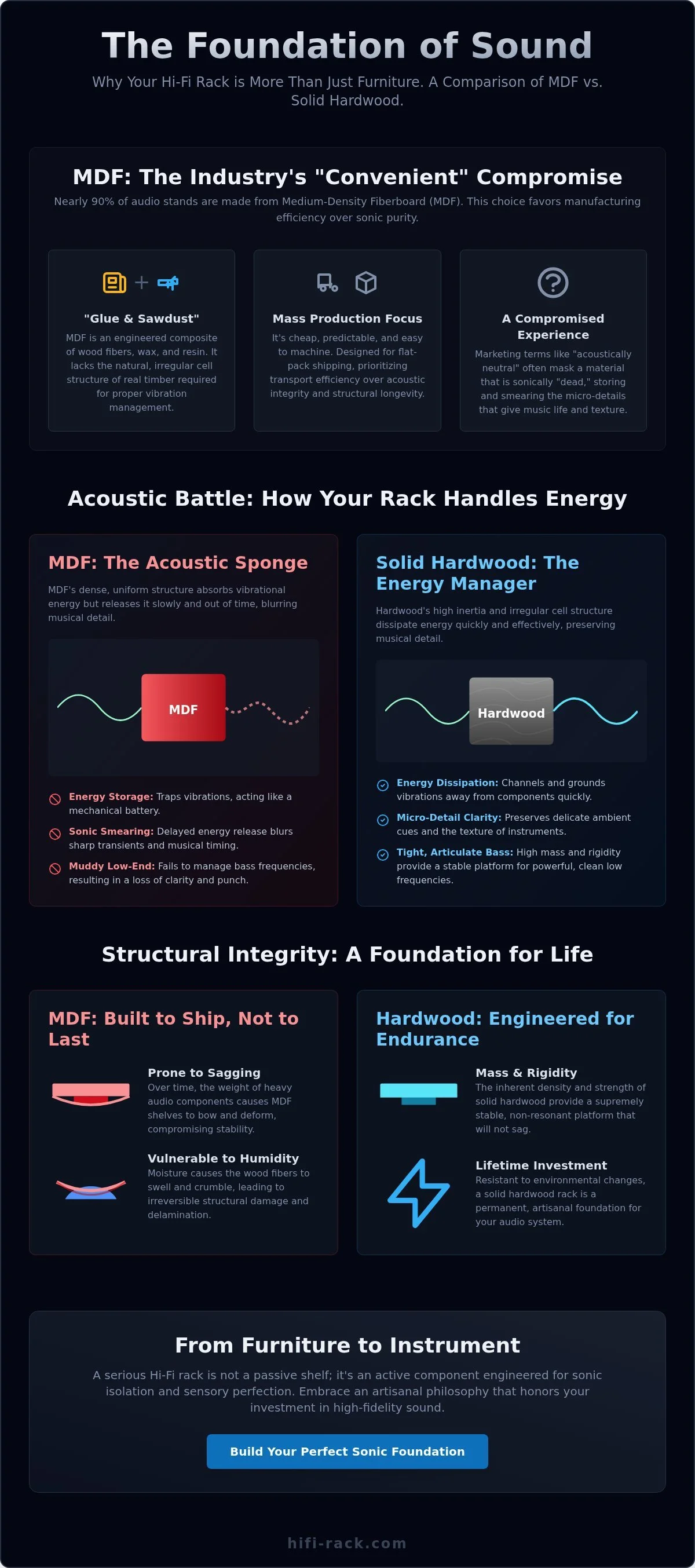
Medium-density fibreboard (MDF) is an engineered product created by breaking down wood residuals into fine fibers. These fibers are combined with wax and resin, then pressed into panels. It's the industry default because it's predictable. There are no knots to work around. There's no grain to match. It machines with robotic ease. Manufacturers love it because it's a blank canvas for thin veneers that mimic luxury without the cost of real timber. It's a commodity compromise that favors the factory over the listener. This material is essentially glue and sawdust, lacking the organic complexity required to manage high-frequency vibrations effectively.
The hidden cost of the 'Cheap' standard
The true cost of this standard is hidden in the shipping container. Most MDF racks are designed to be flat-packed. This prioritizes transport efficiency over sonic integrity. These pieces lack the artisanal soul found in handcrafted wood. When you invest in premium electronics, they deserve a foundation of equal integrity. Marketing departments often use terms like "acoustically neutral" to describe these boards. In reality, this is often a mask for manufacturing convenience. A material that's "dead" isn't necessarily musical. It simply lacks the character to breathe life into the soundstage.
We must move beyond the idea of furniture as a mere utility. In the world of high-fidelity sound, every component in the chain matters. A rack isn't just a shelf; it's a vital instrument. By choosing a solid hardwood foundation, like the Reference Myro HiFi Rack, you're investing in a structure designed for sensory perfection. It's a psychological shift from seeing a rack as "furniture that holds gear" to recognizing it as the acoustic foundation upon which your entire system's performance is built. This transition marks the difference between a casual listener and a true connoisseur of sound.
Acoustic Limitations: Why MDF Fails the Resonance Test
Many manufacturers boast about the "deadness" of their platforms. They claim that because MDF doesn't ring like a bell, it's the perfect choice for audio. This is a fundamental misunderstanding of musicality. A material that's completely inert often achieves that state by swallowing the micro-vibrations that give music its breath and texture. In the search for sonic purity, we don't want a platform that kills the music; we want one that manages energy with grace.
The core issue lies in energy storage. Because of its dense, non-porous structure, MDF acts like a mechanical sponge. It absorbs vibrations from your speakers and the environment, but it cannot dissipate them quickly. Instead, it holds onto this energy and releases it back into your components with a slight time delay. This phenomenon is a central reason why avoid MDF for high end audio, as research into the acoustic properties of fiberboards reveals how density and resin content dictate energy absorption. This delayed release causes sonic smearing, where the sharp transients of a snare drum or the delicate decay of a piano note become blurred and indistinct.
Energy storage vs. energy dissipation
Energy storage in composites is the primary enemy of micro-detail, as it traps mechanical vibrations and releases them as delayed sonic interference. Unlike the irregular, tubular cell structure of natural timber, MDF is a uniform mass of resin-bound dust. It offers high damping, which is the absorption of energy, but poor isolation, which is the prevention of energy transfer. For sensitive components like tube amplifiers or high-compliance turntable cartridges, this stored energy translates directly into a loss of soundstage clarity. While solid wood allows energy to travel through its grain and dissipate naturally, MDF keeps the vibration trapped within the rack's shelf, clouding the performance.
The 'Dead' sound vs. the 'Natural' sound
Over-damping is a silent killer of high-fidelity systems. When a rack is too "dead," it can make your music sound constricted and dull. You lose the sense of the room where the recording took place. The harmonic integrity of the instruments is sacrificed for a false sense of silence. Solid hardwood foundations provide a more organic and breathable soundstage because they don't over-absorb the life of the music. It allows the natural harmonics of a cello or the air around a vocalist to remain intact.
We believe your furniture should be an extension of your instruments. Choosing a foundation like the Reference Myro HiFi Rack ensures that your system's harmonic life remains intact rather than being swallowed by industrial glue. It's about finding the balance between stability and vitality, allowing your gear to perform with its intended soul.
Structural Failure: The Long-Term Audiophile Investment
A high-end power amplifier is a masterpiece of engineering, often weighing upwards of 30 or 40 kilograms. Placing such a significant weight on a composite shelf is a recipe for gradual disaster. This physical reality is a primary reason why avoid MDF for high end audio. While a board might seem rigid on the day of purchase, it lacks the internal cellular strength to resist the relentless pull of gravity over years of service. It's a material designed for convenience, not for the enduring support of heavy, sensitive electronics.
Permanent deformation and structural creep
In the world of material science, 'creep' refers to the tendency of a solid material to move slowly or deform permanently under the influence of persistent mechanical stresses. MDF is particularly susceptible to this because its resin-bonded fibers aren't a continuous, natural structure. Over time, a shelf supporting a heavy transformer or a massive platter will begin to bow. This isn't just an aesthetic flaw. A sagging shelf compromises the precise leveling required for turntables and sensitive optical drives. Once the rigidity is lost, the rack's ability to isolate vibration vanishes, turning your foundation into a source of mechanical instability.
Moisture is another silent enemy of the composite board. Standard MDF is highly susceptible to humidity. Even minor seasonal changes can cause the edges to swell or the core to soften. Unlike solid timber, which breathes and moves with the seasons, MDF undergoes irreversible damage when exposed to moisture. It doesn't return to its original shape. It simply degrades, losing the density required for high-fidelity performance. This vulnerability makes it a poor choice for a sanctuary intended to last a lifetime.
The fragility of the veneer
Most "wood" audio furniture is actually a thin slice of timber glued over a composite core. This veneer is incredibly fragile. A single slip while moving a spiked component can result in a deep gouge that exposes the industrial gray fibers beneath. You can't sand it down. You can't refinish it. It's a surface-level beauty that masks a fundamental lack of soul. When you consider the longevity of solid wood furniture, the contrast is stark. Solid oak or walnut can be restored, oiled, and passed down through generations. MDF is a consumable; solid hardwood is a legacy.
Rigidity also depends on the integrity of the joints. MDF has notoriously poor screw-holding capacity. Once the fibers around a fastener are crushed or stripped, the joint loses its bite. The rack begins to sway, and the tight, high-inertia foundation your system needs is gone. We build our products to endure. Choosing a solid foundation like the Classic Myro HiFi Rack ensures that your investment remains as stable and beautiful in twenty years as it is today. It's a commitment to both sonic excellence and physical permanence.
The Solid Hardwood Advantage: Engineering for Sonic Purity
While we've explored the limitations of composite boards, the alternative is found in the organic complexity of nature. Understanding why avoid MDF for high end audio often leads enthusiasts to the realization that timber is not just a material; it's a mechanical filter. Unlike the uniform density of industrial composites, solid hardwood possesses a biological architecture perfected over decades of growth. This natural foundation provides a sophisticated management system for the micro-vibrations that threaten to cloud your listening experience.
Internal damping in natural fibres
The secret to hardwood's acoustic superiority lies in its cellular structure. Timber is composed of a complex, non-uniform network of tracheids and vessels. This irregular internal geometry is highly effective at breaking up standing waves before they can travel through the rack. When mechanical energy enters a solid wood shelf, it's forced to navigate this labyrinth of organic fibres. This process naturally dissipates energy as trace amounts of heat rather than storing it like a sponge.
Solid wood "sinks" vibration more effectively than uniform composites because it lacks a single resonant frequency. Every piece of timber is unique, which prevents the build-up of harmonic peaks that can color the sound of your gear. Specific hardwoods like American Walnut or European Ash are prized in audio for their ideal balance of stiffness and internal damping. These materials don't just hold your equipment; they actively refine the environment in which it operates, allowing the true character of your components to shine through without interference.
Mass, density, and structural silence
Mass is the ultimate solution for floor-borne vibrations and airborne acoustic feedback. The sheer weight of a Reference Myro HiFi Rack provides a high-inertia foundation that remains unbothered by the energy in the room. This density creates a stable platform where sensitive turntable needles and laser assemblies can track with absolute precision. High-density timber inherently acts as a low-pass filter for resonance, preventing high-frequency noise from reaching your sensitive electronics. This structural silence is something that lightweight, resin-bonded boards simply cannot replicate.
We view the HiFi rack as a vital instrument in the acoustic chain. Just as a master luthier selects tonewoods for a violin, we select premium hardwoods for their ability to harmonize with your music. Beyond the technical metrics, there's an emotional payoff in the aesthetic harmony of real grain. The warmth of solid oak or the deep lustre of walnut creates a sanctuary that feels as good as it sounds. It's a commitment to excellence that bridges the gap between high-end engineering and artisanal beauty.
If you're ready to liberate your system from the constraints of industrial composites, discover how our handcrafted hardwood foundations can transform your listening experience.
Beyond the Board: The HiFi Rack Philosophy of Excellence
In our workshop in Novi Sad, woodworking isn't just a production process. It's a heritage. We merge multi-generational craftsmanship with modern acoustic demands to create something that transcends the category of furniture. This is exactly why avoid MDF for high end audio in every piece we craft. We refuse to use industrial composites because they lack the soul and the structural integrity required for a true high-fidelity sanctuary. Your equipment is an expression of your passion, and it deserves a foundation that matches that intensity.
A significant but often overlooked reason to bypass engineered boards involves the health of your listening environment. Most MDF panels are bonded with urea-formaldehyde resins. These can off-gas volatile organic compounds (VOCs) into your home for years. In a dedicated listening room where you spend hours immersed in music, the air should be as pure as the signal. We choose to finish our timber with natural oils and waxes. This approach honors the material and ensures your personal sanctuary remains a healthy space, free from the chemical scents of mass production.
Uncompromising build quality
Our commitment to solid materials means every rack we produce is a legacy piece. Unlike veneered alternatives that degrade at the first scratch, solid wood can be sanded, re-oiled, and loved for decades. It's a living material that matures alongside your system. You can learn more about our ethical sourcing and our connection to the environment on our Responsibility page. For those beginning their journey into high-end foundations, our Classic Myro HiFi Rack provides a superior entry point. It offers a level of rigidity and resonance control that even the most expensive MDF alternatives cannot match.
The Union of Performance and Aesthetics
We believe a rack must look as good as it sounds. This is our definitive promise; the union of performance and aesthetics is not a compromise but a requirement. High-fidelity audio is a deeply tactile experience. It's about the weight of the volume knob, the glow of a vacuum tube, and the smooth grain of a walnut shelf. By choosing a solid hardwood foundation, you're invited to slow down and appreciate the finer details of the craft and the music alike. This consistent alignment of high-end performance with organic aesthetics is the hallmark of a true connoisseur's system.
Your system represents a life-altering passion rather than a casual pastime. It deserves a foundation that reflects that commitment. From the Minimal to the Reference, our racks are built to be the final home for your most cherished components. Explore our range of solid hardwood foundations and discover the difference that artisanal integrity makes to your sound.
Elevate Your Acoustic Foundation
The journey toward sensory perfection requires a foundation that respects the physics of sound. By understanding why avoid MDF for high end audio, you've taken the first step toward liberating your system from the muddy bass and smeared soundstages of industrial composites. Solid hardwood isn't just a choice; it's a commitment to harmonic integrity and structural longevity that engineered boards simply cannot replicate. Your gear is a collection of precision instruments, and it deserves a platform of equal caliber.
Our workshop in Novi Sad remains dedicated to the soul of the craft. We utilize multi-generational woodworking techniques to ensure every rack is a unique instrument of isolation. With zero MDF or veneer used in any product, we provide a bespoke solution for the most sensitive electronics. It's time to replace commodity furniture with a legacy foundation that will endure for decades while elevating every note you hear.
Discover the Reference Myro: The ultimate solid hardwood foundation for your audio system
Invest in a foundation that breathes with your music and transforms your listening room into a true sanctuary of sound. Let your system finally reach its full potential on a foundation built for a lifetime of sensory perfection.
Common Questions About Audio Foundations
Is MDF really that bad for audio if it's thick and heavy?
Yes, because thickness doesn't change the fundamental physics of energy storage in resin-bonded fibers. Even heavy boards trap vibrations and release them as delayed sonic smearing, which clouds micro-detail. This is a core reason why avoid MDF for high end audio even in heavy-duty applications. It lacks the natural, irregular cellular structure of timber that dissipates energy rather than holding it like a mechanical sponge.
Does solid wood change the sound of my HiFi system?
Solid wood acts as a mechanical filter that clarifies the sound by managing resonance more effectively than composites. It doesn't "add" a sound so much as it removes the "mud" or "deadness" associated with over-damped materials. By allowing micro-vibrations to dissipate naturally through its grain, a foundation like the Reference Myro HiFi Rack reveals the holographic shimmer and soundstage depth intended by the original recording engineer.
What is the best type of hardwood for an audio rack?
High-density hardwoods like American Walnut, European Oak, and Ash are the gold standard for high-fidelity support. These timbers offer an ideal balance of stiffness and internal damping. Their complex organic structures break up standing waves across a broad frequency spectrum. We select these materials for our racks because they provide the high-inertia foundation necessary to support heavy amplifiers while remaining acoustically transparent and vibrant.
Can I use an isolation platform on an MDF rack to fix its issues?
An isolation platform offers temporary relief, but it can't fully compensate for a compromised foundation. If the primary rack stores and smears energy, those vibrations still migrate through the structure and affect your components. It's more effective to address the root cause by replacing the commodity board with a solid hardwood foundation. This ensures total sonic isolation for every component in your chain, from source to power.
How do I maintain a solid hardwood HiFi rack compared to MDF?
Maintaining a solid wood rack is a simple, tactile process involving the occasional application of natural oils or waxes. Unlike MDF, which is a consumable material that degrades permanently when the veneer is chipped, solid hardwood is a legacy investment. You can sand and refinish solid timber to its original luster even decades later. This artisanal longevity makes it a far more sustainable and rewarding choice for a personal sanctuary.
Why is MDF so common if solid wood is acoustically superior?
MDF is the industry default because it's inexpensive to manufacture and easy to ship in flat-pack boxes. It's a commodity choice driven by profit margins rather than acoustic performance. Manufacturers favor its lack of grain for robotic machining and thin veneering. For the connoisseur, the choice is different. You're investing in a vital instrument rather than a mass-produced item of convenience, prioritizing the art of listening over factory efficiency.
Is solid wood furniture more prone to warping than MDF?
Properly seasoned solid wood is remarkably stable, whereas MDF is highly vulnerable to irreversible moisture damage. While natural timber "breathes" with seasonal changes, master craftsmen use specific techniques to manage this movement. In contrast, once standard MDF absorbs moisture, it swells and loses its structural integrity permanently. Our racks are engineered to endure these environmental shifts while maintaining a precise, high-inertia foundation for your gear.
Will a solid hardwood rack help stop my turntable from skipping?
Yes, a high-mass solid hardwood rack significantly improves turntable stability by resisting floor-borne vibrations. The density of a Reference Myro HiFi Rack acts as a low-pass filter, preventing mechanical interference from reaching the sensitive stylus. By providing a rigid, level, and high-inertia platform, you ensure that your turntable tracks with absolute precision. This is a practical, physical justification for moving away from lightweight, unstable composite boards.