

Achieving Peace of Mind for Expensive Audio Equipment: The Foundation of Sound
Your five-figure amplifier is only as good as the floor it stands on. You have spent years meticulously selecting every cable and component to achieve sonic perfection, yet a subtle anxiety often lingers. You feel it when you walk across the room and see a delicate component quiver, or when you realize your premium electronics are resting on a mass-produced MDF shelf that vibrates with every low-frequency note. It is a frustrating disconnect between the quality of your sound and the instability of its support.
Achieving true peace of mind for expensive audio equipment requires more than just a flat surface; it demands a structural foundation built with the same reverence for physics as the gear itself. I believe that the right rack is not just furniture, but a vital instrument in your pursuit of sensory perfection. In this guide, you will discover how handcrafted solid hardwood and precision-engineered resonance drainage protect your investment from mechanical interference. We will explore how to create a stable, vibration-free environment that finally allows your system to breathe, ensuring your sanctuary of sound remains secure for decades to come.
Key Takeaways
Understand why high-end electronics require a specialized physical environment to perform at their peak and avoid mechanical degradation.
Learn why solid hardwood offers superior organic resonance control compared to the energy-storing properties of mass-produced MDF.
Discover how precision-machined spikes and decoupling techniques provide essential peace of mind for expensive audio equipment by neutralizing floor-borne vibrations.
Identify the critical factors of structural rigidity and weight capacity to ensure your furniture remains secure as your system evolves.
Explore how the Reference and Classic Myro HiFi Racks serve as handcrafted sanctuaries that harmonize technical performance with timeless aesthetic appeal.
Table of Contents
The Audiophile Anxiety: Vibration, Stability, and Your Investment
The Structural Integrity of Solid Hardwood vs. Composite Materials
The Audiophile Anxiety: Vibration, Stability, and Your Investment
You know the feeling. It's that quiet, nagging doubt that surfaces every time you adjust a cable or swap a record. You've curated a system that represents years of passion and significant financial commitment. Yet, if that system rests on a shelf designed for books rather than high-fidelity electronics, you aren't just risking the sound. You're risking the equipment itself. True peace of mind for expensive audio equipment is the confidence that your foundation is as uncompromising as your components.
High-end audio gear is heavy, delicate, and sensitive. A reference-grade amplifier can easily exceed 50 kilograms, placing immense stress on its support structure. When furniture isn't engineered for these specific loads, it doesn't just fail suddenly. It fatigues slowly, bowing under the weight and compromising the precise alignment of your components. To appreciate the scale of engineering involved in the finest electronics, it's helpful to see what these foundations are actually supporting.
Mechanical Vibration and the Noise Floor
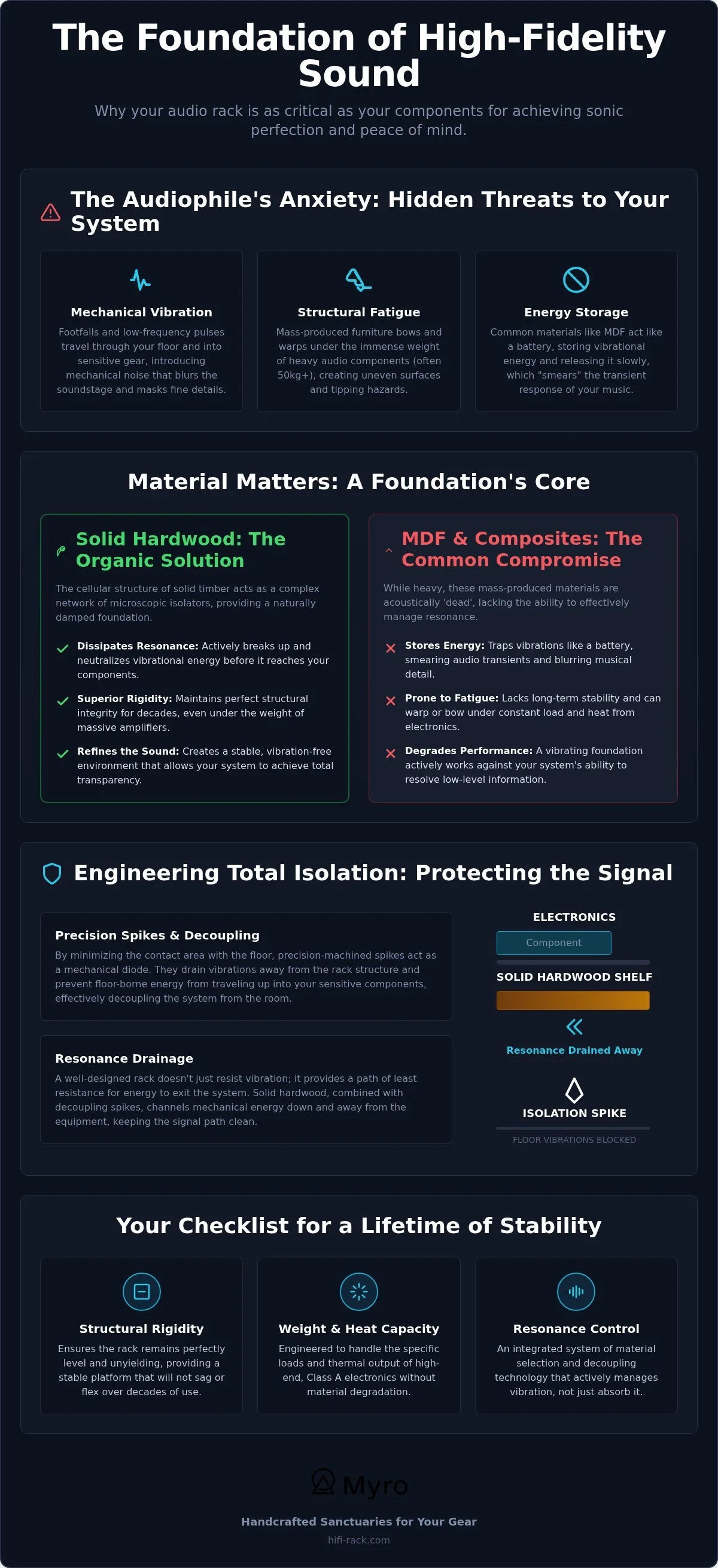
Visual stability is a common deception in the listening room. A rack might look solid while it simultaneously acts as a conduit for energy. Every footfall on a hardwood floor or low-frequency pulse from your subwoofers travels through the floor and into your gear. For sensitive digital-to-analog converters and phono stages, these micro-vibrations are catastrophic. They introduce mechanical noise into the signal path, blurring the soundstage and masking the fine details you paid to hear. Understanding the principles of vibration isolation is essential for any enthusiast. It's the difference between a system that sounds "good" and one that achieves total transparency.
The Risk of Structural Fatigue
Generic furniture often relies on particle board or thin veneers that lack internal bracing. Over months and years, the heat from Class A electronics and the sheer mass of transformers cause these materials to warp. I've seen enthusiasts regret using mass-produced shelves when they notice a permanent curve in the wood. This isn't just an aesthetic issue. A bowing shelf creates an uneven surface that can cause high-center-of-gravity components to tip. This instability is the primary enemy of peace of mind for expensive audio equipment. Bespoke engineering isn't a luxury for a reference system; it's a safety requirement. When you choose a foundation like the Reference Myro HiFi Rack, you're investing in a structure built to remain perfectly level for decades. It's about creating a permanent sanctuary where your passion can thrive without the threat of physical failure.
The Structural Integrity of Solid Hardwood vs. Composite Materials
I have seen many enthusiasts settle for industrial composites, believing that mass alone equals stability. It is a common misconception. While materials like MDF are heavy, they lack the organic complexity needed to manage resonance effectively. Choosing solid timber is the only way to secure long-term peace of mind for expensive audio equipment. It is the difference between a foundation that merely holds weight and one that actively refines the listening environment.
The debate between "dead" and "damped" materials is central to high-fidelity design. MDF is acoustically dead. It has no natural resonance, but it also has no way to dissipate energy. This causes it to store vibrations like a battery, slowly "smearing" the transient response of your music and blurring the fine details of the soundstage. Solid hardwood is naturally damped. Its cellular structure acts as a complex network of microscopic isolators that break up energy before it can reach your components.
Research into characterizing isolator performance confirms that the internal composition of a support matters deeply. Timber fibers are not uniform. They vary in density and direction, which prevents standing waves from forming within the shelf itself. This structural integrity ensures that your gear remains perfectly still, even when the music is demanding and the room is alive with sound.
Why We Avoid MDF and Veneer
Composite materials are essentially wood particles held together by synthetic glues. Over time, the heat from a vacuum tube or a massive power supply can accelerate the degradation of these adhesives. Veneers may look elegant at first, but they are often a mask for structural weakness. I choose solid materials because they do not hide. They offer a level of integrity that mass-produced furniture simply cannot match. It is a commitment to a foundation that will never bow, swell, or delaminate under the pressure of your investment.
The Science of the Grain
Each piece of wood we use is handcrafted by a single woodworker who understands the soul of the material. Whether it is the dense stability of Walnut or the timeless strength of Oak, the grain is a living history of growth. This organic foundation breathes with your room and ages gracefully alongside your electronics. It creates a sanctuary for your gear that feels as natural as the sound it supports. If you are ready to move beyond the limitations of synthetics, the Classic Myro HiFi Rack offers an uncompromising path to sensory perfection.
Total Isolation: Protecting the Analog and Digital Signal
I view every shelf in a high-fidelity system as a physical firewall. It is not enough to simply hold a component in place; a rack must actively isolate it from the chaotic energy of the room. True decoupling is the first line of defense. When you separate your gear from floor-borne vibrations, you create a sanctuary where the signal remains unmolested—an environment of balance that mirrors the holistic energetic harmony supported by Sinhronica7. This level of physical security is what provides lasting peace of mind for expensive audio equipment, ensuring that your investment is never compromised by the environment it inhabits.
Precision-machined spikes are the silent sentinels of this isolation strategy. These solid steel points are designed to drain resonance away from your electronics, channeling internal energy out of the chassis while preventing external vibrations from entering. The physics of these interactions can be complex, but visualizing how waves travel through different mediums helps clarify the necessity of rigid coupling. These Acoustics and Vibration Animations offer a compelling look at the wave phenomena we work to neutralize. By using these principles, we ensure every component in your chain operates in a perfectly inert environment.
Turntables and the Analog Vulnerability
Analog playback is an exercise in microscopic precision. A turntable's stylus is designed to detect movements measured in microns, making it hypersensitive to the slightest floor tremor. On bouncy or suspended floors, even a gentle footfall can cause the needle to skip or introduce low-frequency muddying. I recommend using high-mass platforms to provide the necessary inertia for tracking accuracy. For a deeper look at specific solutions, you can explore The Ultimate Guide to Turntable Isolation Platforms. A perfectly level, isolated surface is not an upgrade; it is a requirement for analog integrity.
Digital Components and Microphonics
It is a mistake to assume that digital components are immune to vibration. High-end digital-to-analog converters rely on ultra-precise clocks to maintain timing accuracy. When external resonance impacts these delicate circuits, it introduces jitter, a timing error that manifests as a loss of soundstage depth and a subtle hardening of high frequencies. Vacuum tubes in preamplifiers are also notoriously microphonic, acting like small microphones that pick up physical vibrations and amplify them into the signal path. Solid hardwood foundations, like those found in the Reference Myro HiFi Rack, provide the organic damping needed to minimize this interference. This creates a stable, quiet floor where the finest musical details can finally emerge from the darkness.
Evaluating a HiFi Rack for Long-Term Equipment Safety
I often tell my fellow enthusiasts that a rack should be evaluated with the same scrutiny as a power transformer. It is the physical anchor of your system. To achieve true peace of mind for expensive audio equipment, you must look beyond the surface finish and assess the structural architecture. You are not just buying a shelf. You are choosing the environment that will hold your legacy components for the next twenty years. A foundation of this caliber requires a blend of artisanal joinery and uncompromising material density.
Visual cues of quality are often your first indicator of long-term security. I look for substantial material thickness that suggests a high load-bearing capacity without the risk of bowing. Look at the joinery. Are the shelves joined with the precision of a master woodworker, or are they held together by hidden cam-locks and plastic brackets? Bespoke manufacturing offers a level of integrity that mass-produced items cannot replicate. When a single craftsman oversees the construction of your rack, every joint becomes a point of strength rather than a point of failure. This commitment to structural pride ensures your system remains physically secure as it evolves.
Loading and Weight Distribution
Calculating the total load of a reference system is a vital step in equipment safety. High-end power amplifiers can weigh as much as a small person, and managing such weight safely requires the same level of structural precision used by RIHA Industries to design advanced patient transfer systems. Placing that mass on an upper shelf is a recipe for instability. I always recommend using the bottom shelf as the anchor of your acoustic stability. This lowers the center of gravity of the entire rack and provides the most rigid platform for your heaviest components. Proper spacing is equally critical. High-power electronics generate significant heat, so ensure you have ample clearance for dissipation to prevent thermal fatigue in both your gear and the solid wood structure.
Leveling and Precision
A perfectly horizontal plane is essential for both the safety of your gear and the focus of your soundstage. A rack that leans by even a fraction of a degree creates lateral stress on equipment feet and can affect the internal mechanics of sensitive components. Precision-machined adjustable feet allow you to compensate for the natural imperfections of your flooring. If you need assistance with this process, you can learn How to Level Your Modular HiFi Rack to ensure peak performance. A level rack is a safe rack, providing a stable sanctuary where your passion for sound can thrive.
If you are ready to build a foundation that matches the caliber of your electronics, I invite you to explore our range of handcrafted Myro HiFi Racks and discover the difference that true structural integrity makes.
The Myro Series: Handcrafted Sanctuary for Your Gear
The Myro series represents the final step in your journey toward sensory perfection. I don't see these racks as mere furniture. They are the physical manifestation of our commitment to the art of listening. Every Reference Myro HiFi Rack is engineered to be a definitive sanctuary. It provides the ultimate isolation for components that demand a perfectly inert environment. This is the absolute peace of mind for expensive audio equipment that only 100% solid European hardwood can deliver. The union of performance and aesthetics is our definitive promise to you.
For those who value a heritage aesthetic, the Classic Myro HiFi Rack balances timeless beauty with immense structural pride. It offers the same uncompromising damping properties we've discussed, but in a silhouette that honors traditional design. If your listening space is more intimate, the Minimal Myro HiFi Rack provides compact security without sacrificing a single ounce of integrity. We don't use MDF. We don't use veneers. We only use raw, high-quality timber that breathes and lives with your system.
Artisanal Pride in Every Joint
Our Novi Sad workshop is where high-end engineering meets multi-generational woodworking traditions. Each rack is handcrafted by a single woodworker. This ensures that every joint is a testament to excellence. This human element is vital. It creates a connection between the hands that built the foundation and the ears that enjoy the results. We take our environmental and material responsibility seriously, sourcing only the finest walnut, cherry, ash, and oak. It's this level of care that allows us to offer a lifetime guarantee of craftsmanship. It's a promise of longevity that spans generations.
Customizing Your Sonic Foundation
No two audio systems are identical. Whether you have a massive mono-block amplifier or a delicate vintage turntable, your foundation should fit your gear. You can browse the HiFi Rack Shop to explore bespoke solutions tailored to your specific equipment list. Selecting the right dimensions and wood species transforms a collection of gear into a definitive statement. You aren't just protecting your investment. You're elevating your relationship with the music. You are ensuring your sanctuary is secure for decades to come.
Secure Your Sonic Legacy
Your journey toward the perfect listening experience shouldn't be undermined by a fragile foundation. We have explored how the cellular complexity of solid hardwood outperforms the energy-storing nature of MDF; ensuring that your signal remains pure and your components remain level. A precision-engineered rack does more than support weight. It provides the essential peace of mind for expensive audio equipment by neutralizing floor-borne resonance and ensuring your heavy amplifiers are physically secure for a lifetime.
Just as you invest in a stable foundation for your equipment, maintaining your own physical health is essential for a lifetime of listening; for those seeking expert rehabilitation and movement support, RED Physiotherapy offers the professional care needed to stay in peak condition.
Every piece we create is handcrafted from solid timber, following a strict policy that rejects veneers in favor of raw structural integrity. This approach guarantees that your furniture is as enduring as the electronics it supports. If you're ready to provide your system with the handcrafted sanctuary it deserves, I invite you to Explore the Reference Myro Series for your high-end system. Our focus on reference-level isolation means your attention can finally return to the music itself. Let your passion flourish on a foundation built with the same reverence you bring to every listening session.
Frequently Asked Questions
Is it really dangerous to put a heavy amplifier on a standard wooden shelf?
Yes, standard shelving often relies on particle board or thin veneers that lack internal bracing. Over time, the immense mass of a reference-grade amplifier can cause these materials to bow or warp. This structural fatigue creates an uneven surface, increasing the risk of equipment tipping and compromising the long-term safety of your investment.
How does solid wood provide better "peace of mind" than metal racks?
Solid wood offers organic damping that metal structures, which often ring at specific frequencies, simply cannot match. The complex cellular structure of timber naturally breaks up energy rather than reflecting it back into your electronics. This inherent stability provides lasting peace of mind for expensive audio equipment, ensuring a quiet, inert foundation that protects both the signal and the hardware.
Will a specialized HiFi rack actually make my music sound better?
Yes, a specialized rack improves sound quality by significantly lowering the noise floor of your system. By isolating components from mechanical vibration, you reduce the interference that masks fine musical detail and blurs the soundstage. You'll notice improved transient response and greater clarity, especially in sensitive analog stages and digital clocks.
What is the maximum weight a Reference Myro HiFi Rack can support?
The Reference Myro HiFi Rack is built to support the most substantial components in the high-fidelity market. While the exact capacity varies by wood species, our handcrafted solid hardwood shelves are designed to handle heavy Class A amplifiers without bowing. This structural pride ensures that even the most massive gear remains secure, providing peace of mind for expensive audio equipment over decades of use.
Do I need a separate isolation platform if I already have a high-quality rack?
While a high-quality rack provides the primary foundation, sensitive components like turntables often benefit from an additional layer of isolation. High-mass platforms can further decouple these devices from micro-vibrations that the rack itself has already minimized. This dual-layer approach offers the highest level of security and performance for analog playback in rooms with suspended floors.
Why does HiFi Rack strictly avoid using MDF or veneer in their products?
We avoid MDF and veneer because these materials lack the structural integrity and acoustic properties of solid timber. MDF is an acoustically dead material that stores energy like a battery, which can smear the sound. Our commitment to solid hardwood ensures that every rack is a durable, heirloom-quality instrument that ages gracefully without delaminating or losing its shape.
Can I customize the dimensions of a Myro rack for my specific gear?
Yes, we offer extensive customization options to accommodate your unique equipment list. You can specify custom shelf heights and widths to ensure a perfect fit for oversized amplifiers or evolving systems. This bespoke service allows you to create a foundation that is perfectly matched to your specific needs, maintaining the harmony between form and function.
How do brass spikes contribute to the stability of the audio equipment?
Spikes provide a critical drainage path for mechanical resonance, channeling energy away from the equipment chassis and into the floor. This rigid coupling ensures that components remain perfectly still during playback. By minimizing the transmission of vibration, these precision-machined points enhance both the physical security and the sonic transparency of your entire system.