

If you spent thousands on a precision turntable but placed it on a mass-produced sideboard, have you truly invested in a high-end system, or have you simply bought a very expensive vibration sensor? It's a question that haunts many dedicated listeners as they eye the significant price tags on specialized equipment stands. You're likely wondering: are expensive audio racks worth it, or are you simply paying for a designer label and a polished finish?
I understand the skepticism. We've all seen furniture that promises the world but delivers little more than a place to collect dust. However, a true audio rack isn't an accessory; it's the structural foundation that prevents your room's environment from degrading your equipment's signal. In this guide, we'll explore the technical and acoustic realities behind high-end furniture and show you how to distinguish genuine performance from mere aesthetic luxury.
We'll examine how solid hardwood construction and rigid engineering contribute to a quieter noise floor and a more expansive soundstage. I'll explain why mass matters for heavy amplifiers and how proper structural integrity protects your long-term investment. This is your path to creating a listening sanctuary where your gear can finally breathe and perform as intended.
Key Takeaways
Understand why a high-end rack functions as a precision vibration management system rather than simple furniture.
Learn how the natural density of solid hardwood provides superior resonance control compared to mass-produced MDF or veneer.
Discover the technical performance markers that determine are expensive audio racks worth it for improving your system's signal-to-noise ratio.
Identify critical structural requirements like load capacity and modularity to ensure your foundation supports heavy, evolving gear.
Recognize how a rigid, "dead" surface is essential for unlocking the full potential of sensitive analog components like turntables.
The Audiophile Dilemma: Are High-End Audio Racks Truly Necessary?
It's a common struggle. You've carefully selected your speakers, your phono stage, and your cables, but the question remains: are expensive audio racks worth it when a simple bookshelf might hold the weight just as well? To the uninitiated, an audio rack looks like furniture. To the enthusiast, it's a sophisticated vibration management system. It's the silent partner in your signal chain. If your components sit on a surface that rings, flexes, or traps heat, you aren't hearing your system. You're hearing the room's interference.
High-fidelity components are remarkably sensitive. A turntable's stylus tracks grooves measured in microns. Even the smallest micro-vibrations from floorboards or speaker energy can introduce "mud" into the mid-range. I've found that moving gear from a standard credenza to a dedicated platform is often the single most significant upgrade a listener can make. It's a psychological shift. You stop seeing the rack as an accessory and start seeing it as the foundation of your soundstage.
The Role of the Equipment Support
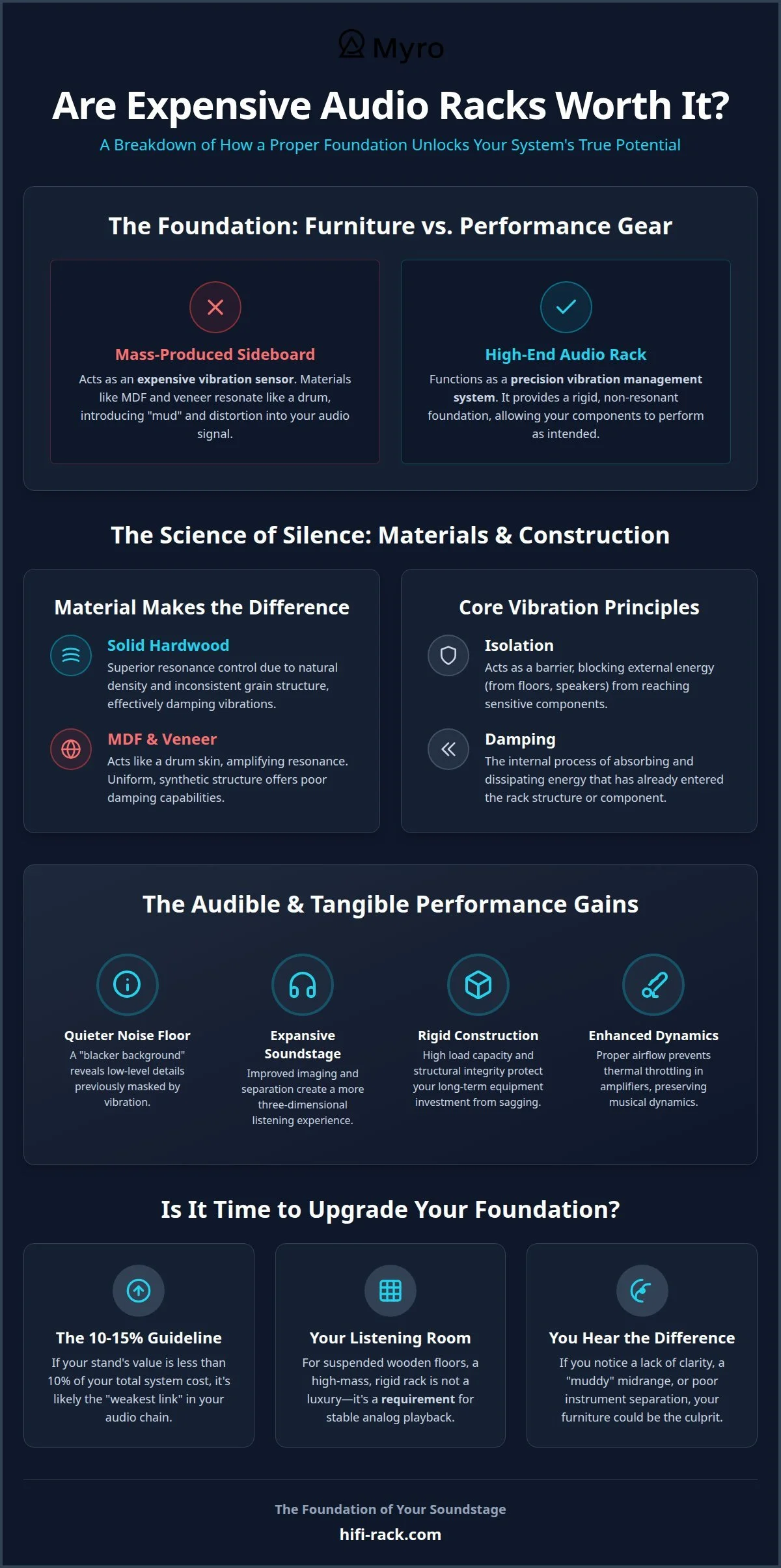
A premium rack provides mechanical grounding. This isn't just about weight; it's about The Science of Silence and how we manage energy transfer. When we designed the Reference Myro HiFi Rack, we focused on massive, rigid structures that refuse to sag. Cheap furniture uses MDF or veneer that acts like a drum skin, amplifying resonance. A truly rigid support ensures that your high-current amplifiers have the airflow they need to stay cool, preventing thermal throttling that can flatten your music's dynamics.
When Does the Investment Make Sense?
Many experts suggest a 10-15% rule. If your system's value has reached a certain threshold, the rack becomes the "weakest link." You'll know it's time to upgrade when you notice a lack of clarity in low-level details. There's a vital difference between a "stand" and an "isolation platform." A stand merely holds an object. An isolation platform, like our solid hardwood designs, actively works to decouple your gear from the environment. If you want to know if are expensive audio racks worth it for your specific setup, look at your floor. If you have suspended wooden floors, a high-mass rack isn't a luxury; it's a requirement for stable analog playback.
The Science of Silence: How Materials Manage Micro-Vibrations
Every object in your listening room has a voice. In the world of high-fidelity audio, this voice is known as a resonant frequency. When your speakers move air, they also move your floor, your walls, and your furniture. If your equipment sits on a material that rings in sympathy with those vibrations, it colors the sound you hear. This physical reality is exactly why the question of are expensive audio racks worth it is rooted in physics rather than marketing. A true performance rack doesn't just hold your gear; it manages energy.
To achieve a blacker background and sharper imaging, we must address two distinct concepts: damping and isolation. Isolation acts as a barrier, attempting to block energy from entering the component. Damping, however, is the internal process of absorbing energy that has already arrived. High-end racks use mass-loading to lower the resonant frequency of the entire system. By increasing the weight and density of the support, we move the resonance point far below the audible spectrum, ensuring your electronics remain undisturbed by the chaos of the room.
Solid Hardwood vs. MDF: The Acoustic Reality
Many mass-produced stands rely on MDF or veneer, which are essentially wood dust held together by synthetic glues. These materials lack a consistent grain structure, often leading to unpredictable resonance patterns. The internal damping of solid wood is its ability to convert kinetic energy into heat. This organic process allows species like oak, walnut, and ash to dissipate energy naturally without the "ringing" associated with metal or the "deadness" of plastic composites. Because we prioritize this natural energy management, we strictly avoid MDF and veneer in every piece we craft. When Calculating the Value of your system's foundation, the material's ability to handle micro-vibrations is the most critical factor.
Coupling and Decoupling Techniques
The interface between your rack and the floor is just as vital as the shelves themselves. Spikes are used for coupling, concentrating the massive weight of the system into a single point to provide absolute stability. This creates a direct path for energy to exit the rack. Conversely, isolation feet use softer interfaces to decouple sensitive components from the shelf. Our Reference Myro HiFi Rack utilizes extreme mass and rigid coupling to stabilize sensitive electronics, ensuring that the only movement in your room is the vibration of the air itself. If you're looking to refine your current setup, exploring our collection of solid hardwood supports can provide the structural silence your music deserves.
Beyond Aesthetics: The Hidden Performance Benefits of Rigid Construction
A common misconception is that a premium rack is merely a piece of fine furniture. While the visual appeal is undeniable, the true value lies in the structural silence it provides. When people ask are expensive audio racks worth it, they often overlook the direct impact of stability on signal-to-noise ratios. A stable platform allows for finer detail retrieval by reducing the noise floor. It prevents the "microphonic" effect where sensitive circuitry, especially in vacuum tube amplifiers, picks up mechanical vibrations and converts them into audible distortion. This interference masks the subtle nuances of a recording, robbing the listener of the intended emotional depth.
I've seen many enthusiasts invest in high-end phono stages only to have the performance crippled by a flimsy stand. A rigid, hand-joined structure ensures that the only thing vibrating in your room is the music itself. Unlike mass-produced furniture that relies on cam-locks and staples, our approach utilizes traditional joinery that remains stable under load. This isn't just about looking good; it's about creating a foundation that doesn't interfere with the delicate electrical signals passing through your gear.
Turntables and the Floor-Borne Challenge
Analog playback is where structural integrity becomes non-negotiable. Turntables demand a "dead" surface to perform at their peak. If you have springy wooden floors, every footstep can translate into a stylus skip or a low-frequency rumble that muddies your bass. High-mass supports act as a mechanical anchor, absorbing these disturbances before they reach the platter. You can explore the physics behind this in our detailed look at The Science of Vibration Damping in Solid Hardwood. For a high-end vinyl setup, an isolation platform is a mandatory partner in the pursuit of sonic purity.
The Longevity of Solid Craftsmanship
Cheap furniture often suffers from "creep." This is the slow, permanent warping that happens when an MDF shelf is subjected to the 50kg weight of a massive power amplifier over several years. Solid wood resists this decay. It offers a sense of integrity and longevity that flat-pack alternatives simply cannot match. In our workshop in Novi Sad, we treat every joint as a performance feature. We use multi-generational woodworking traditions to ensure your rack remains as rigid in twenty years as it is today. This heirloom quality is a core part of the answer when deciding if are expensive audio racks worth it. You aren't just buying a stand; you're securing the long-term health and performance of your entire system.
If you value this level of durability and natural character in other areas of your home, you can check out Urban Reclamation for their unique, hand-made rustic furniture crafted from reclaimed timber.
Calculating the Value: A Framework for Your System's Foundation
Determining whether are expensive audio racks worth it requires a shift in perspective. You shouldn't look at it as a purchase of furniture. It's an acquisition of structural insurance. To help you evaluate a potential foundation, I've developed a simple framework based on four pillars: load capacity, material purity, isolation features, and modularity. When these elements align, the rack ceases to be a passive stand and becomes an active contributor to your system's fidelity.
Consider your heaviest component. A flagship power amplifier or a high-mass turntable often exceeds 40kg. Standard shelving isn't designed for this localized stress. It will flex. It will vibrate. A performance rack offers a certified load capacity that ensures your gear stays perfectly level. Much like the precision engineering required for the heavy-duty healthcare equipment manufactured by RIHA Industries, an audio rack must provide absolute stability. This levelness is critical for the mechanical health of your turntable's bearing and the tracking accuracy of your stylus; if a shelf bows even slightly, you've compromised the geometry of your entire analog front end.
Material purity is the next benchmark. Many "audiophile" stands use hollow metal tubes or veneered particle board. These often act as echo chambers for resonance. A solid timber structure, handcrafted from dense hardwoods, provides the mass required to sink vibrations away from your electronics. Integrated spikes then concentrate this mass, providing a stable exit path for energy. When you evaluate a rack, ask if it's built from raw, high-quality materials or hollow-core imitations.
Just as evaluating the integrity of your audio foundation is key to performance, owners of electric vehicles should prioritize similar technical verification; you can check out EVdiagnostika.si for licensed, independent testing of your car's battery health and range.
The Modular Advantage
Your system is a living entity. It grows as your passion deepens. This is why I believe a modular system like the Classic Myro HiFi Rack is a smarter long-term investment. It allows you to add tiers as you acquire new pre-amps or streamers. You can adjust the spacing between shelves to accommodate taller components, future-proofing your setup. This flexibility ensures you don't have to replace the entire rack just because you upgraded a single piece of gear. It also makes leveling individual tiers much simpler, ensuring perfect horizontal alignment for every component.
Aesthetic Harmony in the Listening Room
We shouldn't ignore the psychological impact of our environment. A cluttered, industrial-looking rack can create visual noise that distracts from the music. Integrating high-performance gear into a living space requires a balance of form and function. For those who value a clean aesthetic, the Minimal Myro HiFi Rack serves the minimalist audiophile without sacrificing an ounce of rigidity. It provides the necessary structural performance while maintaining a soulful connection to your personal sanctuary. If you're ready to build a foundation that matches the quality of your gear, explore our full range of solid hardwood supports here.
When extending this focus on aesthetics and functionality to a professional or commercial setting, such as a high-end audio showroom, it pays to check out hildebrands GmbH for their expertise in retail design and spatial branding.
The Artisan’s Answer: Why Solid Hardwood is the Ultimate Acoustic Platform
I often tell visitors to our workshop that we don't just build furniture; we create instruments of silence. The philosophy behind every piece we craft is simple. We believe that performance and aesthetics should exist as a single, definitive promise. When you choose a platform for your system, you're deciding how your environment will interact with your music. Mass-produced furniture, born in factories and held together by synthetic glues, can't manage resonance with the same organic grace as hand-selected timber. It lacks the soul and the structural density required to truly anchor a high-fidelity experience.
The ultimate answer to whether are expensive audio racks worth it lies in the transition from being a casual listener to becoming a connoisseur of sound. It's an investment in the art of listening. When you remove the structural "blur" caused by inferior supports, you're finally hearing the full potential of your equipment. You aren't just buying a shelf; you're securing a piece of heritage that elevates your personal sanctuary. This is where the pursuit of sensory perfection meets the reality of master craftsmanship.
Enhancing this sanctuary can extend to the very entrance of the room; for example, Hide-A-Way Doors specializes in handcrafted hidden bookcase doors that blend master craftsmanship with the need for a private, dedicated listening space.
Handcrafted in Serbia: A Tradition of Excellence
In our workshop in Novi Sad, we rely on multi-generational woodworking skills that have been refined over decades. Every Myro rack is a testament to this commitment to uncompromising quality. We don't use MDF or veneer because they lack the internal damping properties of raw, high-quality materials. There's a tactile reward in solid wood that goes beyond the audio signal. The warmth of the grain and the massive weight of the structure provide a grounded, soulful connection to your gear. It's a piece of heirloom-quality furniture that's built to last a lifetime, ensuring your system's foundation is as enduring as your passion for sound.
Your Next Step Toward Sonic Perfection
Beginning your journey toward a quieter noise floor starts with choosing the right foundation. Whether you require a standard configuration or need to consult on custom dimensions for unique amplifier footprints, we're here to help you refine your listening environment. A Reference-grade support is more than a luxury; it's a vital component in the pursuit of harmony between form and function. If you're ready to transform your relationship with your music, it's time to invest in a structure that respects the integrity of your signal. Explore our range of solid hardwood racks and stands and discover the transformative effect of structural silence.
Secure the Foundation of Your Sonic Legacy
The journey from a casual listener to a true connoisseur is defined by the details we prioritize. A dedicated support is more than furniture; it's a silent partner in your signal chain. We've explored how managing micro-vibrations reveals the hidden depth within your favorite recordings. By choosing solid hardwood over resonant, processed composites, you provide your electronics with the structural silence they require to perform at their peak.
Ultimately, when you consider are expensive audio racks worth it, the answer is found in the clarity of your soundstage and the longevity of the craft. Our strict no-MDF policy is a performance standard rooted in a multi-generational family tradition. Every piece, handcrafted in Novi Sad, is built to anchor your system for a lifetime. You've invested in precision gear; now give it the stable foundation it deserves.
Explore the Reference Myro Collection
Your pursuit of sensory perfection is a lifelong passion. We're honored to be part of that story, helping you create a sanctuary where every note rings true and every instrument finds its place.
Frequently Asked Questions
Do expensive audio racks actually improve sound quality?
Yes, they improve sound quality by lowering the noise floor and managing mechanical resonance. By isolating sensitive components from floor-borne vibrations and internal feedback, a performance rack allows for better detail retrieval and a more expansive soundstage. When listeners ask if are expensive audio racks worth it, the answer is often found in the newfound clarity and rhythmic precision of their music.
Is solid wood better than metal for HiFi racks?
Solid wood offers natural internal damping that metal often lacks. Metal tubes can ring or act as echo chambers unless they're heavily mass-loaded with sand or lead shot. Dense hardwoods like oak, walnut, and ash dissipate kinetic energy as heat. This organic process provides a more natural acoustic signature that complements high-fidelity playback without the sterile ringing associated with hollow metal supports.
Why shouldn't I use a regular TV stand for my audio equipment?
Regular TV stands are designed for aesthetics and light loads rather than vibration management. Most mass-produced furniture uses hollow-core MDF or thin veneers that flex under the weight of a heavy power amplifier. They lack the rigidity and mass required to prevent micro-vibrations from reaching your source components. A dedicated rack acts as a structural foundation specifically engineered to keep your gear stable and silent. However, for other areas of your home where vibration control is less critical, Ja Tak Møbler provides excellent advice on selecting high-quality furniture for smaller living spaces.
What is the most important feature to look for in a high-end rack?
Rigidity and material density are the most critical features for any high-end support. A rack must be massive enough to lower the resonant frequency of the entire system. You should look for solid-joint construction rather than flat-pack assembly. Gaps in cam-lock joinery create points of instability that can introduce unwanted resonance into your signal chain, robbing your music of its intended detail.
How much should I spend on an audio rack relative to my system?
A common guideline is to allocate 10-15% of your total system value to its structural foundation. This ensures your rack's performance level matches your electronics. If you've invested thousands in high-end gear, a budget stand becomes the weakest link. It's an investment that ensures you're actually hearing the full potential of the components you've already purchased.
Can a rack help reduce turntable feedback and skipping?
Yes, a high-mass rack is essential for stabilizing analog playback, especially on suspended wooden floors. By acting as a mechanical anchor, a heavy rack absorbs floor-borne energy before it reaches the turntable's sensitive stylus. This significantly reduces the likelihood of skipping and eliminates low-frequency feedback loops that can occur between your speakers and your cartridge at higher volumes.
What is the difference between coupling and decoupling in audio furniture?
Coupling creates a direct energy path, while decoupling acts as a vibration barrier. Spikes are typically used to couple the rack to the floor, concentrating mass to drain energy away from the system. Decoupling uses soft interfaces or isolation platforms to prevent external energy from entering a component. Determining if are expensive audio racks worth it often depends on how effectively the design balances these two technical approaches.
Why does HiFi Rack avoid using MDF and veneer?
We avoid these materials because they lack the structural integrity and acoustic properties of solid timber. MDF is essentially wood dust and synthetic glue, which can ring or warp under the localized stress of heavy gear. We prioritize solid hardwood to ensure our racks provide genuine resonance control and a lifetime of durability. It reflects our multi-generational commitment to the craft and our refusal to compromise on sonic performance.