

HiFi Rack Vibration Isolation: The Audiophile’s Guide to Resonance Control
What if the greatest obstacle to your system’s performance isn’t the quality of your cables or the price of your speakers, but the very floor beneath them? It’s a frustrating reality many of us face. You’ve invested in premium components, yet the bass remains muddy and the soundstage feels strangely veiled. We understand that pursuit of the "blacker background" because we’ve felt the same disappointment when a beautiful piece of gear is held back by micro-vibrations. Effective hifi rack vibration isolation is often the missing link between a good system and a transcendent one.
In this guide, you’ll discover how precision-engineered vibration isolation transforms your listening experience from mere sound into a pure, immersive sanctuary. We agree that your equipment deserves better than cheap, resonant furniture that ruins both your room’s aesthetic and your music’s clarity. We will explore the delicate balance of decoupling and damping, showing you how the right structural choices can tighten low-end frequencies and create a visual aesthetic that finally matches the quality of your gear. From managing energy through material integrity to selecting artisanal pieces that last a lifetime, such as the high-quality home pieces from Grosvenor Furniture, we’re going to help you reclaim the soul of your music.
Key Takeaways
Understand how external kinetic energy enters your signal chain and the essential role of mechanical separation in preserving audio integrity.
Learn to navigate the choice between damping and decoupling to implement the most effective hifi rack vibration isolation strategy for your specific gear.
Discover why solid hardwood’s organic grain structure is superior to MDF for breaking up standing waves and managing stored energy.
Master the "Brain and Brawn" layout and leveling techniques to ensure your turntables and transports perform at their absolute peak.
Explore the transformative impact of a reference-grade foundation that balances high-end engineering with timeless, artisanal craftsmanship.
What is HiFi Rack Vibration Isolation and Why Does It Matter?
We view the listening room as a personal sanctuary. It's a space where time slows down and the focus shifts entirely to the art of sound. However, that sanctuary is under constant siege by kinetic energy that we often cannot see. At its core, Vibration isolation is the mechanical process of separating your sensitive electronics from both external and internal energy. Without this separation, your system lives in a state of constant agitation. Effective hifi rack vibration isolation acts as the essential barrier that protects the purity of your music.
Vibrations are more than just physical movement; they are a form of noise that corrupts the signal. They enter your system through "footfall" vibrations traveling through the floor or via acoustic feedback from your speakers. When these tremors reach your components, they trigger a phenomenon known as microphonics. This is where internal parts turn mechanical energy into unwanted electrical noise. The result is a smeared soundstage, loose bass response, and a loss of the fine micro-detail that makes a recording feel authentic and intimate.
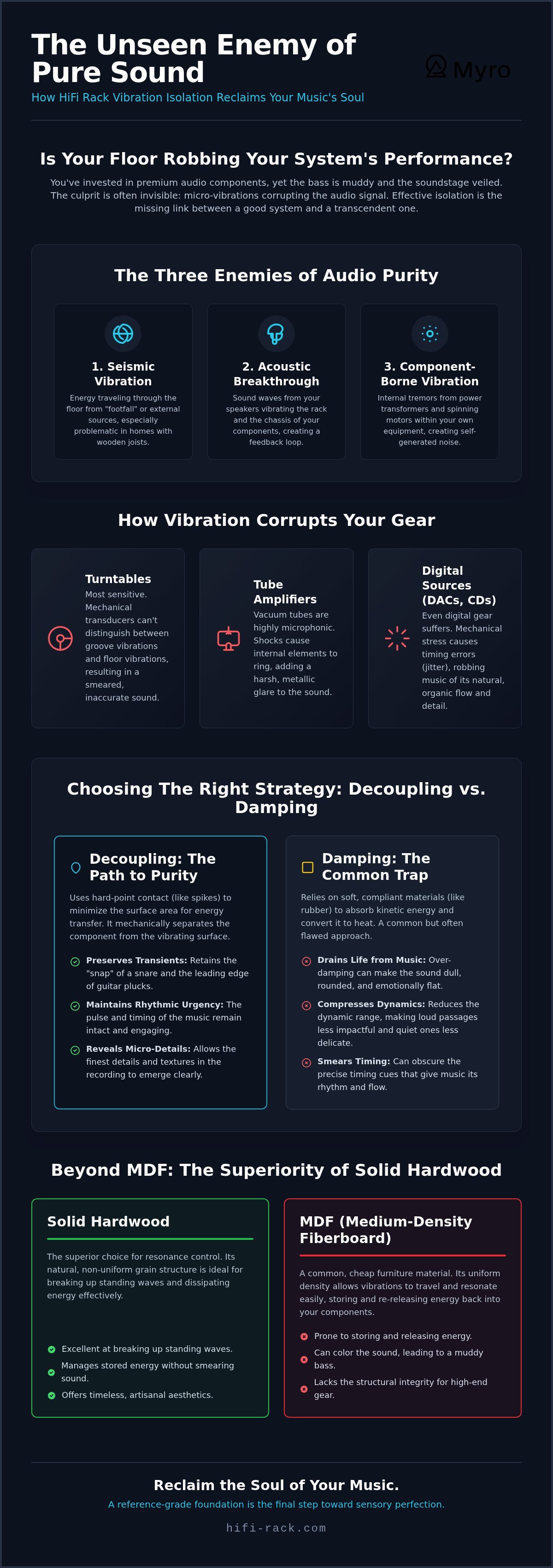
The Three Enemies of Sound
Energy doesn't just disappear. It finds a way into your gear from three distinct directions. Seismic vibration travels from the floor, which is a common issue in homes with wooden joists that act like a drum skin. Acoustic breakthrough occurs when energy from your speakers vibrates the rack and the chassis of your components. Finally, we must manage component-borne vibration. These are the internal tremors caused by power transformers and spinning motors within your own equipment. Each of these forces robs your system of its potential.
Impact on Your Gear
Not all components react to vibration in the same way, but all are affected by its presence. Identifying how your specific gear responds is the first step toward sensory perfection.
Turntables: These are the most sensitive. As mechanical transducers, they can't distinguish between the vibration in the record groove and the vibration coming through the floor.
Tube Amplifiers: Vacuum tubes are highly susceptible to microphonics. External shocks can cause the internal elements of the tube to ring, adding a metallic glare to the sound.
Digital Sources: Even CD players and DACs suffer. Mechanical stress can lead to timing errors, or jitter, which robs your music of its natural, organic flow.
Decoupling vs. Damping: Choosing the Right Acoustic Strategy
In our pursuit of the perfect listening sanctuary, we often encounter two distinct philosophies for managing energy. Damping and decoupling are frequently used interchangeably, but they serve very different masters. Damping relies on soft, compliant materials to absorb kinetic energy and convert it into heat. In contrast, decoupling utilizes hard-point contact, like stainless steel spikes, to minimize the surface area through which energy can travel. Choosing between them is not just a technical decision; it's an artistic one that defines the final character of your system.
Many enthusiasts fall into what we call the "Damping Trap." While it’s tempting to layer every shelf with thick rubber pads, over-damping often drains the life from your music. You might notice the background gets quieter, but the "snap" of a snare drum or the leading edge of a guitar pluck becomes rounded and dull. This is why we advocate for a balanced approach to hifi rack vibration isolation. Hard-point isolation preserves those vital transients, ensuring the music retains its rhythmic urgency and emotional impact. It's the difference between hearing a performance and feeling its pulse.
Understanding the physics behind these interactions is crucial for any serious listener. Recent scientific research on vibration isolation highlights how different materials respond to low-frequency energy. This data confirms that managing resonance requires more than just "padding" a system. It requires a strategic path for energy to exit. Without this exit path, vibrations simply bounce back into your electronics, clouding the very detail you've worked so hard to uncover.
When to Use Damping
Damping is most effective when dealing with high-mass components that generate significant internal vibration, such as large power amplifiers with heavy transformers. It also provides a stable foundation for very lightweight components that might otherwise "skate" on hard points. In high-end rack design, we often look for constrained layer damping. This involves sandwiching a damping material between two rigid layers to kill resonance without sacrificing structural integrity or making the sound feel "dark."
The Power of Decoupling
Decoupling acts as a mechanical diode. By using spikes and floor protectors, we create a high-pressure, low-surface-area connection. This allows energy to flow out of the component and into the ground, but it prevents floor-borne vibrations from traveling back up. This is particularly effective for solid wood shelves, where the natural grain already works to dissipate energy. Decoupling ensures your equipment remains "fast" and detailed. If you're ready to see how these principles come together in a finished piece, explore our Reference Myro HiFi Rack, which is designed to master this delicate balance.
Beyond MDF: The Superiority of Solid Hardwood in Resonance Control
We believe the foundation of any high-fidelity system starts with the materials you choose. While mass-market solutions often rely on composite boards, true hifi rack vibration isolation requires a more organic approach. The material your equipment sits on isn't just a shelf; it's a critical component in your signal chain. If that material is incapable of managing energy, your music will always suffer from a perceived "grayness" or lack of dynamic contrast.
MDF, or Medium Density Fibreboard, is an isotropic material. This means it has the same physical properties in all directions. Because it's essentially compressed wood dust and synthetic binders, it lacks a natural internal structure to redirect energy. Instead, MDF tends to trap and store kinetic energy, acting like a reservoir that slowly leaks vibrations back into your components. This stored energy is what leads to the "muddy" bass and smeared transients we discussed earlier. As noted in this audiophile’s guide to resonance control, managing these unwanted interactions is the key to unlocking the true potential of your gear.
Solid hardwood offers a vastly different acoustic profile. It possesses a complex, non-uniform grain structure that naturally breaks up standing waves. We follow a strict "No-Veneer" rule because we believe structural integrity must go all the way through the shelf. When you use solid timber, the energy doesn't just sit there; it's dissipated through the wood's cellular matrix. For a deeper look into these material choices, you might find our article on The Audiophile’s Guide to Custom Hardwood Audio Furniture: Myths vs. Reality particularly enlightening.
Acoustic Properties of Premium Hardwoods
Density and hardness are vital metrics in audio furniture design. We favor woods like European Walnut, Oak, and Cherry because of their high Janka hardness ratings and specific gravity. These woods don't just look beautiful; they act as a natural damping system. The microscopic cellular structure of the timber converts vibrational energy into a tiny amount of heat, effectively silencing the shelf. This provides a "blacker" background, allowing the smallest details of a recording to emerge with clarity and soul.
The Problem with Mass-Produced Veneers
Many high-end racks use veneers to hide a low-quality core. The issue here isn't just aesthetic. Every layer of glue in a piece of plywood or veneered MDF creates a "boundary reflection." Vibrations hit these glue layers and bounce back into the component rather than traveling through the material to the ground. Our artisanal approach in Novi Sad rejects these synthetic binders. By using solid, slow-grown timber, we ensure that the path for energy is clear and unobstructed, preserving the emotional weight of your music.
Optimising Your Setup: Leveling, Spikes, and Component Placement
The finest solid timber and precision engineering are merely the starting line. To reach the finish, we must look at how each component interacts with its neighbor. Achieving peak hifi rack vibration isolation is as much about the physical layout of your gear as it is about the rack itself. If a shelf isn't perfectly level, or if a high-current power supply is vibrating directly beneath a sensitive phono stage, the benefits of premium materials are quickly diminished. We treat the setup process as a ritual of precision, ensuring every element works in harmony.
One often overlooked aspect of setup is cable management. Cables shouldn't be allowed to act as "vibration bridges" between shelves or the floor. When a heavy power cord rests against a shelf, it carries mechanical energy directly into the component, bypassing your isolation strategy. We recommend dressing cables so they hang freely or use dedicated supports. Similarly, floor protectors are essential on hard surfaces. They aren't just for preventing scratches; they provide the necessary hard-point termination that allows spikes to drain energy effectively without the rack shifting or "walking" during deep bass passages.
The Five-Step Leveling Process
Precision leveling is non-negotiable, particularly for turntables and CD transports. A slight tilt can cause uneven wear on bearings and introduce tracking errors that blur the soundstage. Our recommended approach follows a logical progression:
Foundation: Start with the bottom tier. Ensure the base of the rack is perfectly plumb to the floor using the primary spikes.
Weight Distribution: Adjust each precision-machined spike so the weight is distributed equally. A spike that can be turned easily by hand is a "loose" connection that will resonate.
Shelf Alignment: Use a high-quality spirit level on the shelf surface itself before placing gear.
Chassis Check: Once the component is in place, check the level on the chassis or the turntable platter.
Final Settlement: Re-check the level after 24 hours. Solid wood and spikes can settle slightly under the weight of heavy equipment.
Organising Your "Brain" and "Brawn"
We advocate for a "Brain and Brawn" philosophy when arranging your system. "Brawn" components, such as power amplifiers and external power supplies, contain large transformers that generate both mechanical vibration and electromagnetic fields. These should always be placed on the lower shelves. This keeps the heaviest vibrations near the floor where they can be drained most efficiently. It also creates distance from your "Brain" components.
The "Brain" includes pre-amplifiers, phono stages, and streamers. these are low-signal devices that are incredibly sensitive to noise. By placing them on the upper tiers, you protect them from the "Brawn" below. We also suggest maintaining an "Air Gap" between shelves. This vertical spacing isn't just for heat dissipation; it reduces the chance of energy jumping between components. If you’re seeking a foundation that simplifies this process through superior engineering, consider the Minimal Myro HiFi Rack for its clean lines and uncompromising stability.
The Myro Philosophy: Reference-Grade Isolation for the Devoted Listener
We don't see our work as mere furniture manufacturing. It's a lifelong commitment to the art of listening. The Reference Myro HiFi Rack represents our pinnacle of vibration management. It's the physical manifestation of our belief that a high-end system is only as good as its foundation. By choosing only solid hardwood from sustainable sources and strictly rejecting the resonance-prone nature of MDF and veneers, we provide a definitive promise: a union of high-end performance and organic beauty for your personal sanctuary.
Our roots are in Novi Sad, where a multi-generational legacy of woodworking excellence informs every joint and finish. This isn't mass production; it's a slow, deliberate craft. We understand that for the devoted listener, a rack isn't just a place to store gear. It's a vital instrument that ensures your hifi rack vibration isolation is absolute. This artisanal integrity is what allows us to transform a listening room from a simple space into a deep, soulful connection with your music.
The Reference, Classic, and Minimal Collections
We've curated three distinct paths toward sensory perfection. The Reference Myro is designed for those with top-tier systems requiring maximum mass and isolation. For the essential audiophile setup, the Classic Myro offers a timeless design that honors traditional aesthetics without compromising on acoustic integrity. If your space demands a punchy profile, the Minimal Myro delivers high-performance hifi rack vibration isolation in a sleek, modern form.
Artisanal Integrity and Global Reach
Our workshop serves a global community of music lovers. We offer worldwide shipping because we believe every sanctuary deserves a foundation built to last a lifetime. Beyond our standard collections, we specialize in bespoke manufacturing. We can tailor dimensions to your specific equipment needs, ensuring a perfect fit for even the most unique components. For those still deciding which path is right for them, The Ultimate Guide to Choosing a Solid Wood HiFi Rack provides deeper insights into selecting the ideal piece for your system. We invite you to slow down, appreciate the finer details, and choose a partner in your pursuit of excellence.
The Foundation of Sensory Perfection
True isolation is more than a technical requirement; it's the final step in honoring the music you love. We've explored how the right hifi rack vibration isolation strategy transforms your system by managing energy through material integrity and structural precision. By moving beyond the resonant limitations of MDF and choosing the natural damping properties of solid hardwood, you provide your components with the quiet sanctuary they need to perform at their absolute peak. It's the difference between hearing a recording and feeling the presence of the artist in your room.
Our commitment to your listening experience is rooted in a multi-generational woodworking heritage in Novi Sad. Every piece we craft comes with a strict No MDF or Veneer Guarantee, ensuring that the beauty of your furniture is matched by its acoustic performance. We take pride in our artisanal roots while offering worldwide shipping to help audiophiles everywhere refine their personal sanctuaries. If you're ready to ground your system in quality that lasts a lifetime, we invite you to take the next step. Explore the Myro Collection: Handcrafted Isolation for the Devoted Listener and rediscover the hidden depth in your favorite records.
Common Questions on Resonance Control
Do HiFi racks really make a difference in sound quality?
Yes, a dedicated rack serves as a mechanical filter for your entire system. By managing kinetic energy, it lowers the noise floor and allows for a "blacker" background in your soundstage. This results in tighter bass and more defined imaging. Without proper hifi rack vibration isolation, micro-vibrations reach your components and introduce electrical noise that smears the finer details of your music.
Why is solid wood better than MDF for vibration isolation?
Solid wood possesses a natural, non-uniform grain structure that breaks up standing waves and dissipates energy as heat. MDF is an isotropic material, which means it lacks internal complexity; this causes it to trap and store energy like a reservoir. This stored energy eventually leaks back into your equipment, clouding the signal. Solid timber ensures a clear exit path for vibrations, preserving the dynamic "snap" of the performance.
Should I use spikes or rubber feet for my HiFi rack?
Spikes are generally preferred for their ability to decouple the rack from the floor, creating a mechanical diode effect. This allows energy to exit the system while minimizing the surface area for floor-borne vibrations to enter. Rubber feet provide damping, which is useful for absorbing internal motor noise in very light components. However, over-using soft materials can lead to a dull, lifeless sound that robs the music of its energy.
How does a turntable isolation platform work?
An isolation platform acts as a secondary barrier between the turntable and the main rack structure. It combines mass with specialized damping or decoupling materials to neutralize the high-frequency tremors that a stylus is uniquely sensitive to. This prevents acoustic feedback from your speakers from vibrating the platter and tonearm. It ensures the only movement the needle tracks is the record groove itself.
For DJs and vinyl enthusiasts who want to perform in an environment where these isolation principles are professionally applied, you can visit Book a DJ Studio to experience a fully equipped space optimized for audio clarity.
What is the "Brain vs. Brawn" arrangement for audio components?
This philosophy involves placing signal-sensitive "Brain" components like phono stages and pre-amps as far as possible from high-current "Brawn" components. Power amplifiers and external power supplies contain large transformers that generate both mechanical vibration and electromagnetic interference. Placing "Brawn" on the lowest tiers and "Brain" on the top tiers minimizes noise transfer and protects the delicate signal purity.
Can I use a normal bookshelf as a HiFi rack?
You can use a bookshelf, but you'll likely experience a loss in soundstage clarity and bass definition. Normal bookshelves are designed for static weight, not resonance control. They often feature hollow cores or thin veneers that act as echo chambers for kinetic energy. A dedicated hifi rack vibration isolation solution is engineered to drain energy, whereas a standard bookshelf tends to amplify and store it.
How do I level a HiFi rack on an uneven floor?
Use the adjustable precision spikes at the base of your rack to compensate for floor variances. Start by making the bottom tier perfectly plumb, then work your way up shelf by shelf. It's essential to use a high-quality spirit level on the shelf surface and eventually the component chassis. A perfectly level foundation is non-negotiable for the correct operation of turntable bearings and CD laser assemblies.
Is decoupling the same as damping in audio furniture?
No, they are two distinct acoustic strategies. Decoupling uses hard-point contact to minimize surface area and separate the component from external tremors. Damping uses soft, compliant materials to absorb energy and convert it into heat. We believe the most soulful listening experiences come from a balanced approach that uses decoupling to maintain musical transients and damping only where internal component noise is excessive.