

Choosing the Best Wood HiFi Rack for Premium Sound
What if the most critical component in your signal chain isn't an electronic one at all? You've likely spent years refining your setup, yet you might still be searching for the perfect wood hifi rack to solve frustrating turntable feedback or a muddy low-end. It's exhausting to invest in premium gear only to have the experience dampened by the cold, vibrating shelves of a generic metal or glass stand.
A precision-engineered solid hardwood foundation is more than just furniture; it's a vital acoustic instrument designed to eliminate resonance and ground your soundstage. By choosing the right support, you can finally unlock the tighter bass response and clear instrument separation your system was built to deliver. We'll explore how artisanal craftsmanship meets acoustic science to help you select a timeless, heirloom-quality centerpiece that treats your music with the reverence it deserves.
Key Takeaways
Understand how the organic cellular structure of solid timber dampens microphony more effectively than synthetic MDF.
Learn to assess your current equipment and future upgrades to select a wood hifi rack that offers lasting modularity.
Discover why precise leveling and mechanical grounding are the final steps to achieving a perfectly focused soundstage.
Explore how artisanal craftsmanship creates a foundation that's both a technical necessity and an heirloom centerpiece.
Table of Contents
The Role of a Wood HiFi Rack in High-Fidelity Audio
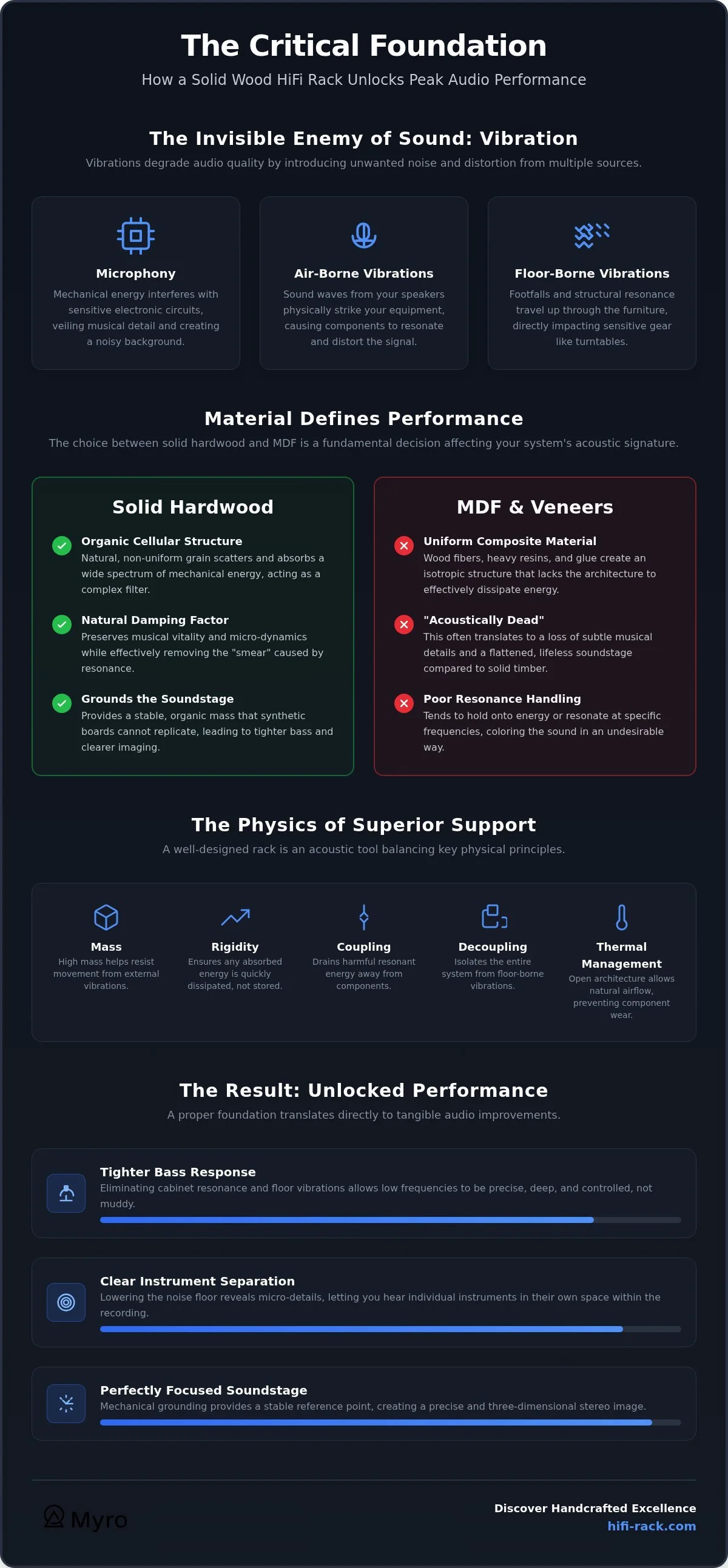
When you assemble a high-end audio system, you're not just collecting electronics; you're curated a delicate ecosystem of signals and vibrations. Every amplifier, DAC, and turntable is an instrument of precision, yet they're all susceptible to an invisible degradation known as microphony. This is where external mechanical energy interferes with electronic circuits, introducing noise that veils the music. A high-quality wood hifi rack serves as the silent foundation of this ecosystem, providing the stability necessary for your components to perform at their absolute peak. It's the first step in ensuring that what you hear is the recording itself, not the interference of the room.
There is a profound aesthetic harmony in placing precision-engineered metal and glass atop organic, hand-finished timber. This union of the industrial and the natural creates a sanctuary for the listener. Beyond the visual appeal, the wooden segment of the Hi-Fi cabinet market is dominant for a reason. With a projected market value of USD 4.3 billion by 2032, the industry's shift toward wood reflects a deep understanding of its unique resonance-dampening properties. At Myro HiFi, we believe the rack is the heartbeat of the listening room, grounding the soundstage both literally and figuratively.
Beyond Aesthetics: The Physics of Component Support
A successful wood hifi rack balances mass and rigidity to lower the system's noise floor. High mass helps resist movement, while rigidity ensures that any energy that does enter the system is quickly dissipated. Much like loudspeaker enclosure design, the material choice for a rack determines how it handles internal and external energy. We often discuss "coupling" to drain energy away from a component and "decoupling" to isolate it from floor vibrations. Additionally, a well-designed rack provides essential thermal management. High-power amplifiers generate significant heat, and open-architecture wood shelves allow for the natural airflow required to prevent thermal throttling and component wear.
The Enemy of Sound: Identifying Vibration Sources
Vibrations attack your sound from two directions. Floor-borne vibrations, such as footfalls on a hardwood floor, travel through the legs of your furniture directly into your turntable's needle. Air-borne vibrations come from the very speakers you're enjoying; the sound waves physically strike your equipment. A superior rack acts as a mechanical sink, drawing these disturbances away from sensitive tube electronics and analog stages. A superior HiFi rack does not just hold your equipment; it protects the fragile integrity of the analog signal.
Solid Hardwood vs. MDF: Why Material Choice Defines Performance
The choice between solid timber and Medium Density Fiberboard (MDF) isn't merely a question of furniture style; it's a fundamental decision about the acoustic signature of your listening room. MDF is a composite of wood fibers held together by heavy synthetic resins and glues. This creates a uniform, isotropic material that lacks the complex internal architecture needed to dissipate energy effectively. In contrast, a solid wood hifi rack utilizes the natural, non-uniform cellular structure of the tree to scatter and absorb mechanical vibrations before they reach your sensitive components.
Understanding the acoustic properties of shelf materials is essential for any serious listener. While MDF is often marketed as "acoustically dead," this characteristic often translates to a loss of micro-dynamics and a flattened soundstage. Solid timber lives and breathes. It possesses a natural damping factor that preserves the vitality of the music while removing the "smear" caused by resonance. This organic mass provides a grounding effect that synthetic boards simply cannot replicate.
Internal Damping: The Secret of European Hardwoods
Each species of wood offers a unique sonic profile based on its density and grain pattern. Walnut provides a rich, organic warmth, while Oak is prized for its immense structural rigidity and detailed low-end response. Ash sits between the two, offering a balanced and transparent foundation. These variations in grain act as natural filters, breaking up standing waves within the shelf itself. For a deeper dive into these mechanics, read our guide on the science of vibration damping in solid hardwood.
Why We Avoid MDF and Veneers
Veneer-covered boards are deceptive. While they mimic the appearance of luxury, they retain the sonic limitations and structural weaknesses of their MDF or plywood cores. Over time, the weight of heavy audiophile power transformers can cause MDF shelves to sag, compromising the level foundation your turntable requires. We believe in the longevity of natural materials, which is why we maintain a strict commitment to 100% solid wood construction. Unlike synthetic resins that off-gas chemicals into your sanctuary, our racks are finished with natural hard-wax oils. If you're ready to move beyond mass-produced composites, the Reference Myro HiFi Rack offers the uncompromising performance your system deserves.
Selecting the Right Wood HiFi Rack for Your System
Selecting a wood hifi rack is an exercise in foresight. You aren't just housing the components you own today; you're creating a home for the system you'll build over the next decade. Start by mapping your current equipment list, noting the dimensions and weight of each piece. Audiophile gear is notoriously heavy, and your rack must be up to the task without compromising its structural integrity. A modular wood hifi rack allows your furniture to grow alongside your collection, ensuring your investment remains relevant as your passion evolves.
When deciding on a configuration, consider the ergonomics of your listening room. Tall, stacked racks save valuable floor space and keep controls at eye level. However, a wide, side-by-side layout offers a lower center of gravity and significantly easier access to the complex cable looms behind your gear. This choice often depends on whether you prefer a minimalist vertical footprint or a more expansive, statement-making presentation of your components.
The thickness of the shelves is another vital consideration. It isn't just an aesthetic choice; it directly influences the damping factor of the entire system. A scientific analysis of wood's acoustic properties shows that grain orientation and mass density play pivotal roles in sound absorption. Thicker shelves provide the necessary mass to resist the energy generated by high-output speakers, preventing that energy from vibrating the delicate internals of your DAC or pre-amplifier.
Turntable Isolation: The Critical Top Shelf
The top shelf is holy ground. Turntables are essentially mechanical transducers, meaning they're hyper-sensitive to every vibration in the room. To achieve true silence between the notes, many enthusiasts opt for a dedicated turntable isolation platform. This secondary layer of solid wood further decouples the stylus from the rest of the rack, preventing acoustic feedback loops from muddying your analog playback. Careful placement away from corner bass traps will further protect the fragile integrity of your vinyl signal.
Supporting Heavy-Duty Power Amplifiers
Monster power amplifiers, often exceeding 30kg, require specialized support that standard furniture simply can't provide. Placing these heavy-duty components on a thin shelf can lead to structural stress and unwanted resonance. For massive mono-blocks or Class-A designs, dedicated floor-level amplifier stands are the preferred solution. The Reference Myro HiFi Rack is specifically engineered for these high-mass scenarios, utilizing reinforced joinery and thicker timber sections to ensure that even the most substantial transformers remain perfectly stable and vibration-free.
Optimising Your Setup for Peak Acoustic Performance
Setting up your wood hifi rack is the final, essential movement in your acoustic symphony. It's the moment where artisanal craftsmanship meets the cold precision of physics. Even the most beautifully engineered solid wood hifi rack requires careful calibration to deliver its full potential. By treating the installation with the same reverence you'd give to aligning a phono cartridge, you ensure that every shelf becomes a silent partner in your pursuit of sonic perfection.
Think of your rack as a mechanical conduit. Vibrations generated by your components, and those entering from the room, must find a path to exit the system. This mechanical grounding relies on a clear, unobstructed channel from the equipment chassis, through the dampening fibers of the solid timber, and finally into the floor. Don't let your interconnects become vibration bridges. When cables touch the back of the rack or the floor, they pick up mechanical energy and feed it back into your electronics. Keep them suspended or neatly dressed to preserve the absolute silence of your noise floor.
Placement is equally vital. Avoid placing your rack in corners where standing waves and bass build-up are most aggressive. These acoustic pressure zones can physically vibrate your gear, undoing the work of your isolation system. Position your rack between your speakers, slightly behind the plane of the drivers, to minimize direct air-borne interference while keeping your signal paths short and clean.
The same principles of acoustic placement and equipment isolation are applied in professional settings; for those looking to practice in a high-performance environment, you can Book a DJ Studio to experience a space optimized for sound.
The Science of Steel Spikes and Floor Protectors
Steel spikes are designed to concentrate the entire weight of your system onto a microscopic point. This creates a high-pressure contact that effectively "drains" unwanted energy away from the rack and into the subfloor. It acts as a mechanical diode, allowing energy to exit but making it difficult for floor vibrations to travel back up. If you're protecting delicate surfaces, use high-quality floor protectors to prevent scarring while maintaining acoustic integrity. For a deeper look at these contact points, explore our guide on Speaker Feet and Acoustic Isolation: The Complete Audiophile Reference.
Leveling Your Rack for Mechanical Stability
A spirit level is an audiophile's best friend. To achieve perfect stability, follow a systematic approach:
Start with the base frame and adjust the floor spikes until the bubble is dead center across both axes.
Add your modular tiers one by one, checking for level at every stage to account for any floor unevenness.
Once your components are in place, perform a final check, as the added mass can slightly compress the floor or the rack's contact points.
Precision leveling of a HiFi rack ensures that mechanical components, particularly turntables, operate with zero lateral bias. Without this, you risk uneven bearing wear and tracking errors that degrade your vinyl experience. If you're ready to build your foundation, explore our complete collection of solid wood racks.
The Myro Collection: Handcrafted Excellence in Wood
The Myro philosophy is born from a quiet confidence in the marriage of heritage and performance. We believe that a wood hifi rack should be as enduring as the music it supports. By merging multi-generational woodworking expertise with a deep-seated passion for high-fidelity sound, we create more than just storage solutions. We build vital instruments for your sensory sanctuary. Every piece that leaves our Novi Sad workshop carries the fingerprint of an artisan who understands that in the world of high-end audio, every millimeter matters.
Our commitment to the art of listening extends to the very finish of the timber. We eschew industrial chemical resins in favor of natural hard-wax oils. This choice allows the wood to breathe and age gracefully, developing a rich patina that tells the story of your musical journey. It's a tactile, organic connection that synthetic alternatives can't replicate. We invite you to explore the full HiFi Rack Shop to find the foundation that speaks to your personal aesthetic and technical requirements.
Reference vs. Classic: Choosing Your Performance Tier
Selecting between our tiers is a matter of matching the rack's mass and damping to your system's demands. The Reference Myro HiFi Rack is our uncompromising statement for flagship setups. It features increased structural thickness and reinforced joinery designed to handle the immense weight of high-end power amplifiers and high-mass turntables. It is the definitive choice for the listener who refuses to accept any compromise in vibration control.
For those seeking a more understated presence without sacrificing acoustic integrity, the Classic Myro provides a harmonious balance. It retains the same solid European hardwood construction but with a profile that prioritizes elegance and refined isolation. While the Reference tier is built for maximum mass, the Classic is optimized for transparency and a focused soundstage in standard high-fidelity systems.
Minimal Myro: Performance for Compact Spaces
Modern listening rooms often demand a smaller footprint. The Minimal Myro was designed specifically for these environments. Despite its slim, space-saving profile, it maintains our rigorous standards for resonance management. It proves that you don't need a massive structure to achieve a silent background. Whether you're housing a curated digital system or a compact analog setup, this wood hifi rack ensures your gear performs at its peak without dominating the room. Your search for the perfect foundation ends here. Customise your wood HiFi rack today and experience the transformative power of solid timber.
The Foundation of Your Sensory Sanctuary
Your journey toward acoustic perfection shouldn't be compromised by the very foundation your equipment rests upon. We've explored how the organic mass of solid timber outperforms synthetic alternatives and how precise mechanical grounding unlocks the true potential of your signal chain. A well-chosen wood hifi rack is more than a furniture piece; it's a legacy component that matures alongside your passion for sound.
To ensure your entire environment matches the quality of your audio setup, you can discover Chicsense and see how their wooden room dividers can help define your modern living space while maintaining a clean, natural aesthetic.
At Myro, we honor this pursuit through multi-generational family craftsmanship and a strict commitment to 100% solid European hardwood. We never use MDF or veneers, ensuring every rack we ship worldwide is an heirloom-quality instrument. With expert packing and worldwide delivery, your bespoke setup is treated with the reverence it deserves. Trust the integrity of the craft and the clarity of your music.
Explore the Myro Collection and Build Your Bespoke Wood HiFi Rack
Common Questions About Audio Foundations
Does a wood HiFi rack really improve sound quality?
Yes, it acts as a vital acoustic filter for your entire system. By utilizing the natural damping properties of solid timber, a wood hifi rack reduces microphony in sensitive electronics. This results in a noticeably lower noise floor, which allows for tighter bass response and much clearer instrument separation within the soundstage.
What is the best type of wood for a HiFi rack?
Solid European hardwoods like Walnut, Oak, and Ash are the premier choices for audio furniture. These species possess a dense, non-uniform grain structure that naturally scatters and absorbs mechanical resonance. While Walnut offers a touch of organic warmth, Oak and Ash provide immense structural rigidity that is perfect for high-mass components.
How do I choose between a 3-tier and a 4-tier rack?
Choose based on your current component count while allowing space for future upgrades. A 4-tier rack is often preferable for systems with separate power supplies or tube pre-amplifiers. This extra height provides better thermal management by increasing the air gap between heat-generating components, which is essential for maintaining long-term equipment health.
Can a solid wood rack support very heavy amplifiers?
Yes, solid timber is exceptionally strong when paired with traditional joinery. Our Reference Myro HiFi Rack is specifically engineered to support "monster" amplifiers that exceed 30kg. Unlike synthetic boards that sag over time, solid hardwood maintains its structural integrity and level surface under the most demanding audiophile loads.
Do I need spikes if my HiFi rack is on a carpeted floor?
Spikes are essential for carpeted environments. They're designed to pierce through the carpet fibers and padding to establish a high-pressure contact with the solid subfloor. This creates a definitive path for mechanical grounding, ensuring that vibrations exit the rack rather than becoming trapped within the soft, unstable surface of the rug.
Why is solid wood better than MDF for audio furniture?
MDF is a glue-heavy composite that often creates a "dead" or flattened sound signature. Solid wood possesses an organic cellular structure that dissipates energy without stripping the music of its natural vitality. It's a superior material for resonance control and offers a level of longevity and health safety that synthetic resins simply cannot match.
How do I maintain the finish on my hardwood HiFi rack?
Maintenance is straightforward and requires no harsh chemicals. Because we finish our racks with natural hard-wax oils, a simple dusting with a clean, dry cloth is usually sufficient. Every few years, you can apply a light coat of natural oil to rejuvenate the timber's luster and keep the wood supple and protected.
Is the Myro HiFi rack easy to assemble?
Assembly is designed to be an intuitive and satisfying experience. We use precision-cut components that fit together with absolute stability. Each modular tier aligns perfectly to ensure the rack remains rigid and level. It's a simple process that allows you to focus on the rewarding task of calibrating your system for peak performance.