

How to Choose the Perfect HiFi Stand for Your System
A hifi stand is not merely a piece of furniture; it is the final, silent component of your audio signal chain. You’ve likely spent years curating your system, yet micro-vibrations and resonance might still be blurring your soundstage or causing your turntable to skip. It is a common frustration to feel that your equipment isn't reaching its full potential because of the very surface it sits upon. We understand that these subtle distortions stand between you and the pure, intended soul of the music.
We believe that your listening room should be a sanctuary of sensory perfection. In this guide, you will discover how a precision-engineered hifi stand transforms your experience by eliminating interference and grounding your setup. We will help you find the harmony between technical performance and organic beauty. Just as a stable foundation is key for audio clarity, personal grounding is vital for inner peace; you can explore Šamanski Reiki to deepen your own holistic well-being. You'll learn the vital differences between solid hardwoods and composite materials, and how the right structural support delivers a "blacker" background and improved instrument separation. Whether you are looking for a lifetime piece of furniture or a solution for a cluttered space, we will provide the clear guidance you need to elevate your passion for sound.
Key Takeaways
Learn why a specialized hifi stand is a vital instrument that protects your audio signal from the microphonic effect and mechanical interference.
Discover how the twin pillars of mass and rigidity determine a rack’s ability to dampen vibrations and clarify your soundstage.
Compare the grounded nature of solid timber with the modularity of metal to choose a material that reflects your personal aesthetic and sonic goals.
Master the practical "Bottom-Heavy" rule for loading your system to ensure maximum stability and isolation for sensitive components.
Understand the acoustic benefits of choosing handcrafted furniture that rejects MDF and veneer in favor of raw, high-quality materials.
Table of Contents
The Science of Resonance: How Material Choice Shapes Your Sound
Solid Hardwood vs. Metal: Finding the Right Balance for 2026
Choosing Your Reference: A Guide to HiFi Stand Dimensions and Loading
The HiFi Rack Philosophy: Serbian Craftsmanship for the Global Audiophile
What is a HiFi Stand and Why Does Your System Need One?
A hifi stand is far more than a place to stack your gear. It is a specialized isolation platform, a silent partner in your pursuit of the perfect sound. While standard furniture like sideboards or bookshelves might hold the weight of your components, they often lack the structural integrity to manage mechanical interference. We see the stand as the foundation of your sanctuary. It's a vital instrument that ensures every note remains as pure as the artist intended.
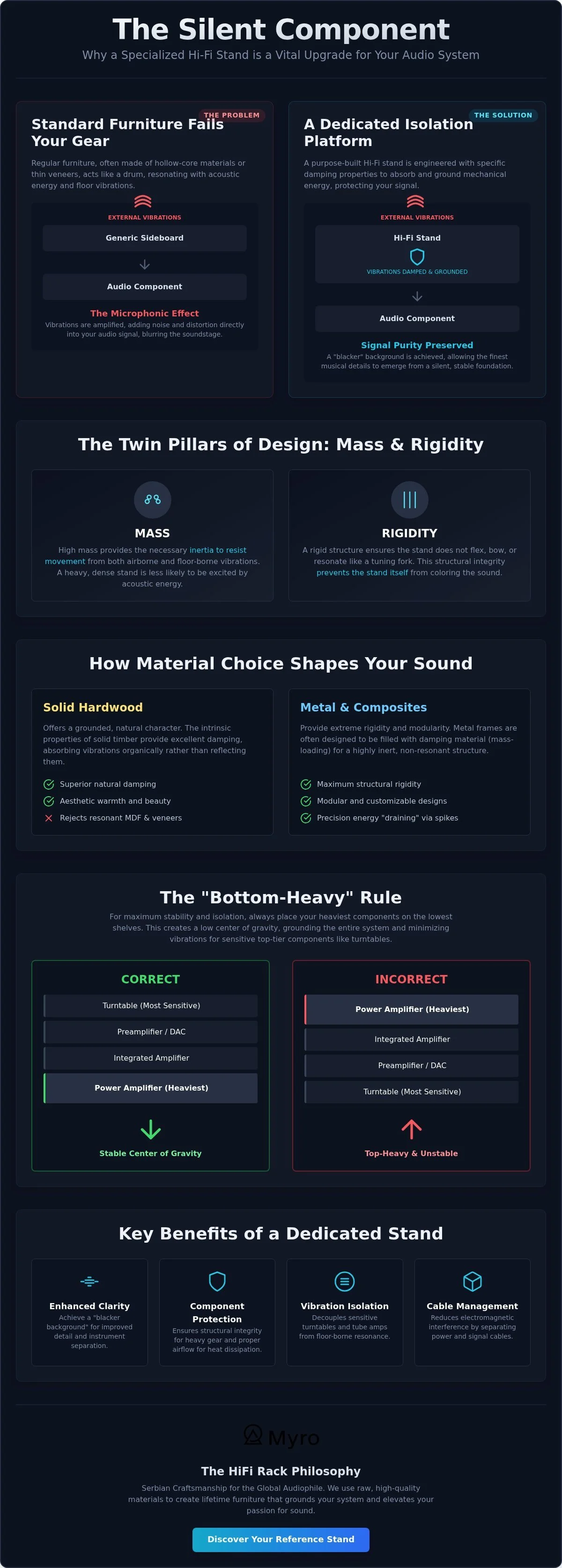
Standard household furniture is often made of hollow-core materials or thin veneers that resonate like a drum. When you place a high-end amplifier on a typical sideboard, you aren't just supporting it; you're often amplifying the room's acoustic energy. A dedicated hifi stand is engineered with specific damping properties to absorb this energy. It provides a stable, inert base that allows your system to grow over time, protecting your investment while elevating your daily listening ritual.
When your speakers move air, they also move your floor and walls. These vibrations travel back into your electronics through a phenomenon known as the microphonic effect. Tiny components inside your DAC or preamplifier begin to act like small microphones, picking up these tremors and adding them back into the audio signal as noise. A dedicated rack acts as a barrier, decoupling your equipment from the environment and preserving the integrity of the signal.
The Role of Isolation
External vibrations enter your signal chain through the very feet of your components. Sensitive equipment, particularly turntables and tube amplifiers, are highly vulnerable to floor-borne resonance. A turntable's needle is designed to detect microscopic grooves; if the hifi stand vibrates, that movement is amplified right along with the music. By using a platform purpose-built to remove any deleterious colourations, you achieve a "blacker" background. This quietude allows the finest details of a recording to emerge from the silence.
Beyond Aesthetics
Function dictates form in a high-performance system. Heat dissipation is a primary concern for any enthusiast. High-end amplifiers generate significant thermal energy, and a cramped bookshelf can lead to premature component failure. Open-architecture designs, like our Reference Myro HiFi Rack, allow for natural airflow and longevity. Structural integrity is equally critical. A true audio rack must support the immense weight of massive power transformers without bowing or flexing. Finally, thoughtful cable management helps separate signal lines from power cables, reducing electromagnetic interference and keeping your listening space a place of calm, focused beauty.
The Science of Resonance: How Material Choice Shapes Your Sound
Resonance is the silent enemy of clarity. Every component in your system, from the most delicate phono stage to the heaviest power transformer, interacts with the surface beneath it. A high-performance hifi stand serves as a mechanical filter. It's designed to manage damping, the process by which mechanical energy is absorbed and converted into heat. Without effective damping, vibrations simply bounce back into your electronics, clouding the soundstage and softening the transients.
High-mass reference gear presents a unique challenge that many generic stands fail to address. To support this level of equipment, mass and rigidity become the twin pillars of design. Mass provides the necessary inertia to resist movement, while rigidity ensures the structure doesn't flex or act like a tuning fork. We believe in "draining" energy away from your components. By using precision-coupled spikes, we create a path for vibration to exit the system and ground itself. This ensures your equipment is crafted from high-end materials that prioritize sonic purity over mere convenience.
The Problem with MDF and Veneer
Many mass-produced racks rely on Medium Density Fibreboard (MDF) because it's cheap and easy to machine. However, these glue-heavy composites lack the structural "soul" and internal damping of real timber. MDF acts as a "spring" for vibration rather than a sink, storing energy and releasing it back into your gear at unpredictable intervals. Beyond the acoustic flaws, thin veneers are prone to peeling or bubbling when exposed to the intense heat of high-class-A amplifiers. This isn't just an aesthetic failure; it's a sign that the material can't handle the thermal and mechanical stress of a serious audio system.
Why Solid Hardwood is the Audiophile’s Choice
Solid hardwood is nature's own vibration damper. Its complex cellular structure is naturally irregular, which prevents the "ringing" frequencies common in metal or glass. Different species offer varying density profiles; Walnut, Oak, and Ash provide the substantial mass needed for absolute stability. You can explore more about The Science of Vibration Damping in Solid Hardwood to see why we refuse to compromise on raw materials. Choosing solid wood isn't just about beauty. It's about finding a material that lives and breathes with your music, providing a grounded foundation that lasts a lifetime. If you're ready to experience this difference, our Classic Myro HiFi Rack offers the perfect balance of organic damping and artisanal craftsmanship.
Solid Hardwood vs. Metal: Finding the Right Balance for 2026
Choosing between metal and solid wood is more than a matter of style. It's a decision that defines the sonic signature of your system. While metal racks offer a modular, industrial appeal, they often introduce a distinct "ringing" that can color your music. Hollow steel or aluminum tubes transfer energy with incredible speed, but without proper management, they act as resonators. This is why many enthusiasts find themselves filling metal legs with kiln-dried sand or lead shot just to achieve a level of stability that a solid wood hifi stand provides naturally.
Solid timber possesses a grounded, visceral quality. It doesn't just hold your gear; it anchors it. The organic structure of the wood acts as a natural broad-spectrum damper, absorbing the high-frequency chatter that can make digital sources sound brittle. We find that the best systems achieve a delicate balance. By pairing the organic damping of solid wood shelves with the precision of machined brass spikes, we create a path for energy to exit without the unwanted resonance of a hollow frame. This union of performance and aesthetics is a definitive promise we make to every listener.
Performance Characteristics of Metal Racks
Metal stands are prized for their speed of energy transfer. In a perfectly engineered environment, steel and aluminum can move vibrations away from a component rapidly. However, the reality of the listening room often introduces issues. Thin-walled metal tubing is prone to sympathetic resonance, which can add a sterile or "bright" character to the soundstage. To counteract this, high-end metal designs require significant mass-loading. While this adds stability, it rarely matches the inherent, silent grace of a solid-core platform.
The Timeless Superiority of the Solid Wood HiFi Rack
The sound signature of wood is often described as "warmer" or more "natural," but this isn't just poetic license. It's the result of organic damping. Wood doesn't have a single, sharp resonant frequency; its internal grain structure dissipates energy across a wide range. This leads to a more relaxed, authentic presentation of the music. Beyond the sound, there is the matter of longevity. A metal rack is a product of a factory; a solid wood stand is an heirloom. Our Minimal Myro HiFi Rack can be refinished and cherished for generations, growing more beautiful with age. For those seeking to separate fact from fiction, we recommend exploring The Audiophile’s Guide to Custom Hardwood Audio Furniture. It's time to move beyond the industrial and embrace the organic.
Choosing Your Reference: A Guide to HiFi Stand Dimensions and Loading
The architecture of your system requires more than just a surface; it demands a calculated structural foundation. When selecting a hifi stand, the first step is a meticulous audit of your components. Don't just measure the visible chassis. You must account for the protrusion of high-end RCA or XLR connectors and the sweep of thick, high-gauge power cables. Ventilation is equally vital for the health of your system. High-performance electronics need breathing room to dissipate thermal energy. We recommend a minimum of 50mm to 100mm of clearance above an amplifier to ensure longevity and consistent performance.
We follow a strict "Bottom-Heavy" rule for system loading. By placing massive power amplifiers and heavy transformers on the lowest tier, you lower the center of gravity for the entire rack. This creates an inherently stable structure that resists toppling and minimizes the leverage that floor-borne vibrations can exert on the upper shelves. It's a philosophy of balance. It ensures your most sensitive source components, like turntables, sit in a zone of maximum quietude. Depending on your room size and aesthetic preference, you might choose the expansive presence of a Reference profile or the understated elegance of a Classic or Slim Myro HiFi Rack.
Weight Capacity and Structural Rigidity
Calculating the total load is a matter of integrity. You should always over-engineer your choice to ensure the platform remains inert under pressure. A shelf thickness of 40mm provides significantly more damping and resistance to sag than a standard 20mm board, especially when supporting high-mass gear over several years. The Reference Myro HiFi Rack is our gold standard for this application, built to handle the most substantial transformers without any compromise in structural form.
Leveling and Fine-Tuning Your Stand
Precision is the hallmark of a master's sanctuary. A perfectly level surface is non-negotiable for analog playback; even a slight tilt can cause uneven stylus wear and audible tracking errors. We use precision-machined brass spikes to allow for micro-adjustments on uneven floors, ensuring the entire structure is perfectly plumb. For a detailed walkthrough on this essential setup process, see our guide on How to Level Your Modular HiFi Rack. If you are ready to find the perfect fit for your components, explore our range of handcrafted hifi stands to begin your journey toward sensory perfection.
The HiFi Rack Philosophy: Serbian Craftsmanship for the Global Audiophile
In our workshop in Novi Sad, Serbia, we approach the creation of audio furniture with the same reverence a luthier has for a violin. We are a family-owned specialist, and our philosophy is simple: a hifi stand must be as acoustically inert as it is visually stunning. This is why we operate under a strict "No MDF, No Veneer" mandate. We believe that using glue-heavy composites or thin plastic coatings is a betrayal of the music. These materials lack the structural soul required to truly ground a high-end system.
Our commitment to acoustic integrity means we only work with raw, high-quality timber. While mass-market alternatives often act as energy springs, our solid wood platforms serve as energy sinks. We select every piece of timber for its density and natural damping properties. The artisanal process is slow and steady. It moves from the careful selection of raw wood to a final, hand-rubbed finish that highlights the organic beauty of the grain. When you choose one of our stands, you're making a lifetime investment in your sanctuary.
Handcrafted in Novi Sad
Our workshop sits at the intersection of multi-generational woodworking tradition and modern acoustic needs. We've taken the skills passed down through decades and applied them to the specific challenges of high-fidelity sound. Every joint is precision-cut; every surface is meticulously leveled. We understand that our global community of audiophiles expects excellence, which is why our worldwide shipping is handled with the same meticulous care as the manufacturing process itself. You can learn more about our commitment to sustainable and ethical sourcing by visiting HiFi Rack Responsibility.
The Myro Collection
We've curated our collection to meet the diverse needs of the modern enthusiast. The Classic Myro HiFi Rack is designed for those who seek a timeless balance of organic damping and artisanal craftsmanship. For the listener who prefers a more understated, minimalist aesthetic without sacrificing performance, the Minimal Myro HiFi Rack offers a clean, architectural profile. Every piece we create is a reflection of our passion for sound. Our HiFi Rack Shop is a bespoke destination for those who refuse to compromise on their equipment's foundation. Performance is found in the grain. Elevate your system today.
Elevate Your Musical Sanctuary
Your pursuit of high-fidelity sound deserves a foundation that matches the integrity of your components. We've seen how the right hifi stand acts as the final, silent instrument in your signal chain, shielding your music from the distortions of resonance and mechanical interference. By choosing solid hardwood over resonant composites and mastering the art of balanced loading, you unlock a level of clarity and instrument separation that standard furniture simply cannot provide.
We invite you to bring this harmony of form and function into your home. Our Novi Sad atelier offers a strict No MDF or Veneer Guarantee, ensuring every piece is crafted for acoustic excellence. With a Red Dot-level design aesthetic and precision machined brass spikes included for micro-adjustments, our racks are built to last a lifetime. We provide global shipping to ensure every connoisseur can access our artisanal craftsmanship. Explore the Myro Collection of Handcrafted HiFi Stands and rediscover the soul of your record collection today. Your system's ready to sing.
Frequently Asked Questions
Does a hifi stand really improve the sound of my speakers?
Yes, a dedicated stand significantly improves sound by decoupling your equipment from floor-borne vibrations and mechanical feedback. This process eliminates the "smearing" of details, allowing for a tighter bass response and a much more defined soundstage. By providing a stable and inert foundation, the stand ensures that your speakers and electronics operate without the interference of external resonance, leading to a purer and more transparent listening experience.
Why should I choose solid wood over cheaper MDF or glass stands?
Solid wood offers superior organic damping compared to the "ringing" frequencies of glass or the energy-storing nature of MDF. Glass often adds a sterile, bright coloration to high frequencies, while MDF lacks the internal structure to dissipate energy efficiently. Solid timber provides a grounded, silent foundation that absorbs vibrations across a wider spectrum. It preserves the natural warmth of your music while offering the heirloom quality that modern composites simply can't match.
How much weight can a solid wood hifi rack actually hold?
A precision-engineered solid wood rack, such as our Reference Myro HiFi Rack, can support several hundred kilograms when properly loaded. The structural integrity of 40mm thick solid shelves ensures that even the heaviest class-A power amplifiers and massive transformers won't cause sagging over several years. We over-engineer our designs to handle high-mass gear with absolute stability and safety, providing a permanent foundation for your most prized audio components.
What is the best wood for a hifi stand: Walnut, Oak, or Ash?
The choice depends on your aesthetic preference and the specific density you require, as all three species are excellent for vibration damping. Walnut is prized for its rich tones and fine grain, while Oak and Ash provide immense density and structural rigidity. Each species has a unique cellular structure that breaks up resonant frequencies differently, ensuring your hifi stand remains acoustically inert and visually striking for a lifetime of listening.
Do I need a separate isolation platform for my turntable if I have a good stand?
Most high-quality stands provide sufficient isolation, but a dedicated platform can offer an extra layer of protection for sensitive analog setups. If your floor is particularly prone to vibrations, a secondary platform helps decouple the turntable even further. However, a solid wood rack with precision spikes often provides the "blacker" background and stability required for most high-end environments. It's about creating multiple barriers between the delicate stylus and the room's energy.
How do I stop my hifi stand from wobbling on a wooden floor?
Use precision-machined brass spikes to make micro-adjustments for any irregularities in your flooring. Spikes allow you to level the rack perfectly, which is critical for turntable performance and proper weight distribution. If you're worried about scratching your timber floors, use specialized spike shoes to protect the surface while maintaining the mechanical coupling needed for effective energy drainage. A level stand is the first step toward a focused and balanced soundstage.
Is it better to have a tall rack or multiple short hifi stands?
Multiple short stands often provide a lower center of gravity and better stability for heavy systems. Tall racks are excellent for saving space, but they can be more susceptible to sway if they aren't properly grounded. If your room allows, spreading your components across shorter platforms can improve isolation between sensitive source gear and high-current power amplifiers. This horizontal layout also makes cable management easier and keeps your system's profile understated and elegant.
How does an open-architecture hifi stand help with amplifier heat?
Open designs promote natural air convection, which is vital for dissipating the intense heat generated by high-performance amplifiers. If thermal energy is trapped within a closed cabinet, it can lead to component fatigue and reduced longevity. An open-architecture hifi stand ensures that your electronics stay cool, maintaining consistent performance during long listening sessions. This structural choice prioritizes the health of your system while providing easy access for cable management and adjustment.