

Keeping Audio Cables Off the Floor: The Audiophile’s Guide to Isolation
Is your high-fidelity system truly isolated if its most sensitive signal pathways are resting on the very surface that vibrates with every bass note? I've often found that even the most carefully curated setups can fall victim to a subtle, persistent hum or a loss of micro-dynamics simply because the cables are left to interact with the floor. You've likely felt that same frustration, sensing that your system has more to give but isn't quite reaching its full potential. The practice of keeping audio cables off the floor isn't just about aesthetics; it's a technical commitment to preserving the integrity of every note.
We understand the reverence you have for your listening space. You've invested in the natural damping of solid hardwood and the structural integrity of a Reference Myro HiFi Rack to create a foundation for excellence. This guide will show you how elevating your cables completes that sanctuary, lowering the noise floor and revealing the hidden details in your favorite recordings. We'll look at the science of vibration and static reduction, providing you with a clear path to a cleaner, more professional-looking system that sounds as pure as it looks.
Key Takeaways
Understand how microphonics and the dielectric effect introduce unwanted noise and signal degradation into your system.
Master the technical necessity of keeping audio cables off the floor to prevent capacitive interaction with carpets and hard surfaces.
Learn professional cable dressing techniques to strategically separate power, digital, and analog paths for maximum sonic clarity.
Discover how the open architecture of a solid hardwood foundation, like the Reference Myro HiFi Rack, supports a holistic isolation strategy.
Elevate your listening experience by refining the mechanical details that lower the noise floor and reveal delicate micro-dynamics.
The Audiophile’s Dilemma: Why Keeping Audio Cables Off the Floor Matters
I've spent countless hours refining my listening space, searching for that elusive point where the equipment disappears and only the music remains. It's a journey of inches and degrees. Often, the most overlooked detail is right under our feet. Cable isolation is the deliberate practice of suspending audio leads to shield them from mechanical and electrical interference. It marks the transition from a merely functional setup to a high-fidelity sanctuary. When we leave our cables to rest on the floor, we're inviting the environment to color our sound in ways that are often subtle but undeniably detrimental.
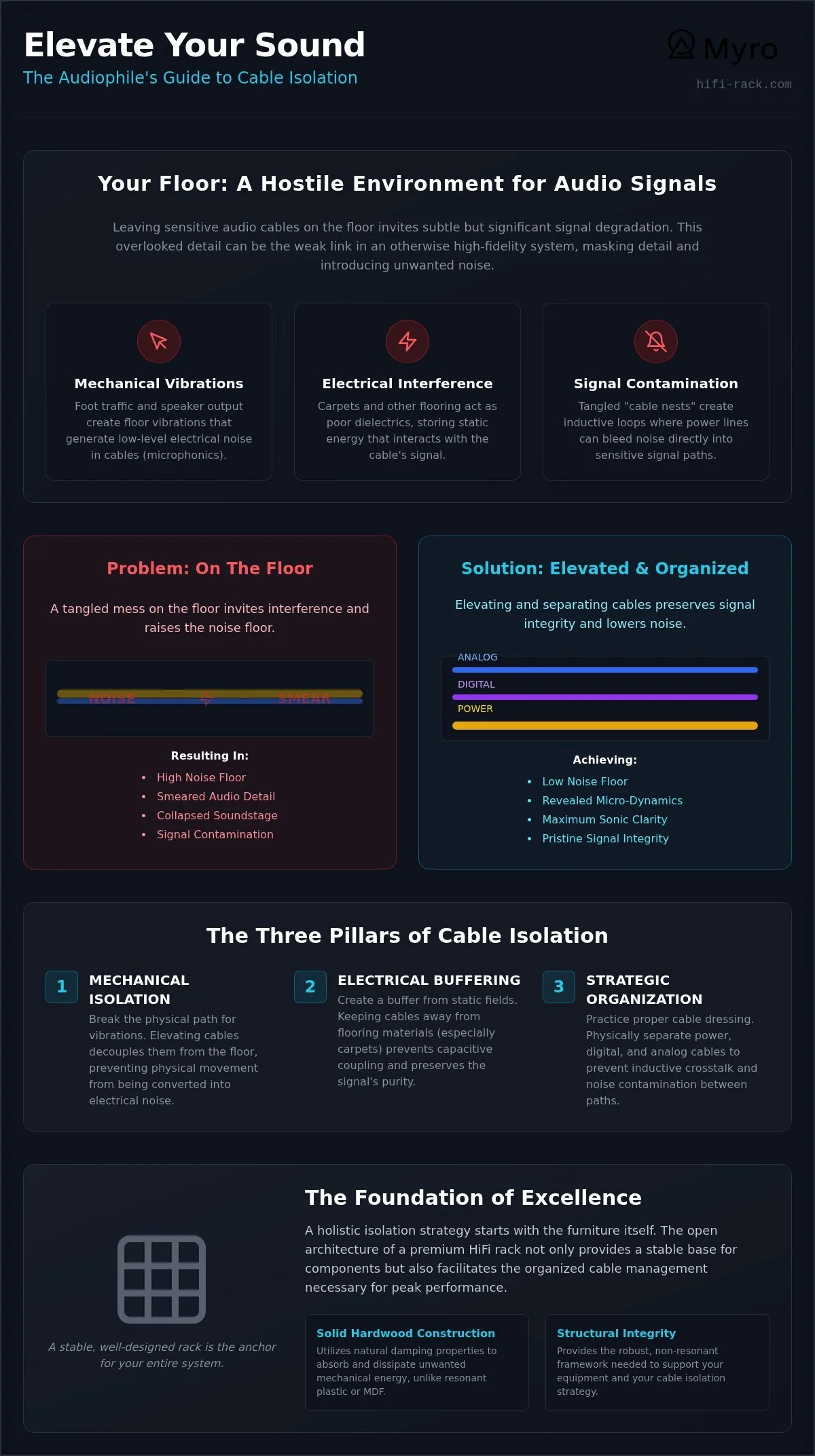
The floor is a surprisingly hostile environment for sensitive analog and digital signals. Between the static charge inherent in synthetic carpet fibers and the mechanical vibrations traveling through the subfloor, your cables are under constant assault. By keeping audio cables off the floor, you create a physical and electrical buffer that preserves the signal's purity from the moment it leaves the amplifier until it reaches the drivers. This isn't just about tidiness; it's about protecting the integrity of the performance.
The Three Pillars of Cable Isolation
Mechanical: Floor-borne vibrations from your speakers or foot traffic can travel into the cable jacket. This creates microphonics, where physical movement is converted into low-level electrical noise.
Electrical: Many floor materials act as poor dielectrics. Understanding the electrical properties of speaker wire reveals how capacitance and inductance can be negatively influenced when a cable sits directly on a surface that stores static energy.
Organization: A "cable nest" behind a rack isn't just an eyesore. It creates inductive loops where power cables can bleed noise into sensitive signal lines. Proper elevation allows for strategic spacing.
Aesthetic Harmony in the Listening Room
There is a psychological weight to visual clutter. When your eyes are met with a chaotic tangle of wires, your brain finds it harder to relax into the soundstage. A clean, organized environment fosters a deeper sensory connection to the music. We believe that the foundation of this harmony starts with the furniture itself. Our Reference Myro HiFi Rack is built from solid hardwood to provide natural damping that plastic or MDF cannot match. It serves as the anchor for your system, providing the structural integrity needed to frame your cable strategy with artisanal pride and quiet confidence.
Mechanical and Electrical Interference: The Science of Cable Isolation
When we discuss the floor in a listening room, we're not just talking about a structural surface. We're talking about a reservoir of stored energy and mechanical noise. The science behind keeping audio cables off the floor rests on two primary pillars: mechanical vibration and electrical interaction. While a cable may look like a passive conduit, it's actually a sensitive instrument that reacts to its environment. When it rests directly on a surface, it becomes part of that surface's physical and electrical ecosystem, often to the detriment of the audio signal.
Microphonics is perhaps the most misunderstood element of cable performance. It's the process where physical vibrations are converted into electrical signals. As your speakers move air, they also send energy through the floor. If your cables are lying flat, they absorb these vibrations. This kinetic energy causes the conductors within the cable to move slightly against the insulation, creating low-level electrical noise that smears detail and collapses the soundstage. By elevating the cable, you break this direct physical coupling, allowing the signal to travel in a state of relative calm.
The electrical interaction is equally critical. Every material has a dielectric constant, which measures its ability to store electrical energy. Air is the gold standard for insulators, with a dielectric constant of approximately 1.0. In contrast, common flooring materials like carpet, PVC, or concrete have much higher constants, often ranging from 2.0 to 5.0. When a cable sits on the floor, the flooring material acts as an unintended part of the cable's insulation system. This "dielectric absorption" can store and then release energy back into the signal path, causing phase shifts and timing errors that rob the music of its life and rhythmic precision.
Vibration Damping and Signal Integrity
Floor-borne resonance is relentless. High-mass cables are particularly susceptible to these external resonances, as their weight keeps them firmly coupled to the vibrating floor. This is why a holistic approach to isolation is necessary. I've found that starting with a solid hardwood foundation, such as the Reference Myro HiFi Rack, provides the natural damping required to keep the entire system's noise floor at a minimum. Hardwood doesn't ring like metal or store energy like MDF; it provides a quiet, organic base that simplifies the task of cable management.
Electromagnetic and Radio Frequency Interference (EMI/RFI)
Cables can inadvertently act as antennas. When long runs of speaker wire or interconnects lay flat on the ground, they're more likely to pick up RFI and EMI from the house's internal wiring or nearby electronics. Cable signal leakage is a documented phenomenon that illustrates how external noise can penetrate poorly managed signal paths. In high-end audio, EMI manifests as a loss of transparency and a harsh, "electronic" texture to the high frequencies. Elevating your cables even a few inches creates a critical distance from the floor-level power mains, significantly reducing the noise floor. For those seeking a more minimalist aesthetic while maintaining this level of performance, the Minimal Myro HiFi Rack offers an elegant way to organize your components and keep signal paths clear of interference.
Cable Dressing Techniques: Organizing Your System for Sonic Clarity
Cable dressing is the final, essential discipline of the dedicated listener. It's where the chaos of a functional setup is refined into the order of a high-fidelity sanctuary. I've spent years observing how a single misplaced power lead can degrade the noise floor. Keeping audio cables off the floor is the first step, but how you arrange them in the air is what defines the ultimate clarity of your system. It's about respecting the natural drape of the materials while enforcing a strict geometric logic that prevents unwanted interference.
The core of this discipline lies in managing tension. A cable should never be strained or forced into an unnatural position. Connectors are sensitive mechanical interfaces; if a heavy speaker cable pulls at an angle, it can compromise the contact pressure and introduce micro-distortions. I always ensure my leads hang with a graceful, unforced curve. This preserves the internal geometry of the conductors and ensures a secure, high-integrity connection at the terminal, protecting the delicate signals traveling through the path.
The 90-Degree Rule and Signal Separation
To achieve a truly black background, you must separate your signal types with intent. Power cables carry high-current AC that generates electromagnetic fields. If these run parallel to sensitive analog interconnects, you'll experience magnetic induction. Follow this three-step framework for a complete system overhaul:
Step 1: Map your power runs to the opposite side of the rack from your signal leads. This physical separation is your primary defense against noise.
Step 2: If a crossing is unavoidable, use the 90-degree technique. Crossing at a right angle minimizes the surface area of interaction and effectively cancels out the inductive coupling.
Step 3: Maintain maximum physical distance between low-level phono signals and mains power. These millivolt signals are the most susceptible to environmental noise and require the most isolation.
Lifting the Signal: Practical Riser Solutions
Once your paths are mapped, the physical lift begins. While many reach for plastic or foam, I prefer solid wood risers for their organic damping properties. Just as our Classic Myro HiFi Rack uses solid hardwood to manage resonance, wood risers provide a stable, non-conductive platform that doesn't ring or store static energy. This approach ensures that the act of keeping audio cables off the floor doesn't introduce new mechanical signatures into the signal.
Placement strategy is key to maintaining a clean layout. For a standard 3-metre speaker cable run, three to four lift points are typically sufficient to maintain a consistent elevation. Be wary of over-damping your system. If you use too many soft, rubberized supports, you can actually suck the life out of the high frequencies, leading to a dull or lifeless sound signature. The goal is a balanced, harmonious suspension that allows the cable to exist in a state of mechanical equilibrium, preserving every detail of the performance.
Integrating Cable Management into Your HiFi Furniture Layout
Your HiFi rack is the silent partner in your pursuit of sonic perfection. While we often focus on the components themselves, the structure that holds them dictates the physical path of every signal. A well-designed rack acts as the architecture for your cable strategy, providing the necessary clearance and structural points to manage the complex web of leads behind your system. By choosing a foundation built for performance, the task of keeping audio cables off the floor becomes a natural extension of the setup rather than a forced correction. It's about creating a harmonious environment where form and function exist in perfect equilibrium.
Open-architecture designs offer a distinct advantage over mass-produced, closed cabinetry. In a closed cabinet, heat from amplifiers builds up, leading to thermal stress that can shorten the lifespan of your electronics. From a cable perspective, these "boxes" create a nightmare of tangled wires and trapped electromagnetic energy. An open rack allows for natural heat dissipation and provides unrestricted access to the rear terminals. This transparency is vital for executing the signal separation techniques discussed earlier, ensuring that your analog, digital, and power paths remain distinct, accessible, and isolated from one another.
Strategic Component Placement
The vertical arrangement of your components is a powerful tool for noise reduction. I always recommend placing high-current power amplifiers on the lower shelves. This keeps heavy power cords short and close to the mains source, reducing the amount of high-current cabling that needs to travel near sensitive low-level signals. Conversely, keep your turntable on the top shelf. This positions it furthest away from the massive power transformers found in power amplifiers and conditioners. For those who demand the highest standard of structural integrity, The Reference HiFi Rack: Excellence in Acoustic Isolation provides the ideal platform for this hierarchical layout.
The Slim Rack Advantage for Small Spaces
Not every listening room permits a wide, sprawling layout. In more intimate spaces, managing cables requires a vertical strategy. Our Slim Myro profile is designed to provide maximum isolation within a compact footprint. In these tight environments, vertical cable management becomes essential. By using the vertical pillars of the rack as guides, you can drop power cables straight down while routing signal interconnects horizontally between components. This spatial separation is a key component of keeping audio cables off the floor while maintaining a minimalist, clutter-free aesthetic. If you're still deciding on the right foundation for your room, consult The Ultimate Guide to Choosing a Solid Wood HiFi Rack for Audiophile Performance.
Ready to refine your foundation? Explore our collection of artisanal HiFi racks and find the perfect partner for your system.
The Myro Philosophy: Elevating Your System Beyond the Floor
In our workshop in Novi Sad, we've inherited a multi-generational tradition that treats woodworking as an act of devotion. We don't see HiFi furniture as a mere commodity. It's a bridge between the technical precision of your electronics and the organic beauty of the music you love. Keeping audio cables off the floor is the final, essential gesture in this pursuit. It's the moment when a collection of high-end components truly becomes a sanctuary. Our philosophy is rooted in the belief that true isolation requires a holistic approach, where every material choice serves the clarity of the signal.
The Reference Myro HiFi Rack stands as the definitive anchor of this strategy. It isn't just a place to set your gear; it's a dedicated environment designed to manage resonance from the ground up. By providing a stable, high-mass foundation, it simplifies the complex task of cable management, allowing you to execute the techniques we've discussed with ease and artisanal pride. When the foundation is correct, the rest of the system falls into place with a sense of quiet confidence.
Crafting the Perfect Foundation
Our commitment to sonic integrity begins with the wood itself. We work exclusively with solid hardwood because of its unique ability to provide natural damping. Unlike MDF or veneers, which can store and release energy in a way that smears the sound, solid timber breathes and absorbs resonance in a predictable, musical fashion. Structural rigidity is paramount. A rack must have the mass to resist external vibrations while remaining inert. This uncompromising stance on materials is part of a larger ethos. You can learn about our commitment to responsibility and quality and how it shapes every joint and finish we produce.
Your Journey to Sonic Perfection
High-fidelity listening is an invitation to slow down. It's a rare opportunity to disconnect from the noise of the world and appreciate the finer details of a performance. When your system is properly isolated, and your cables are dressed with care, the equipment vanishes. You're left with a sensory sanctuary where the emotional payoff of every session is heightened. We believe that a curated environment doesn't just look better; it changes your relationship with the music. It allows for a deeper, more soulful connection to the artist's intent.
This journey toward sensory perfection is personal and enduring. We build our racks to last a lifetime, ensuring that your foundation remains as solid as your passion for sound. If you're ready to elevate your system beyond the floor and experience the full potential of your recordings, we invite you to explore our full range of handcrafted HiFi racks.
Refining Your Sonic Sanctuary
Achieving the ultimate high-fidelity experience is a journey of intentional refinements. We've explored how the simple act of keeping audio cables off the floor protects your signal from mechanical microphonics and electrical interference. By mastering the geometry of cable dressing and integrating these paths into a modular rack layout, you transform a collection of equipment into a cohesive, high-performance instrument. This holistic approach ensures that every detail of the recording is preserved; it allows the music to breathe in a space free from the compromises of floor-borne noise.
True isolation begins with a foundation that respects the art of listening. Our furniture is handcrafted from solid hardwood, ensuring natural damping without the use of MDF or veneer. We ship our artisanal creations worldwide to help enthusiasts everywhere complete their sensory sanctuaries. When you're ready to anchor your system with a structure defined by integrity and beauty, discover the Reference Myro HiFi Rack for ultimate isolation. We look forward to being a partner in your pursuit of sensory perfection.
Common Questions About Cable Isolation
Does raising audio cables off the floor really make a difference?
Raising cables makes a tangible difference by decoupling the signal path from floor-borne resonance. This mechanical isolation prevents microphonics, while electrical isolation reduces the capacitive interaction between the cable and the floor. By keeping audio cables off the floor, you lower the noise floor and allow the subtle micro-dynamics of your recordings to emerge with greater clarity and focus.
What is the best material for audio cable risers?
Solid hardwood is the superior material for risers because of its natural resonance-damping properties. Unlike plastic or foam, which can store energy or create static, high-density wood provides a stable, inert platform. This choice mirrors the philosophy of our Reference Myro HiFi Rack, where raw, high-quality materials are used to ensure the most authentic and transparent sound reproduction possible.
How far should power cables be from speaker cables?
You should maintain a distance of at least 15 to 20 centimeters between power leads and signal cables. This physical gap is the most effective way to prevent the electromagnetic field of a high-current AC line from inducing noise into sensitive analog paths. If they must cross, ensure they do so at a strict 90-degree angle to minimize the area of interaction.
Is it okay to use cable ties in a high-end audio system?
Tight plastic cable ties should be avoided as they can compress the cable's internal insulation and alter its electrical properties. If you must bundle cables, use loose-fitting velcro straps or natural cotton ties. This approach preserves the cable's geometry and ensures that the delicate signal isn't compromised by mechanical stress, maintaining the integrity of your high-fidelity sanctuary.
Do I need to lift my digital cables as well as my analog ones?
Digital cables benefit from isolation just as much as analog ones because they are sensitive to high-frequency interference. External noise can introduce timing errors, known as jitter, which robs the music of its rhythmic precision and natural texture. Elevating these paths ensures that the binary stream remains pure, resulting in a more cohesive and emotionally resonant listening experience.
Can static electricity from my carpet really affect my sound?
Static electricity from synthetic carpets creates a constant electrical field that interacts with the unshielded portions of your cables. This interaction can lead to a grainy or "veiled" sound signature. Keeping audio cables off the floor breaks this capacitive coupling, using air as a natural insulator to shield your signal from the static charges stored in floor materials.
What is cable microphonics and why should I care?
Cable microphonics is the phenomenon where physical vibrations are converted into low-level electrical noise within the conductor. You should care because this noise smears the soundstage and obscures fine detail. By isolating your cables from the vibrations traveling through your floor, you eliminate this interference at the source, allowing the true character of your equipment to shine.
How do I manage cables if my rack is against a wall?
Managing cables against a wall requires an open-architecture rack that provides ample space for vertical routing. Our Minimal Myro HiFi Rack is designed to allow cables to drop naturally behind the shelves without being crushed against the wall. This setup provides the necessary air gap for heat dissipation and ensures that your cable dressing remains organized even in constrained environments.