

How to Stop Turntable Feedback from Speakers: The Audiophile’s Guide to Isolation
That low-frequency howl vibrating through your floorboards isn't just a volume problem. It is a structural failure that threatens the very soul of your analog experience. You've likely felt that sudden spike of anxiety when a crescendo turns into a distorted rumble, wondering if your sensitive stylus or your speakers will survive the feedback loop. It's deeply frustrating to invest in a premium setup only to have the music ruined by mechanical interference. I've spent years refining my own sanctuary of sound, and I know that understanding how to stop turntable feedback from speakers is the first step toward achieving sensory perfection.
In this guide, I'll help you master the physics of acoustic feedback and show you how to isolate your vinyl setup using professional structural solutions. We will explore the "why" behind the noise, distinguish between mechanical and electrical interference, and look at how high-mass foundations like solid speaker stands and dedicated HiFi racks create a vibration-free environment. You deserve crystal clear audio at any volume. The path to that clarity begins with a foundation of uncompromising excellence and a deep reverence for the art of listening.
Key Takeaways
Understand the mechanics of the positive feedback loop and why your stylus acts as a sensitive transducer for unwanted structural vibrations.
Discover strategic placement techniques and how to stop turntable feedback from speakers by utilizing acoustic null points in your listening room.
Learn why solid hardwood outperforms hollow MDF and how mass loading creates a stable, resonance-free foundation for your analog source.
Master the critical distinction between decoupling and coupling to decide when to float or anchor your gear for maximum signal protection.
Identify the hidden bottlenecks in your setup and learn how a handcrafted HiFi rack or dedicated speaker stands can permanently elevate your listening experience.
Table of Contents
Understanding the Acoustic Feedback Loop in Vinyl Systems
At the heart of every high-fidelity vinyl system lies a delicate irony. The stylus, a precision instrument designed to detect microscopic grooves, is also a highly sensitive vibration transducer. It doesn't distinguish between the music etched in vinyl and the energy vibrating through your room. When your speakers push air, they create a physical reaction. If that energy finds its way back to the needle, it is amplified again, creating what we call a positive feedback loop. Understanding the Acoustic Feedback Loop is essential for anyone trying to master their sonic environment.
This cycle manifests in two distinct ways. You might hear a low-frequency howl that threatens to overwhelm your woofers, or a subtle microphonic chatter that muddies the mid-range. Learning how to stop turntable feedback from speakers requires a deep dive into how these vibrations travel. It isn't just about volume; it's about the physical connection between your equipment and the space it inhabits. If your setup isn't properly isolated, your speakers are effectively "talking" back to your turntable, creating a distorted conversation that ruins the clarity of your records.
Airborne vs. Structure-Borne Feedback
Airborne feedback occurs when sound waves physically strike the turntable plinth or the tonearm. Interestingly, your dust cover often acts as a sail, catching these waves and funneling them directly into the stylus. Keeping the lid open or removing it entirely during play is a simple first step. Structure-borne feedback is more insidious. It travels through the floor, up the legs of your furniture, and into the platter. It's a mechanical coupling that turns your entire room into a part of the signal chain. When you're trying to figure out how to stop turntable feedback from speakers, you must address both the air around the deck and the surface beneath it.

How to stop turntable feedback
The Role of Resonance Frequencies
Every object possesses a natural resonant frequency. When the output from your speakers matches the resonant frequency of a shelf, the result is sympathetic vibration. Lightweight or hollow-core furniture, often made from MDF, acts like a drum skin. It amplifies these frequencies rather than absorbing them. To achieve a pure signal, you must break this resonance. This is why we advocate for high-mass, solid materials that resist movement. A Reference HiFi Rack provides the structural integrity needed to damp these vibrations before they ever reach your sensitive components, ensuring that the only thing your stylus picks up is the music.
Strategic Placement: Breaking the Proximity Loop
The most fundamental rule of a high-fidelity analog setup is simple. Never place your speakers on the same surface as your turntable. When you're learning how to stop turntable feedback from speakers, this single adjustment often provides the most immediate relief. A stylus is essentially a "blind" sensor. It cannot distinguish between the intentional music etched into the groove and the external vibrations produced by your woofers. As explored in Understanding Acoustic Feedback, the needle simply reacts to whatever kinetic energy reaches it, leading to that characteristic low-frequency rumble.
To identify your system's current limits, perform a "silent groove" test. Place your needle on a record while the platter is stationary. Slowly increase the volume on your amplifier to your typical listening level. If you hear a rising hum or a sudden howl, you've identified the threshold where your speakers are actively vibrating your turntable. Finding this limit helps you understand how much isolation you truly need. It's a practical way to diagnose whether your issues are airborne or traveling through your furniture.
Managing boundary gain is another critical step. Low-frequency energy builds up against walls and in corners. If your turntable sits in a corner, it's effectively sitting inside an acoustic megaphone. Moving your gear just 12 inches away from a rear wall can significantly reduce the bass energy that triggers feedback. Likewise, pay attention to the dispersion pattern of your speakers. Aiming them slightly away from the turntable's position utilizes the "null points" of the speaker's cabinet, where the least amount of direct energy is projected.
Speaker-to-Turntable Geometry
Aim for a minimum distance of at least 3 feet between your speakers and your turntable. This gap allows airborne energy to dissipate before it strikes the sensitive components of your deck. For high-output bookshelf speakers, this distance is even more vital because they often share the same sideboard or desk as the record player. Utilizing dedicated Speaker Stands is the professional solution here. They decouple the speakers from the floor and ensure that mechanical energy doesn't travel through shared surfaces to reach your stylus. Creating a dedicated space with a Slim HiFi Rack further ensures your source remains isolated from the physical impact of the sound.
The Dust Cover Debate
Removing your turntable's lid during playback is the easiest "free" upgrade you'll ever find. While the cover is excellent for protection when the system is idle, it acts as a microphone diaphragm when the music is playing. It catches airborne sound waves and vibrates. Because the lid is physically attached to the plinth via hinges, it transmits that energy directly into the tonearm. Unless you're in an environment with extreme airborne debris, keep the lid off. This simple act removes a major bridge for mechanical energy and instantly cleans up the mid-range clarity of your favorite records.
The Science of Mass: Why Solid Hardwood Damps Resonance
While strategic placement creates the necessary distance, the material supporting your analog source determines the ultimate resolution of your system. Many enthusiasts attempt to solve resonance issues with thin rubber mats or isolation pucks. These are often mere band-aids. If you truly want to master how to stop turntable feedback from speakers, you must address the structural foundation. Lightweight, hollow-core, or MDF furniture is the primary culprit. These materials lack the density to resist kinetic energy, effectively acting like a drum skin that catches and amplifies speaker output.
The physics of mass loading is straightforward yet profound. Inertia is your ally. A heavy object requires more energy to move, meaning a high-mass surface increases the energy threshold required for feedback to occur. Unlike metal, which can ring with a high-pitched resonance, or glass, which reflects vibrations back into the component, solid hardwood possesses inherent internal damping. Its complex cellular structure converts mechanical energy into trace amounts of heat, preventing it from reaching the stylus. In the pursuit of Advanced Isolation Design, designers look for ways to ground energy rather than storing it.
A common misconception is that a thick rubber mat can compensate for a poor foundation. While these accessories have their place in fine-tuning, they cannot stop the massive energy transfer occurring through a lightweight shelf. It's like trying to steady a skyscraper built on sand by using better window seals. True isolation requires a structural solution that addresses the root cause of the resonance. By choosing materials with high density and natural damping properties, you create a sanctuary where your stylus can perform without interference.
MDF vs. Solid Hardwood for Audio
Real wood is an organic masterpiece of engineering. Its grain is not just aesthetic; it is a network of microscopic chambers that trap and dissipate vibrations. Choosing mass-produced furniture made of MDF or veneer means you lose this benefit. The glues and resins used in these materials create rigid reflection points where vibrations bounce back and forth rather than being absorbed. For a deeper look at this, I recommend reading The Science of Vibration Damping in Solid Hardwood.
Structural Rigidity in Rack Design
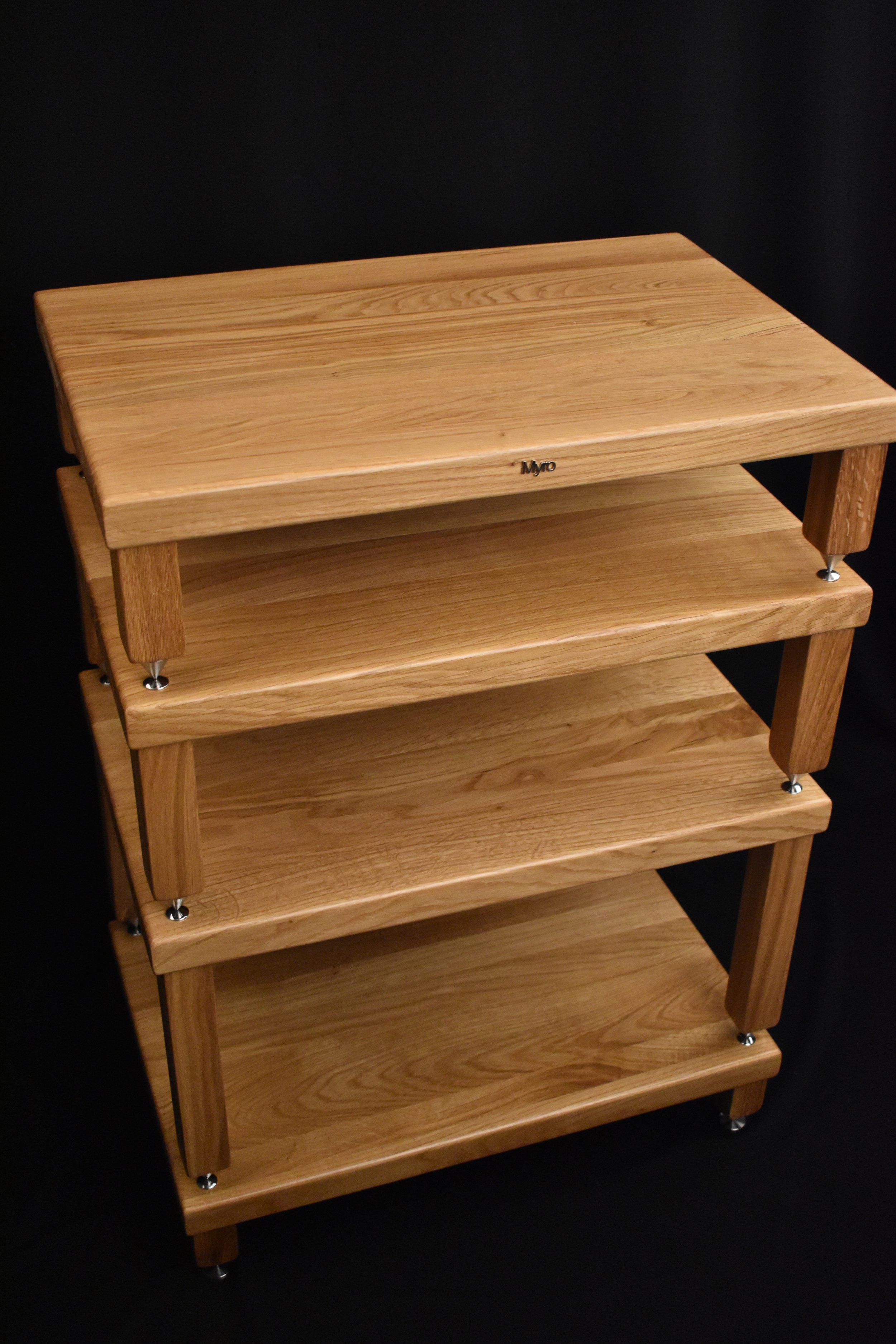
Stability is non-negotiable. A wobbly rack acts like a pendulum, swaying with the low-frequency pulses of your speakers. If your equipment stand relies on screws that loosen over time, it becomes a feedback magnet. We design our furniture with non-resonant joints to ensure permanent rigidity. Our Reference HiFi Rack utilizes significant mass to ground energy, providing the ultimate defense for those seeking how to stop turntable feedback from speakers once and for all.
Advanced Isolation: Decoupling Your Analog Source
Mastering the physics of your listening room requires more than just distance. You've already addressed placement and mass; now, we must look at the specific contact points where your equipment meets its foundation. In the pursuit of sensory perfection, there is a vital distinction between coupling and decoupling. Coupling uses rigid points, like spikes, to anchor a component to a larger mass, effectively "draining" energy away. Decoupling uses compliant materials to float the component, breaking the physical path for vibrations. Both are essential tools when learning how to stop turntable feedback from speakers.
Leveling is the silent hero of isolation. A turntable that isn't perfectly level forces the stylus to work harder on one side of the groove wall. This imbalance increases surface noise and makes the system more susceptible to external interference. Precision is everything. Use a high-quality bubble level on the platter itself, not just the plinth, to ensure your tracking is as pure as the original recording. When every component is balanced, the system achieves a state of harmonic equilibrium that resists the chaotic energy of feedback.
Isolation Platforms and Shelves
High-gain systems often require an extra layer of defense. A dedicated Turntable Isolation Platform acts as a secondary barrier. This "Sub-Plinth" strategy adds a second stage of damping between the rack and the record player. For those dealing with bouncy wooden floors, a wall-mounted shelf is often the ultimate solution. It bypasses floor-borne vibrations entirely by anchoring your gear to the structural studs of your home, ensuring that your listening session remains undisturbed by footfalls or low-frequency pulses.
Spikes, Feet, and Protectors
Precision-machined brass spikes are not just for aesthetics. They focus the entire weight of your equipment onto a single point. This high-pressure contact area makes it incredibly difficult for low-frequency energy to travel back up into the system. It's a one-way street for vibration. When using spikes on delicate surfaces, floor protectors are a necessity. They maintain the mechanical benefit of the spike while preserving the beauty of your personal sanctuary. You can explore more about this in our guide to Speaker Feet and Acoustic Isolation.
If you're ready to build a permanent foundation for your analog passion, explore our Reference HiFi Rack collection to see how precision engineering meets organic beauty.
The Permanent Solution: A Handcrafted Foundation
The journey to perfect sound often leads us to realize that the most critical component isn't actually inside the signal chain. It's the structure supporting it. Many listeners spend years upgrading cartridges and cables while overlooking the furniture beneath them. Cheap, mass-produced pieces are the most common hidden bottleneck in high-end audio. If you've already optimized your speaker placement and experimented with isolation feet but still struggle with how to stop turntable feedback from speakers, the answer lies in your foundation. A handcrafted HiFi Rack isn't just a shelf. It's a vital instrument designed to ground unwanted energy before it ever reaches your stylus.
Our philosophy centers on the union of performance and aesthetics. We believe that a piece of furniture should be as enduring as the music you love. Solid wood acts as a mechanical sink. It draws vibrations away from sensitive electronics and dissipates them through its dense, organic grain. This isn't a temporary fix or a "band-aid" accessory. It's a permanent structural solution that allows your system to breathe and perform at its theoretical limit. When you invest in a foundation built for longevity, you're creating a setup that grows with your passion, rather than one that limits it.
The Reference Series: Uncompromising Isolation
The Myro Reference Rack represents the pinnacle of our craft. In our Novi Sad workshop, we strictly avoid MDF and veneers. These materials lack the structural integrity and internal damping required for true high-fidelity sound. Instead, we utilize solid hardwoods that offer natural resonance control. Each rack is built to order. This allows us to customize dimensions for oversized or exceptionally heavy turntables that require significant mass to remain stable. This bespoke approach ensures that your specific equipment is anchored in a vibration-free environment, providing the final answer to how to stop turntable feedback from speakers.
Crafting Your Personal Sanctuary
The ultimate reward for this attention to detail is a silent, high-fidelity background. When you remove the mechanical chatter of feedback, you're left with a pure, intimate connection to the artist. Premium furniture elevates the ritual of listening, turning a casual pastime into a life-altering passion. You deserve a space that reflects your commitment to excellence and your reverence for the craft. If you're ready to transform your listening room into a true sanctuary of sound, I invite you to explore our full shop for bespoke solutions that harmonize form and function.
Securing Your Sonic Sanctuary
Achieving sensory perfection in your listening room is more than a technical hurdle; it's an act of reverence for the music you love. We've explored how strategic placement and the science of mass loading can break the destructive feedback loop that muddies your analog signal. By moving beyond temporary fixes and addressing the structural integrity of your setup, you reclaim the clarity and emotional depth of your vinyl collection. Mastering how to stop turntable feedback from speakers ultimately requires a foundation that respects the delicate nature of the stylus while grounding the chaotic energy of your speakers.
Our workshop in Novi Sad is dedicated to this pursuit of harmony. We strictly avoid MDF and veneers, choosing instead the natural damping properties of solid hardwood to create instruments of isolation. These racks are trusted by reference-level audiophiles globally who refuse to compromise on the integrity of their personal sanctuary. It's time to let your equipment perform at its absolute peak, free from the interference of the physical world.
Discover Handcrafted Solid Wood Racks for Ultimate Isolation
Your records hold a world of detail waiting to be heard. With the right foundation, you'll finally hear them as they were meant to be experienced. Happy listening.
Common Questions on Vinyl Isolation
Why does my turntable hum only when the music gets loud?
This hum occurs because you've reached your system's feedback threshold. As volume increases, your speakers produce more kinetic energy that vibrates the air and the floor. If your isolation is insufficient, this energy feeds back into the stylus and creates a loop. It's a physical manifestation of a structural failure in your equipment's foundation rather than an electronic fault.
Can I stop feedback by just moving my speakers?
Moving your speakers is an effective first step, provided you follow the rule of never sharing a surface. Increasing the distance helps dissipate airborne energy before it strikes your tonearm. However, structure-borne vibrations can still travel through the floor and up your furniture. Strategic placement is a vital part of the solution, but it doesn't replace the need for a high-mass foundation.
Are isolation pads better than a heavy HiFi Rack?
Isolation pads are often temporary fixes that don't address the root cause of resonance. While they provide minor decoupling, they cannot match the damping power of a heavy, solid wood HiFi Rack. A high-mass structure grounds unwanted energy permanently. This is the most reliable way to learn how to stop turntable feedback from speakers while preserving the sonic purity of your records.
Does the type of floor (carpet vs. wood) affect turntable feedback?
Floors act as a primary conduit for mechanical energy. Hardwood floors are particularly prone to transmitting vibrations from speakers directly to your rack's feet. Carpeting provides some airborne damping but can lead to stability issues if your rack isn't properly spiked. Regardless of your floor type, decoupling your gear with dedicated speaker stands or a heavy rack remains essential for clarity.
Will a wall shelf definitely stop my record from skipping?
A wall shelf is the ultimate solution for structural vibrations like footfalls on bouncy floors. By anchoring your turntable to the wall studs, you bypass the floor's movement entirely. It won't stop airborne feedback if your speakers are positioned too close, but it effectively eliminates mechanical skipping caused by people walking or dancing in your personal sanctuary.
Should I keep my turntable dust cover on or off during playback?
You should always remove the dust cover during playback for the best results. The plastic lid acts as a large diaphragm that catches sound waves from your speakers. These vibrations travel through the hinges and into the plinth, muddying the signal. Removing it is a simple, free upgrade that instantly improves the mid-range clarity of your analog experience.
Is solid wood better than metal for stopping vibrations?
Solid wood is superior because its organic cellular structure naturally dissipates vibrations as trace amounts of heat. Metal and glass tend to be more resonant; they often ring at specific frequencies or reflect energy back into your components. Choosing a solid hardwood foundation ensures a silent background, which is a key part of understanding how to stop turntable feedback from speakers.