

The Art of Listening Room Furniture Arrangement: A Guide to Acoustic Harmony
Your favorite armchair isn't just a piece of furniture; it's a structural element that either clarifies or corrupts every note your system produces. We often treat our living spaces as static backdrops, yet the specific geometry of your listening room furniture arrangement dictates the very soul of your sound. If you've ever felt your soundstage blur or struggled with a muddy bass bloom, you know that even the finest components can't overcome a room working against them.
I believe that true high-fidelity is found at the intersection of form, function, resonance, and soul. In this guide, I'll show you how to transform a cluttered space into a focused, immersive sanctuary. You'll learn to position your Myro HiFi Rack and speaker stands to eliminate mechanical vibration and finally hear the full potential of your high-fidelity system. We're going to explore the spatial anchors and artisanal principles that turn a simple room into a masterpiece of acoustic harmony.
Key Takeaways
Learn how room geometry dictates sonic purity and why your listening room furniture arrangement is the key to managing standing waves.
Establish an immersive soundstage by mastering the equilateral triangle method and maintaining precise distances between speakers and equipment.
Identify the hidden acoustic costs of hollow materials and why solid hardwood serves as a superior damping agent for high-fidelity sound.
Tailor your spatial layout to your specific room shape to neutralize corner bass traps and expand the depth of your soundstage.
Treat your Myro HiFi rack as the room's acoustic anchor to effectively eliminate mechanical vibration and lower the system noise floor.
Table of Contents
The Fundamentals of Listening Room Geometry
A listening room is a vessel for sensory perfection. It's a controlled environment where we strip away the noise of the outside world to find the raw, organic beauty of a recording. To achieve this, we must understand The Fundamentals of Listening Room Geometry. Every dimension of your space, from the ceiling height to the width between the side walls, influences how energy moves. Without a thoughtful listening room furniture arrangement, you'll likely encounter standing waves that blur your bass or reflections that smear your high-end detail.
Your floor plan isn't just a map of where things go; it's a blueprint for energy flow. Identifying "hot spots" where pressure builds and "dead zones" where detail vanishes allows you to place your furniture with intent. When we treat the room as an extension of the system, the walls disappear, leaving only the music. It's a delicate dance between physics and aesthetics that requires patience and a keen ear.
To better understand how these physical principles apply to your specific space, watch this helpful guide on room treatment and setup:
Change video
Symmetry and the Stereo Image
I've found that symmetry is the non-negotiable foundation of a balanced stereo image. I start by calculating the center line of the room. This is the spine of your sanctuary. If you place a heavy, reflective piece of furniture on one side of the room but leave the other side open, the soundstage will inevitably pull toward the denser side. You want your ears to receive identical timing and tonal information from both channels. I prefer using balanced elements, like a Reference Myro HiFi Rack centered between the speakers, to anchor the visual and sonic image. Balancing hard surfaces with diffusive furniture ensures the "phantom center" remains rock-solid.
Understanding Room Modes
Room modes are the physical reality of sound trapped in a box. When low-frequency waves reflect off parallel walls, they can either cancel each other out or stack up into a boomy mess. This is why a strategic listening room furniture arrangement is so vital. I always advise against placing your primary listening chair directly against a back wall. This area is often a high-pressure zone where bass becomes bloated and loses its texture. By pulling your seat forward and using furniture to break up large, parallel surfaces, you can effectively diffuse these reflections. Solid wood shelving or a Classic Myro HiFi Rack acts as a natural damping agent, helping to lower the room's noise floor and clarify the signal.
Speaker Placement vs. Furniture Positioning
Finding the perfect balance in your listening room furniture arrangement requires more than just a tape measure; it requires an ear for the subtle shifts in the soundstage. While we've established the importance of room geometry, the tactical Speaker Placement vs. Furniture Positioning is where the music truly begins to breathe. I often see enthusiasts invest heavily in components only to have their soundstage collapse because the equipment rack is placed too close to the speakers or directly in the path of the primary drivers.
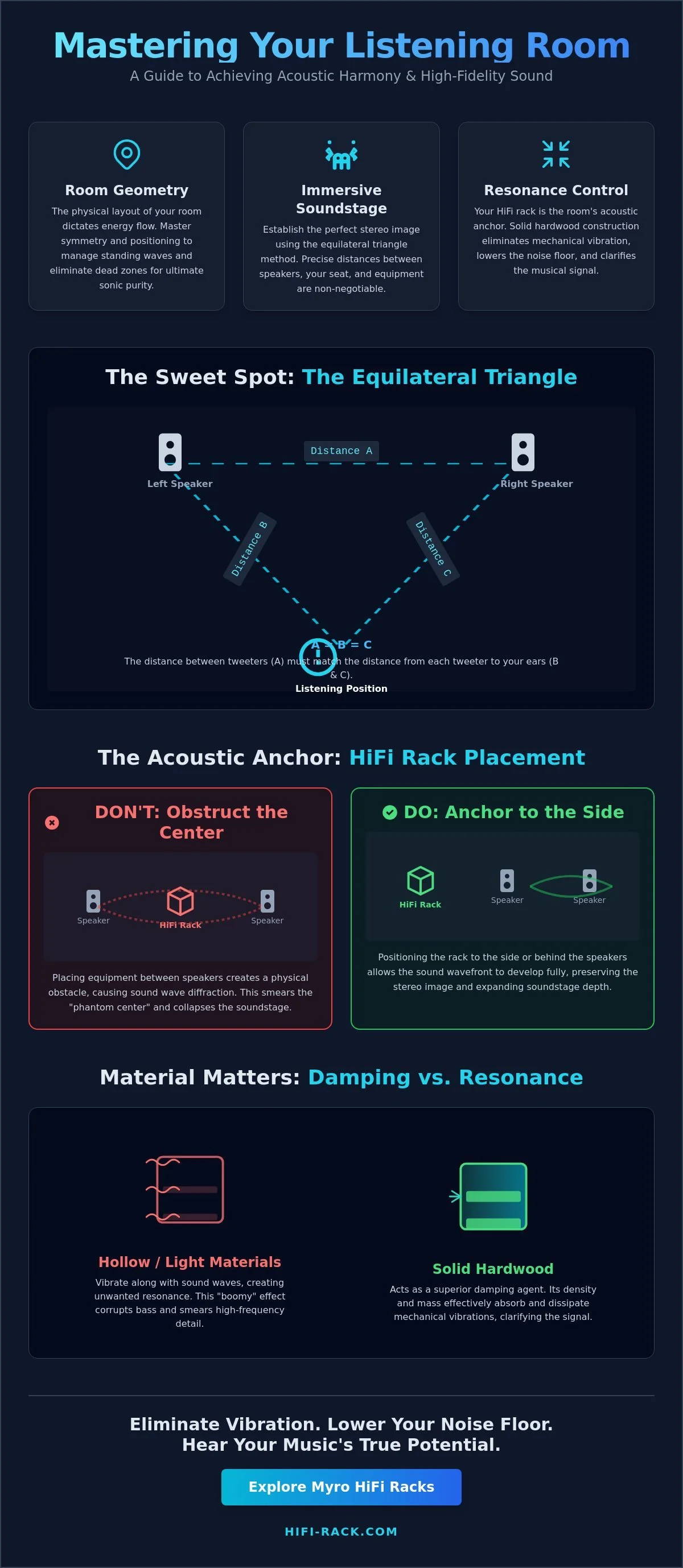
When you place electronics between your speakers, you risk creating a physical obstacle that smears the phantom center. Ideally, your rack should sit slightly behind the plane of the speakers or off to the side to allow the wavefront to develop without diffraction. Managing first reflection points is equally vital. A side table or a heavy armchair placed carelessly can bounce sound waves back to your ears at slightly different times, muddying the detail you've worked so hard to preserve.
The Equilateral Triangle Foundation
The distance between your tweeters should match the distance from each tweeter to your ears. This equilateral triangle is the non-negotiable starting point. As you refine your listening room furniture arrangement, pay close attention to how the depth of your seating affects your toe-in angle. I find that a slight inward tilt, where the speakers aim just behind the listener’s head, often yields the most expansive soundstage. Ensure there's a clear, unobstructed line of sight between the driver and your ear. Any furniture piece that breaks this line acts as a high-frequency filter.
Decoupling Speakers from the Floor
Elevating your monitors on high-quality speaker stands is the most effective way to lift the soundstage to ear level. I strongly believe that mass and material matter here. While hollow metal or MDF stands often store energy and release it as a resonant ring, solid wood stands act as a natural damping agent. By using stands crafted from dense, raw materials, you effectively decouple the speaker from the floor. This prevents mechanical vibrations from traveling through your flooring and into your sensitive electronics. If you're looking to refine this connection, exploring our collection of handcrafted stands can be a transformative step for your system's clarity.
Managing Resonance Through Strategic Furniture Choice
Resonance is the silent ghost that haunts many high-end systems. While your listening room furniture arrangement might look perfect to the eye, the materials supporting your components often dictate the clarity of what you hear. I've found that many enthusiasts focus entirely on the electronics, forgetting that the shelf beneath a DAC or amplifier is a structural extension of the circuit. If that shelf is made of hollow MDF or thin veneer, it acts as an energy reservoir. It stores mechanical vibrations from the speakers and releases them back into your equipment, creating a subtle sonic haze that obscures fine detail.
I believe in the integrity of raw materials. To achieve a truly black background and a deep soundstage, you need mass and structural rigidity. Positioning your rack is just as critical as its composition. I always advise against tucking your equipment into the corners of a room. Corners are high-pressure zones where low-frequency energy gathers and builds. This pressure can physically vibrate your chassis, leading to microphonic interference. By placing a high-mass anchor, like the Reference Myro HiFi Rack, in a lower-pressure area along the front wall, you allow your system to breathe without the burden of external interference.
Why Solid Wood Outperforms MDF
The difference between mass-produced furniture and artisanal craftsmanship is found in the cellular level of the timber. Hardwood possesses a complex, organic internal structure that acts as a natural damping agent. Unlike metal or glass, which tend to "ring" at specific frequencies, solid wood dissipates energy. When you integrate a listening room furniture arrangement built on solid timber, you're choosing a material that converts micro-vibrations into trace amounts of heat rather than reflecting them back into your components. To dive deeper into the physics of this, you can explore The Science of Vibration Damping in Solid Hardwood.
The Turntable Exception
Analog playback requires a different level of reverence. A turntable is essentially a vibration-measuring device, making it hypersensitive to its environment. Footfall interference and acoustic feedback are the enemies of a steady groove. In a thoughtful arrangement, the record player shouldn't just sit on a shelf; it needs a dedicated sanctuary. I recommend using a specialized platform to isolate the stylus from the rest of the room's energy. It's the heart of any serious analog setup. For a complete breakdown on protecting your vinyl playback, read The Ultimate Guide to Turntable Isolation Platforms.
Practical Layouts for Different Room Shapes
Every room possesses a unique sonic thumbprint. While a long, rectangular space naturally lends itself to an expansive soundstage, a square room presents a stubborn challenge for any listening room furniture arrangement. In a square environment, sound waves reflect off parallel surfaces with identical timing, leading to aggressive bass peaks. I recommend breaking this symmetry by staggering your furniture and avoiding a perfectly centered seating position. By placing a high-mass rack off-center or using heavy, upholstered pieces to soften corners, you can neutralize these standing waves before they overwhelm your music.
For those working within a long room, the short wall is your greatest asset. Positioning your system here allows the sound to "throw" down the length of the space, creating a sense of depth that mimics a live performance hall. If you're navigating a multi-purpose living area, the goal is integration without compromise. You can maintain a clean, minimal aesthetic by selecting a rack with a slim profile that provides the necessary mass without dominating the visual landscape. Small rooms benefit from this same philosophy. A compact footprint allows you to keep your speakers away from the side walls, preserving the air and space essential for a convincing stereo image.
The Dedicated Listening Sanctuary
In a room solely committed to sound, the listening room furniture arrangement should revolve around a central anchor. I often start with a Reference Myro HiFi Rack centered between the speakers. This provides a rock-solid foundation for your most sensitive components. To enhance the feeling of space, I prefer "floating" the furniture away from the walls. This reduces the impact of boundary gain and allows the room to breathe. When managing cables, ensure they are routed clearly and don't touch one another. This preserves component isolation and keeps the sanctuary feeling intentional and uncluttered.
The Integrated Living Space
You don't need a dedicated studio to achieve high-fidelity results. In a shared living space, your existing furniture can serve as a secret weapon for acoustic treatment. Large bookshelves and record storage units act as natural diffusers, breaking up reflections and adding texture to the sound. I find that a Minimal Myro HiFi Rack blends seamlessly into these environments, protecting your gear's sonic integrity while respecting the room's design. It is about finding a balance where the equipment serves the lifestyle, not the other way around. If you are ready to anchor your living space with a piece that honors both form and function, explore our collection of artisanal HiFi racks to find your perfect match.
The HiFi Rack as the Room's Acoustic Anchor
I always suggest that the rack should be the first piece of furniture you place in your sanctuary. It's the structural heart of your system, acting as the definitive anchor for every other element in your listening room furniture arrangement. While speakers define the width and depth of the soundstage, the rack defines the stability of the signal itself. By establishing the rack's position early, you create a fixed point around which the rest of the room's geometry can be balanced. This isn't merely a matter of convenience; it's about treating the support system with the same reverence as the components it holds.
The relationship between a rack's mass and the room's noise floor is direct and profound. A high-mass, rigid structure effectively drains mechanical energy away from sensitive internal circuits. When your equipment is properly decoupled from room-borne vibrations, the background becomes "blacker," allowing micro-details and subtle textures to emerge from the silence. I've found that modular designs are particularly valuable for the long-term enthusiast. They allow your system to grow and evolve without forcing you to dismantle your entire layout, ensuring that your pursuit of sensory perfection remains a fluid, lifelong journey.
The Reference Standard
Choosing between a Reference Myro and a Classic Myro setup is a choice about the scale of your acoustic ambition. While both share the same DNA of artisanal pride, the Reference series offers enhanced mass for the most demanding high-fidelity systems. Our commitment to no-MDF construction isn't just a design choice; it's a promise of longevity and sonic integrity. We use only solid, raw timber because we believe that a master craftsman's work should last a lifetime. This focal point becomes more than just storage. It's a statement of technical excellence that reflects your personal relationship with the art of listening.
Final Fine-Tuning
Once the primary listening room furniture arrangement is set, the final adjustments bring the sound into sharp focus. I use the "Mirror Trick" to identify early reflection points. Sit in your primary chair and have a partner move a mirror along the side of your furniture; wherever you see the speaker's tweeter in the reflection, that's a point where sound is bouncing and blurring your image. Leveling and spiking your rack is the final, essential step. A perfectly level shelf ensures that turntable bearings and optical drives operate with minimal friction. This level of detail is at the core of HiFi Rack's responsibility to the craft. It's the difference between a room that simply holds equipment and a sanctuary that breathes with the music.
Cultivating Your Sonic Sanctuary
Achieving acoustic harmony is a deliberate journey of refinement. By mastering the geometry of your space and understanding how physical mass manages resonance, you move beyond mere listening into a state of total immersion. Your system deserves a foundation that respects the art of sound as much as the components themselves. A thoughtful listening room furniture arrangement is the final bridge between high-end engineering and a truly soulful connection to your music.
Every piece we create is handcrafted in Novi Sad, following a multi-generational woodworking tradition that refuses to compromise on quality. We maintain a strict zero MDF or veneer policy. We believe that only solid, raw timber can provide the natural damping properties required for high-fidelity purity. This isn't just furniture; it's a vital instrument in your pursuit of sensory perfection. It's time to unlock the full potential of your soundstage with a support system built for a lifetime of performance.
Discover the Reference Myro: Handcrafted HiFi Furniture for the Ultimate Listening Room
Trust your ears and let the music guide your hand as you finalize your sanctuary. The path to perfect sound is now beneath your feet.
Frequently Asked Questions
Should I place my HiFi rack between my speakers or to the side?
Placing your rack to the side or slightly behind the plane of your speakers is the superior choice for imaging. This prevents a large, reflective surface from sitting between your drivers and smearing the phantom center. If you must place it between them, ensure the rack has a low profile to minimize diffraction. It's about keeping the path between your ears and the soundstage as clear as possible.
How far away from the wall should my equipment rack be?
I recommend keeping your equipment rack at least 6 to 12 inches away from the rear wall. This space allows for essential ventilation and prevents heat buildup around your sensitive electronics. Moving the rack away from the wall also keeps your components out of high-pressure zones where low-frequency energy tends to accumulate. Proper spacing ensures that your listening room furniture arrangement doesn't contribute to a muddy or boomy bottom end.
Does the material of my listening room furniture actually affect the sound?
Material choice is one of the most critical factors in managing resonance. Solid hardwood possesses a natural cellular structure that absorbs and dissipates mechanical energy, whereas hollow MDF or metal often stores vibration and releases it as a resonant ring. By selecting solid wood, you effectively lower the noise floor of your entire system. This allows the organic texture of the recording to shine through without artificial coloration from your furniture.
What is the best way to arrange furniture in a small listening room?
In tight quarters, prioritize a listening room furniture arrangement that keeps your speakers away from side walls to maintain soundstage width. Use a slim-profile rack, like the Minimal Myro, to save floor space while still providing high-mass support. Pulling your primary listening chair away from the back wall is also essential in small rooms to avoid the bass bloat caused by boundary gain.
Can I use a regular bookshelf as a HiFi rack?
While a bookshelf can physically hold your gear, it rarely provides the isolation required for high-fidelity sound. Most consumer bookshelves are made of resonant MDF or thin veneers that vibrate along with your speakers. A dedicated HiFi rack is engineered with the mass and rigidity needed to drain energy away from your components. Transitioning to a purpose-built solid wood support often provides a more significant sonic upgrade than a new cable or accessory.
How do I stop my turntable from skipping when I walk across the room?
To eliminate skipping, you must decouple your turntable from floor-borne vibrations. I suggest using a high-mass isolation platform or a dedicated rack with spiked feet to drain mechanical energy. If your floors are particularly springy, a wall-mounted shelf anchored to a structural stud is the most effective solution. These methods ensure that your stylus remains steady in the groove, regardless of footfall interference.
Is it better to have a tall vertical rack or a wide horizontal one?
A wide, horizontal rack is usually the better choice for acoustic performance. It keeps your sensitive electronics lower to the ground and well below the height of your speaker drivers. This prevents the rack from acting as a massive reflective surface that could interfere with your stereo imaging. Vertical racks can be useful for saving space, but they often put your turntable or top-tier components right in the path of high-frequency energy.
How do I balance room aesthetics with audiophile performance?
You don't have to choose between a stunning living space and a reference-grade system. By selecting artisanal furniture crafted from raw, natural materials, you integrate your hobby into your lifestyle. Solid wood racks serve as spatial anchors that look as beautiful as they sound. We view the union of performance and aesthetics as a definitive promise, allowing you to create a sanctuary that honors both the craft and the music.