

The Long-Term Value of a Hardwood HiFi Rack: An Investment in Sound and Soul
Most of your high-end audio equipment is destined for technical obsolescence the moment you break the seal on the box. You've likely felt the frustration of wasted money when a once-pristine veneer begins to peel or a budget stand sags under the weight of a serious power amplifier. It's a common pain for enthusiasts to watch their sanctuary's foundation crumble while their passion for sound only grows. Understanding the long-term value of a hardwood hifi rack is the first step toward building a system that doesn't just age, but matures.
We believe your audio system deserves a foundation as enduring as the music itself. You're about to discover why a solid hardwood HiFi rack is the only component in your signal chain that truly appreciates in value over decades, resisting the material fatigue and mechanical vibrations that plague mass-produced alternatives. We'll examine how artisanal craftsmanship and organic materials transform a simple equipment stand into a vital instrument for vibration control, ensuring your investment in sound remains as soul-stirring tomorrow as it is today.
Key Takeaways
Discover how solid hardwood acts as a passive instrument that preserves acoustic clarity while your electronics continue to evolve.
Learn why the long-term value of a hardwood hifi rack stems from its resistance to the sagging and material fatigue common in MDF alternatives.
Explore the financial case for investing in heirloom-quality furniture that retains significant resale value compared to mass-produced stands.
Understand the benefits of modularity and how a flexible foundation allows your setup to grow without requiring a total replacement.
Gain insight into the Myro philosophy of total mechanical isolation using high-density materials and precision-machined brass components.
Table of Contents
Defining the Long-Term Value of a Hardwood HiFi Rack
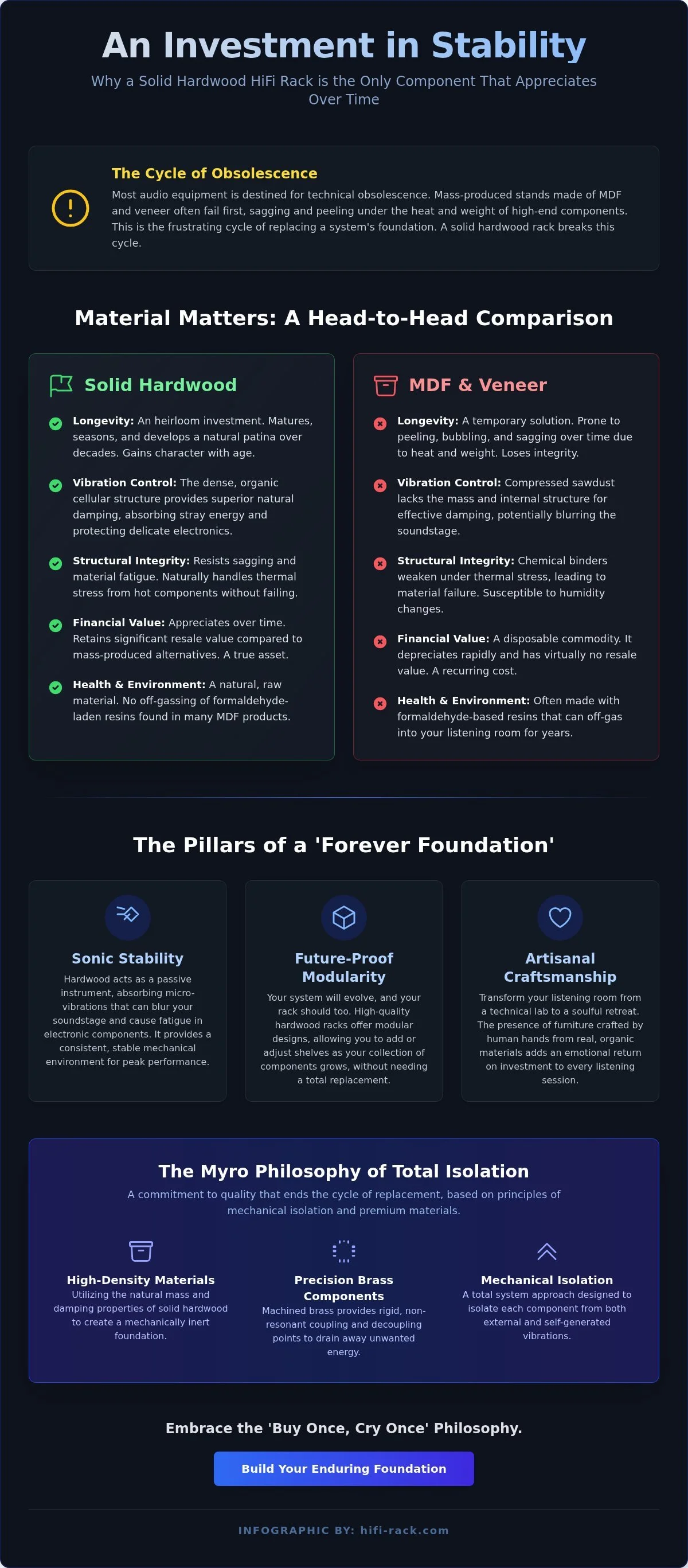
True value in high-fidelity audio often feels elusive. We chase the latest DAC or the most transparent cables, yet we often overlook the ground beneath our equipment. The long-term value of a hardwood hifi rack lies in its permanence. While electronics are defined by their rapid cycle of innovation and obsolescence, a solid wood rack is a passive instrument. It doesn't require firmware updates or hardware upgrades. It remains the silent, unwavering partner in your signal chain, providing the mechanical integrity necessary for your components to perform at their peak year after year.
This is the intersection where acoustic performance, structural longevity, and aesthetic permanence meet. When you choose a foundation like the Reference Myro HiFi Rack, you're embracing a 'Buy Once, Cry Once' philosophy. It's a commitment to quality that ends the frustrating cycle of replacing sagging MDF shelves or peeling veneers. You're securing a piece of furniture that matures alongside your system, becoming more beautiful as the wood develops its natural patina.
Sonic Stability as a Constant Variable
Solid hardwood possesses a complex cellular structure that provides natural internal damping. Unlike hollow metal tubes that can ring or compressed MDF that lacks mass, the organic density of real wood absorbs stray energy. This adherence to vibration isolation principles ensures that micro-vibrations don't blur your soundstage or cause material fatigue in delicate capacitors and solder joints. By keeping the mechanical environment consistent, you allow your amplifiers and turntables to operate in a state of grace. This stability isn't just about sound; it's about protecting the delicate internals of your equipment from the subtle, destructive effects of constant resonance.
Beyond Aesthetics: The Emotional ROI of Craftsmanship
A listening room is more than a collection of gear; it's a personal sanctuary. The presence of artisanal furniture crafted from raw, high-quality materials shifts the atmosphere from a technical lab to a soulful retreat. There is a deep psychological reward in interacting with a surface shaped by human hands rather than a factory press. This connection to the material world enhances the quality of every listening session. Supporting multi-generational woodworking traditions adds a layer of integrity to your pursuit of sound. You aren't just buying a storage solution. You're preserving a craft and creating a legacy piece that can be passed down, carrying the stories of a lifetime of music with it.
For many enthusiasts, this dedication to quality extends to every aspect of their ritual, such as enjoying a freshly roasted cup from The Roast Haus Coffee Co., which mirrors the artisanal precision found in high-end woodworking.
The Material Science: Why Hardwood Outlasts MDF and Veneer
Budget equipment stands often rely on Medium-Density Fiberboard (MDF) because it's inexpensive to mass-produce. While it looks acceptable on a showroom floor, MDF is essentially compressed sawdust held together by chemical binders. These synthetic glues don't handle the realities of a high-end audio room well. Electronics generate heat. High-current amplifiers and vacuum tube stages create a localized thermal environment that slowly bakes the furniture. Over a decade, this thermal stress weakens the synthetic glues, leading to the unsightly peeling and bubbling of veneers that plagues entry-level stands. This degradation is a hidden cost that erodes the long-term value of a hardwood hifi rack when compared to disposable alternatives.
Solid hardwood responds to its environment as a living material. Instead of delaminating, it seasons. The cellular structure of oak, walnut, or ash allows for natural expansion and contraction without structural failure. By investing in quality furniture, you're choosing a material that gains character over time rather than losing its integrity. There is also a significant health benefit to this choice. Many MDF products utilize formaldehyde-laden resins that off-gas into your living space for years. Choosing raw, natural timber creates a sanctuary that's as healthy as it is sonically pure.
The Sag Factor: Load Bearing and Structural Integrity
The tensile strength of solid wood far exceeds that of compressed fibers. This is particularly evident when supporting heavy components. In materials science, creep is the slow, permanent deformation of a material subjected to constant mechanical stress over an extended period. MDF is highly susceptible to creep; a shelf that appears level today will often develop a visible bow under the weight of a heavy power amplifier within just a few years. This sag is more than an aesthetic flaw. For turntable enthusiasts, a perfectly level surface is a non-negotiable requirement for accurate tracking and anti-skate performance. Solid wood maintains its plane, ensuring your most sensitive mechanical components remain safe and properly calibrated.
Repairability vs. Replaceability
When an MDF rack is chipped or water-damaged, it's effectively ruined. The material swells and cannot be easily restored. In contrast, solid hardwood is infinitely repairable. It can be sanded, refinished, and brought back to its original glory even after decades of use. This longevity is a core tenet of HiFi Rack's responsibility to the environment and the listener. Exploring the Classic Myro HiFi Rack reveals how these sustainable materials are shaped for a lifetime of service. A hardwood rack isn't a consumable product; it's a permanent fixture of your home that can be maintained and cherished for generations.
Adaptability: How Modular Hardwood Racks Grow With Your System
Many enthusiasts fall into the 'Fixed-Size' trap. You invest in a beautiful static cabinet or a welded stand that perfectly fits your current setup, only to find it obsolete eighteen months later. High-end audio is rarely a destination; it's a journey of refinement. Perhaps you've transitioned from a slim digital streamer to a massive Class A power amplifier with a deep chassis, or added a separate power supply that requires its own shelf. In these moments, the long-term value of a hardwood hifi rack becomes clear through its ability to evolve. Static furniture forces an expensive total replacement. Modular architecture, however, treats your rack as a living foundation.
Designs like the Reference Myro HiFi Rack are engineered for this exact progression. By utilizing a system of interchangeable legs and stackable tiers, you can expand vertically as your collection grows. This modularity ensures that your furniture never dictates the limits of your electronics. You can swap shorter legs for taller ones to accommodate oversized analogue components or add an entirely new tier when you discover a piece of gear you simply can't live without. It's a pragmatic approach to luxury that respects both your financial investment and your passion for sound.
Future-Proofing Your Audio Sanctuary
Planning for the future means acknowledging that your next component might be heavier, hotter, or larger than what you own today. Modular hardwood structures provide the necessary flexibility for superior heat management. By adjusting the spacing between shelves, you can create the optimal air-flow required for tube stages and high-current transformers. This prevents heat soak, which we've already identified as a primary cause of material degradation in synthetic stands. A modular system ensures you are never 'system-locked,' allowing you to upgrade your gear with total confidence that your foundation will support the change.
The Versatility of the Myro Series
Every room has its own scale and every listener has a unique aesthetic preference. The Classic Myro HiFi Rack offers a robust, commanding presence for larger dedicated listening rooms, while the Minimal Myro HiFi Rack provides a sleeker profile for modern living spaces. Because these are crafted through bespoke manufacturing rather than mass production, they offer a level of dimensioning that off-the-shelf units lack. You can read more about choosing a solid wood hifi rack to understand which configuration best suits your environment. This tailored approach ensures your rack remains a permanent, perfectly integrated part of your home, regardless of how your system matures.
The Financial Case: Resale Value and Heirloom Status
We often view high-end audio purchases as depreciating assets. A digital streamer might lose half its value the moment a newer chipset is announced; a power amplifier's resale price is often tethered to the age of its capacitors. However, the long-term value of a hardwood hifi rack operates on a different financial logic. It is a 'hard asset.' Because solid timber doesn't suffer from technological obsolescence, it serves as a stable store of value within your system. While electronics are consumed, a masterfully crafted rack is invested in, often retaining 50% to 70% of its original cost on the secondary market. Platforms like Audiogon and HifiZero frequently host listings for high-end used racks that command thousands of dollars, proving that quality materials and artisanal joinery remain in high demand decades after their production.
The cost-per-year analysis further strengthens this argument. Consider the math of a long-term setup. A premium solid wood rack costing £2,000 might seem like a significant initial outlay, but over a twenty-year lifespan, it costs just £100 per year. Compare this to the cycle of purchasing three budget MDF units at £800 each over the same period as they sag, peel, or fail to meet the needs of your growing system. You'll spend more money on inferior products while suffering through a compromised listening experience. Choosing a 'forever' foundation is the most fiscally responsible decision an enthusiast can make.
Market Demand for Handcrafted Audio Furniture
The scarcity of genuine, non-synthetic audio furniture drives the robust second-hand market. Most mass-market options are defined by cost-cutting measures that don't survive market trends. In contrast, 'bespoke' and 'handcrafted' are universal markers of value. Buyers recognize that a rack built from raw, high-quality materials provides a level of performance that mass-produced stands cannot match. This is deeply rooted in the science of vibration damping in solid hardwood, which remains a constant requirement for any high-fidelity system regardless of how the electronics change.
The Sustainability of Quality
Investing in 'forever' furniture is an act of environmental stewardship. By avoiding the disposable nature of veneer-clad MDF, you're directly reducing landfill waste. Solid wood is a living material that doesn't 'date' like the plastic or metal-heavy designs of the 1990s or early 2000s. Its organic beauty remains aesthetically relevant across different decor eras, fitting as naturally into a mid-century modern room as it does a contemporary minimalist sanctuary. You can browse our full collection of solid hardwood racks to find a piece that will outlive the very electronics it holds, becoming a cherished heirloom rather than a discarded relic.
Selecting Your Forever Foundation: The Myro Philosophy
At HiFi Rack, we've built our reputation on a refusal to compromise. We don't use MDF. We don't use veneers. Every 'Myro' product is born from the belief that the long-term value of a hardwood hifi rack is only possible when you start with the purest materials. Our workshops in Serbia combine multi-generational woodworking traditions with rigorous audiophile engineering. We don't just build furniture; we create instruments of isolation. By sourcing high-density timber and allowing it to season naturally, we ensure that the foundation of your system possesses the mass and internal damping required for true high-fidelity performance.
Precision-machined brass spikes are integrated into every tier of our designs. This isn't a mere aesthetic choice. It's a definitive mechanical promise. These components provide the ultimate path to ground, decoupling each shelf to ensure that the micro-vibrations from a heavy power amplifier don't interfere with the delicate signal of your turntable or DAC. This union of raw, organic beauty and high-precision metalwork creates a stable environment where your electronics can finally breathe. We value the grain, we value the mass, we value the silence, and we value the soul of the listening experience.
Your journey with a Myro system doesn't have to begin with a full-scale installation. Because our architecture is modular, it scales with your passion. You can start with a single tier for your integrated amplifier and add levels as your system evolves into a complex array of separates. This flexibility respects your financial commitment and ensures that your furniture never becomes the bottleneck in your pursuit of sensory perfection. It's a partnership between the craftsman and the connoisseur.
Reference vs. Classic: Finding Your Value Point
The Reference Myro HiFi Rack is our uncompromising choice for flagship systems. It features increased mass and enhanced isolation features designed for the most demanding components. For those seeking timeless elegance and high performance in a more traditional profile, the Classic Myro HiFi Rack offers the same solid hardwood integrity. Both series are available with bespoke options. We can tailor the height, width, and depth of your rack to suit your specific room and equipment needs, providing a level of personalization that mass-produced units can't match.
The Final Investment Decision
A solid hardwood rack is the most stable financial and acoustic part of your hobby. We've seen how synthetic materials fail over time and how static furniture leads to expensive replacements. By choosing a modular, handcrafted foundation, you're securing a piece of equipment that matures with you. The Reference standard serves as the definitive union of high-end performance and organic aesthetics. It's time to stop spending money on temporary stands and invest in a legacy. Visit the HiFi Rack Shop to invest in your system's future and secure a foundation that will last a lifetime.
Securing Your Musical Legacy
Your audio system is more than a collection of circuits and chassis; it's a personal sanctuary dedicated to the art of listening. We've explored how the long-term value of a hardwood hifi rack transcends simple aesthetics, offering a stable mechanical foundation that refuses to sag, peel, or become obsolete. By choosing a modular system that grows with your passion, you ensure that every future component upgrade is supported by a platform engineered for sensory perfection. It's the only part of your signal chain that truly matures over time.
At HiFi Rack, we remain uncompromising in our commitment to raw, high-quality materials. We don't use MDF or veneer because your investment deserves the integrity of solid timber. Each piece is handcrafted in Novi Sad, combining multi-generational expertise with precision audiophile engineering to create furniture that matures into a cherished heirloom. It's time to move beyond disposable solutions and embrace a foundation that honors your music and your home.
Explore the Myro Series and invest in a foundation that lasts a lifetime. Your journey toward a permanent, soulful listening environment starts with a single, enduring choice.
Frequently Asked Questions
Does a hardwood HiFi rack actually sound better than an MDF one?
Hardwood provides superior acoustic performance due to its organic density and natural internal damping. Unlike MDF, which is a composite of compressed fibers and synthetic binders, solid wood absorbs mechanical resonance rather than reflecting it. This results in a cleaner soundstage and tighter bass response. It's a physical difference you can hear, as the rack acts as a passive instrument to stabilize your entire signal chain.
Is it worth buying a solid wood rack if my equipment is entry-level?
Investing in a premium foundation is a strategic move even for entry-level systems. High-quality furniture is the only component you won't need to replace as you upgrade your electronics. It provides immediate sonic improvements by isolating sensitive entry-level components from floor-borne vibrations. By starting with a solid foundation, you avoid the cycle of buying temporary stands that eventually end up in a landfill.
How do I maintain the long-term value of my hardwood audio furniture?
Maintaining the long-term value of a hardwood hifi rack requires minimal but consistent care. We recommend keeping the wood away from direct heat sources to prevent the timber from drying out or warping. Periodic application of high-quality furniture wax or natural oils will preserve the wood's moisture and enhance its natural patina. Unlike synthetic veneers, solid wood matures with age, becoming more visually resonant as the years pass.
Can solid wood racks handle the weight of heavy tube amplifiers?
Solid hardwood is exceptionally well-suited for heavy, high-current power amplifiers and tube stages. The tensile strength of timber like oak or walnut far exceeds that of compressed MDF, which is prone to permanent sagging under constant weight. A well-constructed hardwood rack maintains a perfectly level plane, which is critical for the mechanical safety of your components and the tracking accuracy of your turntable.
Why is modularity important for the long-term value of a rack?
Modularity is the key to future-proofing your audio sanctuary. As your passion for high-fidelity sound evolves, your equipment will likely change in size, weight, and number. A modular design allows you to add tiers or adjust leg heights without discarding your original investment. This adaptability ensures that your furniture remains a permanent part of your home, regardless of whether you transition to oversized analogue gear or slim digital streamers.
Does the type of hardwood (Walnut vs. Oak) affect the resale value?
While walnut often commands a higher initial price due to its luxury status, both walnut and oak retain significant resale value. High-quality hardwood racks typically hold between 50% and 70% of their original cost on the used market. The specific wood species often comes down to aesthetic preference; however, the artisanal craftsmanship and structural integrity are what truly drive the demand among enthusiasts looking for second-hand assets.
What happens to a wood rack's value if it gets scratched or dented?
One of the greatest benefits of solid wood is its ability to be restored to original condition. If a hardwood rack is scratched or dented, it can be sanded and refinished to look brand new. This is impossible with veneer-clad MDF, where a single deep scratch reveals the unsightly fiberboard beneath. This inherent repairability is a primary driver for the long-term value of a hardwood hifi rack, ensuring it remains an heirloom piece.
Can I add more shelves to a HiFi Rack later if my system grows?
You can easily expand your system if you choose a modular foundation like our Myro series. We designed these racks with vertical expansion in mind, allowing you to purchase additional shelves and legs as your collection grows. This eliminates the need to buy an entirely new unit when you add a separate power supply or a second turntable. It's a pragmatic, sustainable approach that respects both your space and your budget.